4 min read


© The Indian Express Pvt Ltd



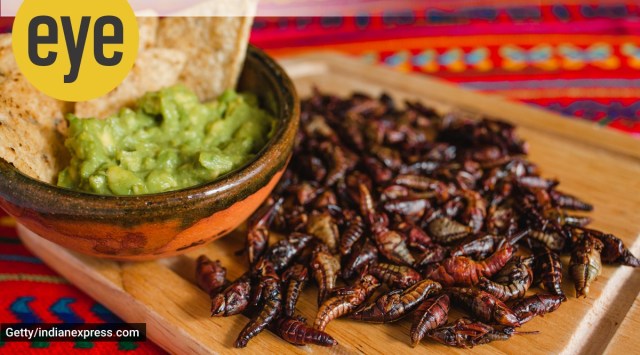 A traditional Mexican snack of chapulines grasshoppers and guacamole. (Source: Getty Images)
In February last year, Hollywood star Robert Downey Jr created something of a stir in the nascent edible-insects industry when he made a case for protein derived from mealworm larvae in an interview with The Late Show host, Stephen Colbert. The product the actor presented to Colbert was from a company that he happens to back, but there’s more to this episode than a simple case of an investor getting people to buy a product he has put money into.
Consider this: the climate emergency is expected to affect current forms of agriculture and, indeed, the entire global food system. At present, food production is responsible for nearly a quarter of greenhouse-gas emissions (among other environmental impacts), the bulk of it coming from the production of animal-based foods. In light of this, millions have been poured into the production of plant-based alternatives to animal food, including vegan meat, eggs, dairy and seafood, with some of the largest companies in the world jumping onto the bandwagon. Not a little of this rush is owing to the positive press that the burgeoning plant-protein industry has received — something that the edible-insect industry has been, unsurprisingly, struggling with. But with high-profile backers, like Downey Jr, that just might be changing.
In fact, there is a slow but definite change in attitudes towards entomophagy (the eating of insects) as an essential element of food security in an increasingly precarious world. In November 2021, the European Union approved migratory locust (Locusta migratoria) as a “novel food”, making it the latest in the still-short list of insects — yellow mealworms and house crickets are others — that could be made available for human consumption in that part of the world.
The problem, until now, has been the belief — pervasive in the West, but also in several other parts of the world — that humans aren’t supposed to eat insects. This is evident in the EU’s formulation of mealworms, locusts and crickets as “novel” foods. Because the fact is that these are not “novel” foods — not in Mexico, where the eggs of a certain water bug are as prized as caviar, nor in Zimbabwe where flying termites are a popular source of protein and not in several other parts of the world.
Even in India, a variety of insects have been consumed — not just for their nutritional value, but also for their taste. In Assam, for example, silkworms are loved not only for the luxurious fabric they yield, but also as a food: they are enjoyed fried, roasted or raw with salt and chilli. Another example is the red-ant chutney, relished in the tribal belt of central India. Apart from the communities that have traditionally made insects a part of their diet, there is a small number of others who seem to have got over the revulsion to the very idea of entomophagy. Writer and researcher Tansha Vohra, for example, has been running the Boochi project, a digital exploration of entomophagy and offers recipes — sourced from the Northeast — such as weaver ant chutney, giant hornet with sichuan pepper, tree tomato and pork fat, carpenter worm with bamboo shoot juice and tree tomato and eri silk worm with chilli, garlic and fermented bamboo shoot.
According to the “Entomophagy: A Resource Guide”, an online research resource created by the US Library of Congress, there are an estimated 2 billion people around the world who regularly consume insects. As the total global population is around 7.9 billion, this means nearly a quarter of the world’s population thinks nothing of snacking on locusts or stir-frying moth larvae for a nutritious meal. This number does not include the growing number of gourmands who are curious — even eager — to try edible insects. All of this implies that if the idea of eating insects disgusts you, you’re likely to find yourself in a minority in the not-too-distant future.