
That argument, while compelling, comes at a steep price. This year, the UN’s Intergovernmental Panel on Climate Change (IPCC) published a report stating that humans have “unequivocally” caused the climate crisis and that “widespread and rapid changes” have already occurred, some irreversibly. UN Secretary General, António Guterres described the report as “a code red for humanity”. Looking back at the events of the past year, his sentiments seem far from hyperbole
Fire and floods
According to Anjali Jaiswal, a Senior Director at the Natural Resources Defense Council (NRDC), who spoke with indianexpress.com, “the climate crisis is hitting us in the face” and the vulnerable continue to suffer the most. Sanjay Vashist, Director of the Climate Action Network for South Asia, added that earlier there were only natural disasters and now there are mostly man-made disasters.
Bare trees stand in a destroyed forest near the Kemerkoy Power Plant, a coal-fueled power plant, in Milas, Mugla in southwest Turkey (AP)
In 2021, Greece and the Western United States faced crippling forest fires which burned almost three million acres of land and displaced thousands of people from their homes. In California, which is particularly vulnerable to climate shocks, the drought levels were more extreme than at any point in the state’s 126-year record.In opposite circumstances, in Tennessee, staggering amounts of rainfall led to flash flooding that killed more than two dozen people. According to one Buzzfeed investigation, between 500 and 1,000 people died during a historic deep freeze in Texas in February. Scientists say that those events would be “virtually impossible” without human caused climate change.
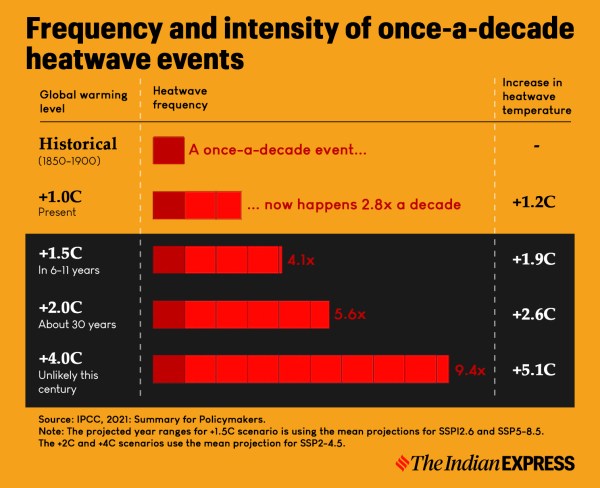
There was also a drought in Kenya, a deficiency of rainfall in Turkey, massive rains in Serbia, catastrophic flooding in China and deadly storms in Germany and Belgium. In Canada, an entire town was erased by a wildfire fuelled by extreme heat. In India, rainfall wreaked havoc in Mumbai, while the polluted Yamuna River in Delhi became covered in foam due to people dumping heavy sewage and industrial waste into the river. According to the IPCC report, events like these which previously occurred around once a decade, are now happening 70 per cent more frequently.
To put it simply, there is no margin for error. Experts warn that we are currently on track to raise the earth’s temperature by 2.4C on average since the pre-industrial era. The last time hotter than now was at least 125,000 years ago. The world has already heated by 1.2C on average and at 1.5C, countries like the Maldives will cease to exist. Beyond 1.5C the Middle East could become uninhabitable, along with large parts of India and China. At 2C, heatwaves will become commonplace and virtually all of Europe and North America will have to contend with frequent wildfires. According to the World Bank, if we continue along our current trajectory, by 2050, 216 million people will be displaced, a third of the world’s food production will be at risk and $23 trillion will be wiped from the global economy.
Story continues below this ad
2021 Recapped
Before looking at the positives, let’s examine the negatives from the past year.
The first is the increase in fossil fuel production and consumption in 2021. According to Vashist, governments were preoccupied with the responsibility of stimulating economic recovery from the pandemic and chose to do so by mining fossil fuels at a greater rate. In addition to its general environmental implications, this can be problematic as according to Vashist because “private companies don’t mine as per the law but instead, as per their convenience”. Fossil fuels are on the rise with the amount of energy generated from coal power plants alone per annum soaring from four per cent in 2020 to nine per cent in 2021. By 2022, worldwide coal demand could reach an all-time high according to the International Energy Agency.
In the past year, European gas prices increased by 611 per cent in light of a global energy crunch. Reports published by the Economist suggest that this increase reveals that the world remains poorly prepared to transition into a purely renewable based economy. The argument is that countries have already accumulated noteworthy renewable projects but when the oil or natural gas dries up, renewables are helpless to prevent economies from falling to their knees. Without rapid reforms, the report warns that there will be more energy crises which would potentially mobilise a popular revolt against climate policies and undo much of the progress that has been made.
Putin has also had an eventful year when it comes to climate change. Already one of the biggest natural gas exporters in the world, Russia, against liberal opposition, managed to continue with its Nord stream 2 pipeline, which would bring Russian natural gas to German households. Right now, Russia is the source of 41 per cent of Europe’s gas exports. Additionally, a report from research firm Bernstien, the global shortage in LNG capacity could rise from 2 per cent of demand now to 14 per cent by 2030. Unless other nations start aggressively exporting their own LNG, Russia will continue to dominate the market, rendering large economies susceptible to the whims and fancies of the Kremlin. Russia is just one example of an authoritarian government threatening the safety of global energy chains, the same can be said of Iran, Egypt and Saudi Arabia. As democracy backslides, autocracies rise. And when autocratic leaders monopolise valuable commodities, it is always a cause for concern.
Story continues below this ad
Biodiversity loss is also a significant problem. Trees absorb 11 billion tonnes of carbon dioxide or 27 per cent of what human industry and agriculture emits. In a close second, oceans absorb another 10 billion. Destruction of natural habitats through human activity and overfishing reduces the number of natural climate sinks and puts us at greater risk for climate disasters
In Brazil, home to the Amazon rainforest (one such climate sink), over 13,00 square kilometres of forest were lost between August 2020 and July 2021. That marks an increase of 22 per cent from the previous year. According to a report in Foreign Affairs Magazine, under President Jair Bolsenaro, Brazil is implementing policies that “risk tipping the region into an ecological death spiral that could cause the release of hundreds of billions of tons of carbon dioxide into the atmosphere, wipe out ten percent of global biodiversity, and destroy a forest system that is essential to regulating the entire region’s rainfall.” Similar destructive policies threaten the climate and it is worth noting that while Brazil signed a pledge to end deforestation by 2030, India refused to do so.
Lastly, 2021 was arguably the year of cryptocurrency. A Cambridge University study published in February claimed that bitcoin mining alone, at the time, possessed a carbon footprint equivalent to Argentina’s. As more countries and institutions adopt crypto friendly policies, the strain on the environment from mining could increase tenfold. This may not sound as ominous as some of the examples described above, but it is a serious problem, and one that is only going to get worse.
On to the positives. According to Vashist, one of the biggest developments of the year was Biden agreeing to re-join the Paris Climate Agreement. That, along with statements from other top policymakers, indicate that “they have recognised the importance of attaching a climate lens to the development agenda.” India has also made considerable strides in 2021 with PM Narendra Modi recently announcing that we would achieve 500GW of non-fossil fuel generated energy, a feat that would severely reduce our dependence on coal.
Story continues below this ad
In September, Iceland opened the world’s largest carbon sucking machine, Orca, which is designed to remove 4000 tons of CO2 from the atmosphere each year. In a landmark ruling in the Netherlands, oil company Shell was ordered to reduce its emissions by 45 per cent by 2030, relative to 2019 levels. In March, the world’s first floating wind farm was opened off the coast of Scotland and in April, JP Morgan set a goal to finance $2.5 trillion in the next decade to combat climate change. Bank of America and Citigroup later made similar pledges. In September, China announced that it would start enforcing the 2016 Kigali Agreement, vowing to immediately stop emitting HFC-23, a greenhouse gas 14,600 times more powerful than CO2. It also announced that it would stop funding oversea coal projects, with the cancellation estimated to avert three months’ worth of global greenhouse gas emissions.
With the negatives and positives covered, we can move on to the biggest mixed bag of the year – the COP26 Summit, an annual meeting of world leaders to discuss issues pertaining to our climate.
COP26
The COP26 summit was held in Scotland this November to great expectation from climate activists. The resulting Glasgow Climate Pact was significant in its recognition that fossil fuels need to be phased out, but ultimately not enough to halt the rapid warming of the earth to unsustainable levels.
The pact called for a faster phasing down of the use of coal and the scrapping of subsidies for fossil fuels. States such as Brazil and Indonesia have signed on to an agreement to end deforestation by 2030, and have recognised that indigenous people are best positioned to care for the forests they live in. The governments also agreed to beef up their respective national plans for reducing emissions over the coming decade, before meeting for the COP27 summit in 2022.
Story continues below this ad
India has also been praised for its climate leadership at the summit. Jaiswal states that “India stepped up with bold pledges to cut climate pollution by a billion tons, in large part by meeting 50 percent of its energy requirements with renewable energy by 2030, signaling a strong commitment to a healthier and cleaner future, for the people of India and the world.” Vashist agrees, noting that India has been much closer to meeting it’s “fair share” of obligations, committing, in relative terms, far more than countries like the US and UK. The NRDC further argues that India is very close to meeting its Paris Agreement targets and by doing so, is sending a strong message to the world that it is committed to decarbonisation.
However, for many, the promises derived from the COP26 were not enough. For one, they are non-binding, and in the past, commitments made during similar summits have infrequently been upheld. Secondly, the gap in tons of CO2 between the emission reductions built into the agreement, and those required to avoid more than 1.5C of global warming, is roughly 17-20 billion tons of CO2e per year. Developing nations were also left disappointed with the lack of climate financing. Although the Glasgow Agreement promises $356 million in climate financing, according to one Council on Foreign Relations (CFR) report, “funding levels remain woefully inadequate.”
Challenges and recommendations
As highlighted above, climate financing is urgently needed in order for developing countries to transition into renewable energy sources. The UN Environment Program estimates that developing nations would require $300 billion per year by 2030 to cope with climate change, far less than what they are projected to receive. Equally concerning is where the funds are deployed. According to the CFR report, the vast majority of funding goes towards mitigation efforts while adaptation measures are left behind. The difference is important. Adaptation allows countries to prepare and work towards eliminating climate disasters, whereas mitigation aims to lessen their impact. Take for example, you worry about a car crash occurring due to a pothole on the road. Adaptation would be getting that pothole fixed while mitigation would be like keeping a medical kit handy, in case the situation arises. Vashist amongst others argue that it is a huge mistake to prioritise mitigation over adaptation. Adaptation must be a priority, he warns, or poorer nations and vulnerable populations will be most at risk of climate disasters.
In countries like India, Vashist also asserts that the needs of communities dependent on fossil fuels should be balanced against the needs of the environment. This goes back to the fair share argument, which stipulates that the needs of people in the global south should not be compromised unjustly relative to those of the West.
Story continues below this ad
While the situation is certainly bleak, there are solutions that can mitigate the climate crisis. Climate financing needs to become a priority, and more money needs to be diverted to adaptation. One Foreign Affairs article notes that adaptation methods can be hyper localised and low-cost. It states that “individual communities and cities can take the lead on their own” by implementing small and simple innovations like painting rooftops white to reduce the heat that they absorb. Additionally, it states that adaptation can consist of “maintaining the natural environment – the forests, coral reefs and coastal wetlands that provide just as much protection against disaster as manmade measures do.” However, man made innovations towards decarbonisation also need to be promoted which, according to another Foreign Affairs article, will include investments in electric power, transportation, heating, and agriculture.
Governments also need to redesign energy markets to absorb shortages and to transition from coal to oil to natural gas to renewables. This would include long term subsidies for renewables, investment in battery storage, and a diversification supply.
According to Vashist, the key to this is not blaming fossil fuel suppliers, but instead, convincing them to transition into green energy. He also notes that so-called green energy solutions need to be carefully evaluated, with nuclear energy in particular coming with a host of its own problems. In terms of renewables, he states that “solar and wind are the most promising” with the former especially important.
Jaiswal argues that as we look ahead, “we need more action and less talk, to implement far reaching climate solutions from India as well as the U.S., China, and all major economies.” She goes on to stress that we need “government, business, and civil society to move into action with the urgency of now, otherwise, the climate crisis will snowball into catastrophic and irreparable devastation for the whole planet”.
Further Reading
Story continues below this ad
Envisioning a Green New Deal, Andrew Chatzky and Anshu Siripurapu, Council on Foreign Relations
A Foreign Policy for the Climate, John Podesta and Todd Stern, Foreign Affairs Magazine
Why Climate Finance Is Critical for Accelerating Global Action, Alice C Hill, Council on Foreign Relations
Building a Resilient Planet, Kathy Baughman McLeod, Foreign Affairs Magazine


 Bare trees stand in a destroyed forest near the Kemerkoy Power Plant, a coal-fueled power plant, in Milas, Mugla in southwest Turkey (AP)
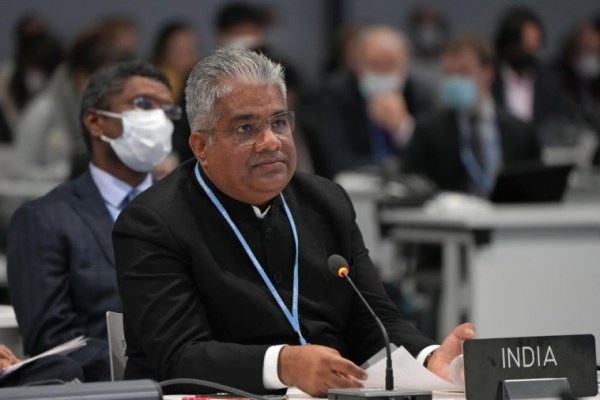 Indian minister for Environment and Climate Change Bhupender Yadav attends a stocktaking plenary session at the COP26 U.N. Climate Summit in Glasgow, Scotland (AP)

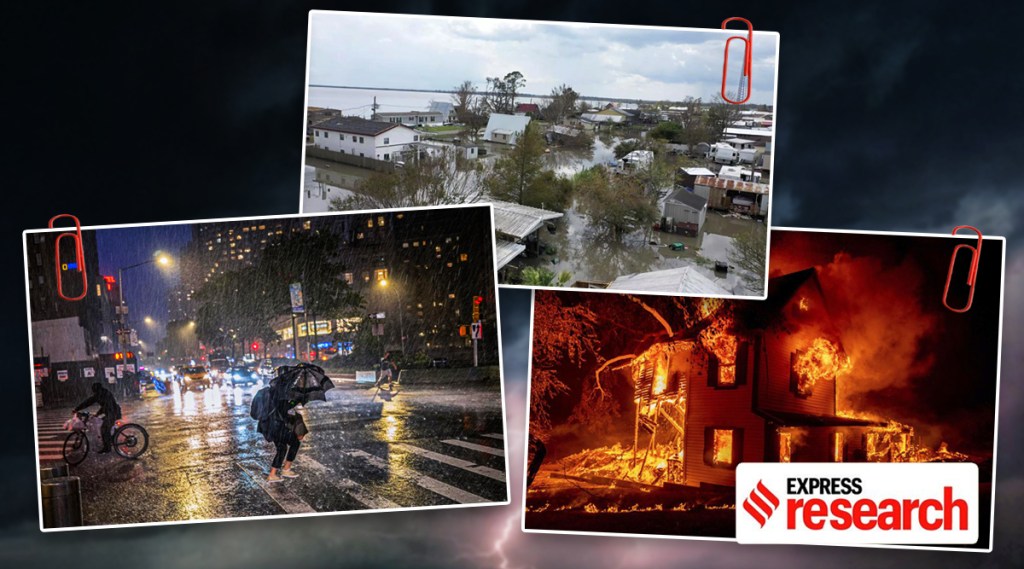 This year was marked by a series of climate disasters. (AP Photos/edited by Abhishek Mitra)