6 min read
© The Indian Express Pvt Ltd



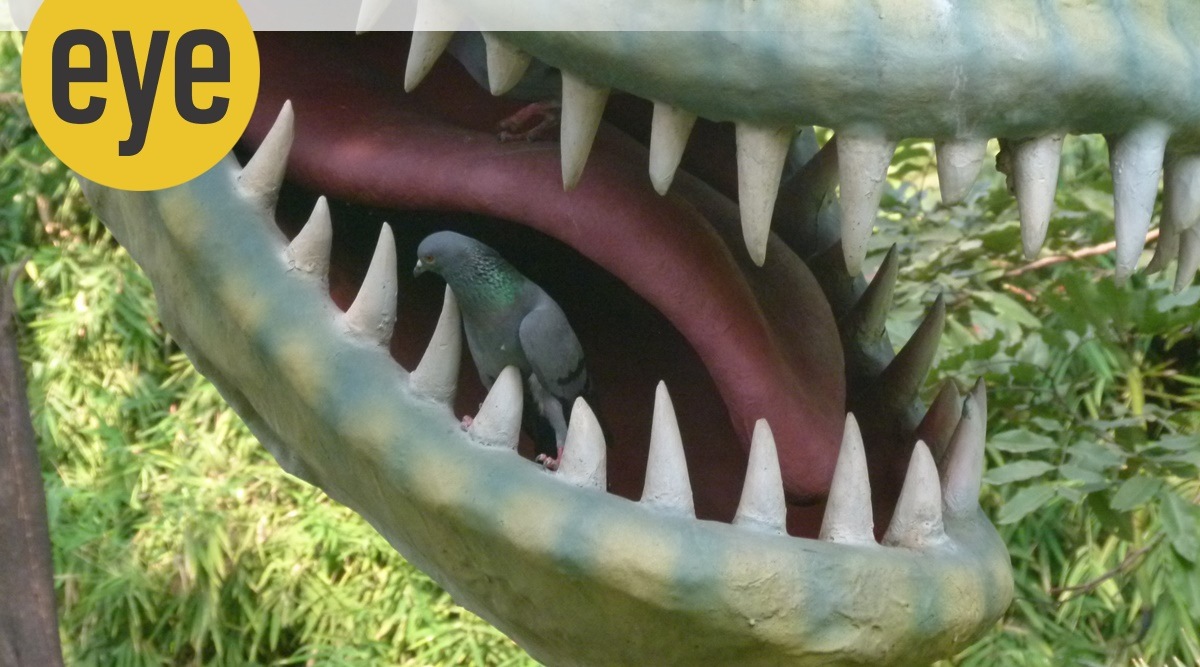 All in the Family: Birds are direct descendants of reptiles -- and dinosaurs (Credit: Ranjit Lal)
At the end of World War II, there was a nasty little joke going around (spread by the Allied Forces) about how the battle-tanks of one axis power had five reverse speeds and one slow forward speed. Which, is exactly the way our education system seems to be going these days: first the learned authorities dumped the Mughal Empire (soon they’ll say that the Eat India Company did not exist nor did Mahatma Gandhi!) and now they’re dumping one of the greatest scientific theories ever: Darwin’s theory of evolution.
Back in 1859, Darwin stuck his neck right out (and nearly got it chopped off!) when he published his theory of evolution by natural selection. He arrived at the conclusion that due to this, we were very closely related to the great apes, and all of us, every living creature on the planet had one common far-away ancestor or grandparent. No human being would like to be compared to a chimpanzee or gorilla – though you just have to stand in front of the monkey enclosures at the zoo. Often it’s impossible to tell the difference.
Darwin was not the only one to have arrived at this momentous conclusion: While he did so studying the differences in the beaks of finches in the Galapagos Islands, at the other end of the world, in the Malay Archipelago, Alfred Russell Wallace arrived at the same conclusion in 1858, but didn’t really go to town about it. But both men basically said that those creatures which evolved the best survival kit for their environment would live and reproduce, handing out those precious traits to their progeny. Those that didn’t or couldn’t adapt would fall by the wayside and go extinct. These traits changed gradually from generation to generation (a sort of super slow-motion jugaad) — to suit environmental changes and competition from other species, but they were not infallible: if environmental conditions changed suddenly, they could be rendered null and void – dooming the creature.
Happy on its island paradise for aeons, the clumsy Dodo decided it didn’t need wings, and grew large, heavy and clumsy because there was nothing on the island (Mauritius) that chased or ate it. Until of course, we came along, with our guns and cats and dogs and rats, and found this oafish looking big bird ready for the taking and the table. The poor Dodo had no time to evolve serviceable wings and that was that.
Evolution takes time, though sometimes not so much time as we might imagine. The White Peppered Moth in pre-industrial Britain was a pale ash-coloured splotched moth that hid out on the pale splotchy trunks of trees. Then along came the Industrial Revolution puffing out vast quantities of black smoke and soot, which adhered to the barks and trunks of trees, darkening them. The white peppered moth now stood out like a beacon for hungry birds and reptiles. But those moths that were a little more darkly splotched than the others did better on the dark trunks and managed to escape predation, and their children inherited this trait until some years later, the moth was what we now call a ‘dark morph’ and almost impossible to see on the dark trunks. And alas, when the skies were cleaned up again, and the dark trees became light again, the poor dark morph stood out like a sore thumb, passing on the advantage to those that were not quite as dark and increasing their number.
Richard Dawkins (author of ‘The Selfish Gene’ and a lot more) explains evolution beautifully. If you take a picture of your parents, and then one of their parents and their parents, all the way down for hundreds of generations, you may not see too many changes – expect in the clothes they wear perhaps and the expressions on their faces. But if you go on ‘taking photographs’ of your ancestors going back a thousand, then a hundred thousand, then a million, then ten million then a billion years back and compare the very first picture with the current one, you’ll be in for a shock!
Darwin himself was troubled by some aspects of his theory; one being sexual selection: for example, why did the peacock carry such an extravagant train; one that was surely a handicap when it had to escape predation. But then, that’s what the girls loved – for them the more flamboyant the cloak was, the fitter the peacock was, the stronger genes it had. If a peacock flaunting a gigantic train could still defy predation and strut and dance, well he was the guy for them!
What’s amazing about evolution is the detailing and perfection involved: how each creature evolves to find its own particular niche, and devises ways to ensure its survival. Camouflage and mimicry serve as perfect examples.
There are those (a considerable number) who believe this is all a part of what they call ‘intelligent design’: that Mother Nature had pre-engineered every living creature to fit into its niche. That doesn’t explain why creatures keep changing over a period of time as environmental conditions change or they constantly engage in an arm’s race with their predators. Yes, animals like the crocodile haven’t changed for millions of years – but that’s only because they had no need to change or evolve further. So did Mother Nature ‘reverse engineer’ in the case of the Peppered Moth?
We keep hectoring our youth to show more interest in nature, to go out into the great outdoors more, to observe, to ask questions. What kind of explanations are we going to provide if we are going to junk and deny the theory of evolution? What are we so afraid of? That we might actually be evolving back into chimpanzees? At the rate we’re going (fifth gear in reverse!), that’s not so hard to believe!