Premium
This is an archive article published on February 11, 2018

Contempt Off Court

A gay lawyer takes the fight against Section 377 beyond the courtroom and onto the stage, with his latest theatre production

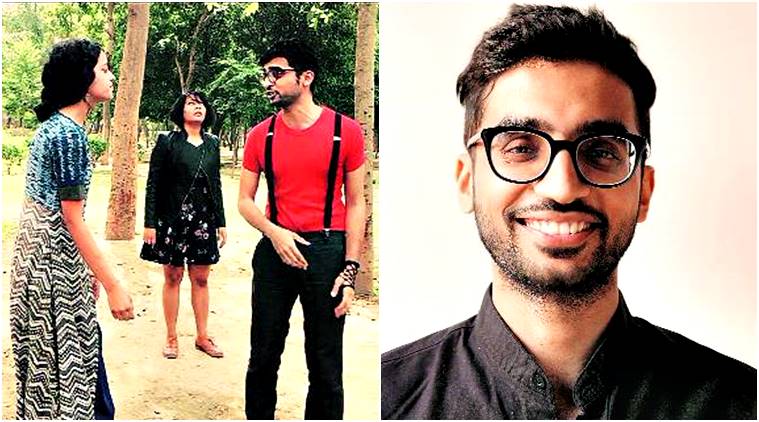
Supreme Court, Suresh Kumar Koushal, Section 377, Naz Foundation, Hyderabad’s Nalsar University of Law, Danish Sheikh, Arcola Theatre, London, Queer Plays Across the World, Delhi High Court, Mahesh Dattani, Bardolators, Romeo and Juliet, A Midsummer Night’s Dream, indian express, indian express news Colour of Protest: Scenes from A Midsummer Night’s Dream in Delhi, 2017 (left) and Danish Sheikh (right)

In 2012, the Supreme Court was preparing to hear a landmark case regarding the constitutional validity of Section 377, titled Suresh Kumar Koushal and another v NAZ Foundation and others. The respondents led by Naz Foundation were represented by a large litigation team, among whom was a recent graduate of Hyderabad’s Nalsar University of Law, Danish Sheikh. But before the hearing could begin, Sheikh had something else to do. He called up his parents in Indore and came out as gay. They asked him to come home for a bit. When he reached Indore airport, Sheikh was driven directly to the office of a psychiatrist.

“He told me homosexuality was a mental disorder, and could be cured by changing my hormonal imbalance. He said, ‘It could be the result of a tumour in your hypothalamus causing you to think you are gay’,” says Sheikh. He remembers whipping out his phone and saying, “I have recorded all of this. Your statement has directly contradicted the WHO’s International Classification of Diseases and I will be suing you for medical malpractice.” The psychiatrist backed off and Sheikh walked out of the room. That real-life incident is now the direct inspiration for a scene led by a female character in the play, Contempt, which Sheikh has written using “97 per cent original transcripts from the case”. It has now been selected by the Arcola Theatre in London to open their festival of Queer Plays Across the World in March, 2018.

In 2013, after two months of hearings, the Supreme Court had overturned a 2009 Delhi High Court verdict and re-established Section 377 — making homosexuality a carnal act against the order of nature. In Contempt, the judge asks an emphatic young lawyer on stage, “What is carnal intercourse against the order of nature? What list of sex acts is covered under this term?”

“You are right, we don’t have a specific list of these acts…” comes the answer but the judge cuts through it: “What if a boy were to insert his tongue into another boy’s mouth? What if a father is kissing his child and he inserts his tongue? What about a breastfeeding mother and child? Is that carnal intercourse?”

Contempt is designed as a set of four courtroom scenes between the lawyer and the judge, each informing the audience how a different kind of argument was placed before the Supreme Court, and how all those arguments failed to convince the judges. The monologues that segment the courtroom scenes are based on affidavits presented in the courtroom and actual experiences of queer people, including Sheikh’s. First staged as a public reading in Colombo in 2017, the script for Contempt was longlisted for the Hindu Metro Plus Playwright of the Year Award the same year.

It was in law school in 2006, that Sheikh discovered Mahesh Dattani’s plays through the dramatics society and began exploring his own sexuality. He found himself at the intersection of theatre and law again when he graduated and joined the Alternative Law Forum in Bengaluru in 2011, a collective of human rights lawyers for whom litigation went beyond courtrooms, to asking larger questions through art and aesthetics. Sheikh’s breakthrough work in theatre came as part of a project by Alliance Francaise to adapt five French plays in the Indian context in 2012. “They had taken Jean Genet’s Deathwatch and done an Indian version called Rajdhani. I went for its audition and it turned out to be a queer character who I connected with,” he says.

In January 2015, he set up a theatre group, called the Bardolators in Bengaluru, with an intent to offer contemporary echoes of Shakespearean plays. Later that year at Cubbon Park, the Balcony Scene from Romeo and Juliet was played out — with a male Juliet and a male Romeo, even as the Bardolators presented six extracts from the play with their own subversion. But the big moment, says Sheikh, came in February 2016 when they staged A Midsummer Night’s Dream in February 2016. In Sheikh’s version of the play, there are two pairs of queer lovers instead. The opposition to their marriage, then becomes symbolic of the state, whch criminalises homosexuality. “When the love juice is put in the characters (just as in the play), they go into an irrational crazy state which, in the logic of our play, became heterosexuality,” says Sheikh.

Story continues below this ad

But the situation off stage isn’t as great. “If you listen to the hearing from 2012, it becomes clear how deep homophobia and transphobia runs, and the lack of empathy towards queer citizens. As for Contempt, there is a part of me, which thinks activism is one of the most optimistic things one can do. To be an activist is to be deeply critical of the present because you are holding on to a vision of utopia,” says Sheikh.

Dipanita Nath is a Senior Assistant Editor at The Indian Express, based in Pune. She is a versatile journalist with a deep interest in the intersection of culture, sustainability, and urban life. Professional Background Experience: Before joining The Indian Express, she worked with other major news organizations including Hindustan Times, The Times of India, and Mint. Core Specializations: She is widely recognized for her coverage of the climate crisis, theatre and performing arts, heritage conservation, and the startup ecosystem (often through her "Pune Inc" series). Storytelling Focus: Her work often unearths "hidden stories" of Pune—focusing on historical institutes, local traditions, and the personal journeys of social innovators. Recent Notable Articles (December 2025) Her recent reporting highlights Pune’s cultural pulse and the environmental challenges facing the city during the winter season: 1. Climate & Environment "Pune shivers on coldest morning of the season; minimum temperature plunges to 6.9°C" (Dec 20, 2025): Reporting on the record-breaking cold wave in Pune and the IMD's forecast for the week. "How a heritage tree-mapping event at Ganeshkhind Garden highlights rising interest in Pune’s green legacy" (Dec 20, 2025): Covering a citizen-led initiative where Gen Z and millennials gathered to document and protect ancient trees at a Biodiversity Heritage Site. "Right to breathe: Landmark NGT order directs PMC to frame norms for pollution from construction sites" (Dec 8, 2025): Reporting on a significant legal victory for residents fighting dust and air pollution in urban neighborhoods like Baner. 2. "Hidden Stories" & Heritage "Inside Pune library that’s nourished minds of entrepreneurs for 17 years" (Dec 21, 2025): A feature on the Venture Center Library, detailing how a collection of 3,500 specialized books helps tech startups navigate the product life cycle. "Before he died, Ram Sutar gave Pune a lasting gift" (Dec 18, 2025): A tribute to the legendary sculptor Ram Sutar (creator of the Statue of Unity), focusing on his local works like the Chhatrapati Shivaji statue at Pune airport. "The Pune institute where MA Jinnah was once chief guest" (Dec 6, 2025): An archival exploration of the College of Agriculture, established in 1907, and its historical role in India's freedom struggle. 3. Arts, Theatre & "Pune Inc" "Satyajit Ray, Ritwik Ghatak were not rivals but close friends, says veteran filmmaker" (Dec 17, 2025): A deep-dive interview ahead of the Pune International Film Festival (PIFF) exploring the camaraderie between legends of Indian cinema. "Meet the Pune entrepreneur helping women build and scale businesses" (Dec 16, 2025): Part of her "Pune Inc" series, profiling Nikita Vora’s efforts to empower female-led startups. "How women drone pilots in rural Maharashtra are cultivating a green habit" (Dec 12, 2025): Exploring how technology is being used by women in agriculture to reduce chemical use and labor. Signature Style Dipanita Nath is known for intellectual curiosity and a narrative-driven approach. Whether she is writing about a 110-year-old eatery or the intricacies of the climate crisis, she focuses on the human element and the historical context. Her columns are often a blend of reportage and cultural commentary, making them a staple for readers interested in the "soul" of Pune. X (Twitter): @dipanitanath ... Read More


Latest Comment
Post Comment
Read Comments
Advertisement
Advertisement
Advertisement
Advertisement