Premium
This is an archive article published on August 5, 2022

Explained: How artists in Ukraine are following the tradition of depicting war through art

Art greats such as Pablo Picasso and Salvador Dali have also made paintings on wars, as is being done now with the Ukraine-Russia conflict.

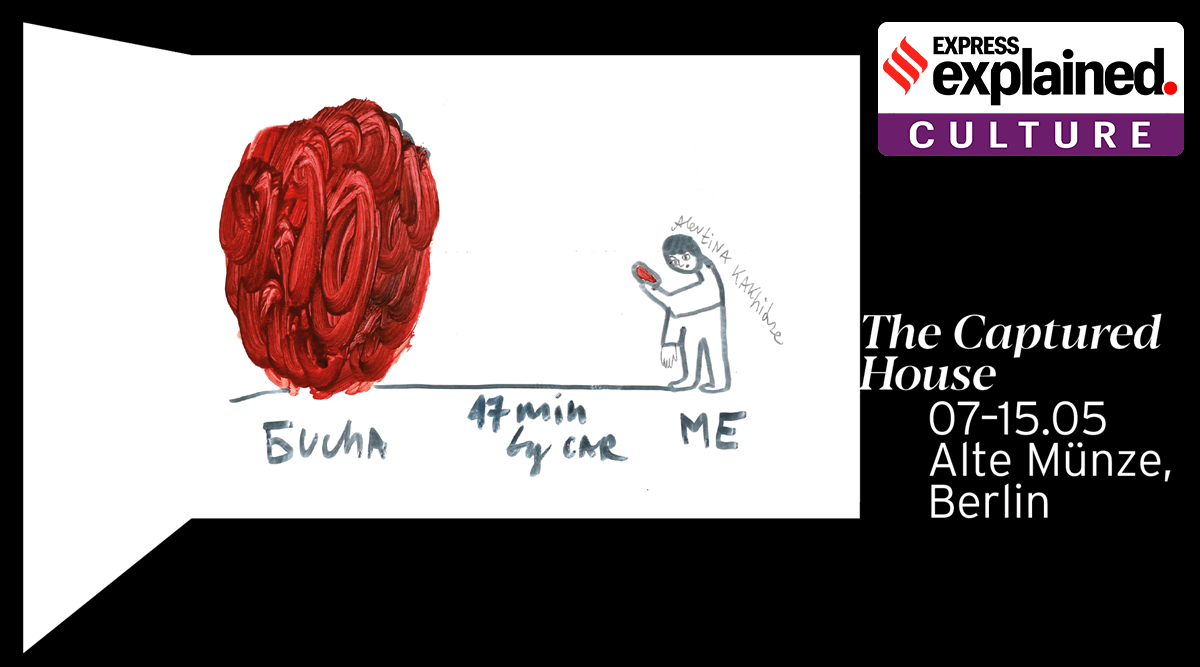
The Captured House exhibition UkraineFeaturing 200 works by 50 Ukrainian artists, 'The Captured House' exhibition portrays different aspects of the war. Painting by Ukrainian artist Alevtina Kakhidze. (Photo Credit: The Captured House)

While several efforts have been directed toward safeguarding Ukraine’s art and artefacts during the Russian onslaught, its artists are also striving to depict the war and its impact through their works. An exhibition titled ‘The Captured House’, which opened at Espace Vanderborght in Brussels this week features works of contemporary Ukrainian artists made after the Russian invasion began on February 24.

“Let this project become not a stream of ‘bad news from Ukraine’, but your personal conversation, a conversation in your kitchen to your heart’s content, with every Ukrainian whose life is in danger in our common ‘Captured House,’” reads a note on the exhibition by curator Kate Taylor.

We look at some of the works from the exhibition, as well as some of the greatest war paintings of the 20th century.

The highlights of ‘The Captured House’

The project was reportedly ideated by Taylor around April after she noticed that Ukrainian artists were creating works responding to the war. Soon, she began following the works, leading to the exhibition that has already travelled to Berlin, Rome and Amsterdam.

In a note on the exhibition on its official website, Taylor states, “This is not just our war. This is a war for the whole of Europe, which we are defending and standing on as a shield, a shield of our and your lives. People who stay in Ukraine protect the country, help to survive and people who continue to appeal not only directly against the war but also because of our cultural codes, the roots of our common identity, Ukraine’s relationship with Europe and our common values.”

Featuring 200 works by 50 Ukrainian artists, the exhibition portrays different aspects of the war. Based in Kyiv when the war broke out, artist Yuriy Bolsa depicts the “sounds of explosions” in his paintings and recalls how he fled to his village in Volyn “out of fear, like a little child hiding behind his mother”.

If artist Vlada Ralko notes that she has used art as her language to speak about the war, Alevtina Kakhidze notes that in Ukraine today “anyone can be wiped out regardless of sex, views, good deeds or crimes. Trees, animals, and houses can be destroyed anytime as well.” Based in Odessa when the war began, Daria Koltsova dedicated her artwork to children who have lost their lives to the war. With the number of children who are being killed during the onslaught growing, she is making a clay sculpture for each of them in remembrance.

Story continues below this ad

“This is my ritual of honouring every little life that was lost, my way of singing the last lullaby,” she writes on the exhibition website. Ukrainian photographer Evgeniy Maloletka, on the other hand, is displaying photographs of death and destruction. “But the hardest thing is death and people mourning their relatives,” he writes.

How have artists in Ukraine been responding to the war?

Months after the war in Ukraine began, artists from the country found centerstage at the Venice Biennale exhibition that began in April. Speaking via a web link, Ukrainian President Volodymyr Zelensky said, “Art can tell the world things that cannot be shared otherwise…There are no tyrannies that would not try to limit art. Because they can see the power of art. It is art that conveys feelings”.

Transported from Ukraine under police supervision, the works included artist Pavlo Makov’s ‘The Fountain of Exhaustion’, an installation featuring funnels with dripping water arranged in a triangle, commenting on democracy.

At New York’s Fridman Gallery, some of Ukraine’s leading women artists are sharing the experience of war. Aspen Institute in Colorado is hosting the exhibition ‘Beast of War, Bird of Hope’, featuring Ukrainian paintings and photography created in response to the war. “One of the most moving sequences of three photos shows an old woman holding her head in her hands, a new mother holding her baby in her arms, and a group of workers holding body bags in a desolate field,” reads a note on the exhibition on the Aspen Institute website.

Story continues below this ad

In the Ukrainian city of Kherson, painters, photographers and playwrights have come together to form an underground art residency entitled ‘Residency in Occupation’, directed at creating works depicting the horrors of living in a war-torn country.

In May, at the World Economic Forum in Davos, Ukrainian artists put together an anti-war exhibition at Russia House comprising photographs depicting war crimes, from the severely injured to razed buildings. Meanwhile, at the nomadic European biennial Manifesta 14 at Prishtina, Kosovo, Hedwig Fijen, the founder and director of Manifesta, has proposed that Kyiv should host the 2028 edition of the art event in a bid to help rebuild the country’s cultural ecosystem and infrastructure.

Great art responding to wars in the 20th century

While artists have been depicting battle scenes since ancient times – from its atrocities to the might of the powerful – the 20th century has seen several masterpieces portraying war. One of the most famous war paintings perhaps is Pablo Picasso’s ‘Guernica’. The 1937 oil on canvas was painted by the Spanish artist in the aftermath of the Nazi bombing of Guernica, Spain. The monumental black and white work depicts misery and pain, including a wounded horse, a bull, dismembered soldiers and wailing women.

Also depicting the horrors of the Spanish Civil War was Salvador Dali’s 1936 ‘Soft Construction with Boiled Beans (Premonition of Civil War)’, portraying the self-destructive nature of war through a monstrous creature.

Story continues below this ad

Made during World War I, in German artist Kathe Kollwitz’s 1923 woodcut titled ‘War’, the protagonists were those left behind – from elderly mothers to widows and children. His countryman Otto Dix depicted a battlefield filled with wounded and dead soldiers during the war in the triptych ‘Der Krieg’.

In more recent years, American pop artist Roy Lichtenstein’s ‘Whaam!’ in 1963 commented on the Vietnam war, through a depiction based on a panel from the 1962 DC war comic ‘All American Men of War’.

Vandana Kalra is an art critic and Deputy Associate Editor with The Indian Express. She has spent more than two decades chronicling arts, culture and everyday life, with modern and contemporary art at the heart of her practice. With a sustained engagement in the arts and a deep understanding of India’s cultural ecosystem, she is regarded as a distinctive and authoritative voice in contemporary art journalism in India. Vandana Kalra's career has unfolded in step with the shifting contours of India’s cultural landscape, from the rise of the Indian art market to the growing prominence of global biennales and fairs. Closely tracking its ebbs and surges, she reports from studios, galleries, museums and exhibition spaces and has covered major Indian and international art fairs, museum exhibitions and biennales, including the Venice Biennale, Kochi-Muziris Biennale, Documenta, Islamic Arts Biennale. She has also been invited to cover landmark moments in modern Indian art, including SH Raza’s exhibition at the Centre Pompidou in Paris and the opening of the MF Husain Museum in Doha, reflecting her long engagement with the legacies of India’s modern masters. Alongside her writing, she applies a keen editorial sensibility, shaping and editing art and cultural coverage into informed, cohesive narratives. Through incisive features, interviews and critical reviews, she brings clarity to complex artistic conversations, foregrounding questions of process, patronage, craft, identity and cultural memory. The Global Art Circuit: She provides extensive coverage of major events like the Kochi-Muziris Biennale, Serendipity Arts Festival, and high-profile international auctions. Artist Spotlights: She writes in-depth features on modern masters (like M.F. Husain) and contemporary performance artists (like Marina Abramović). Art and Labor: A recurring theme in her writing is how art reflects the lives of the marginalized, including migrants, farmers, and labourers. Recent Notable Articles (Late 2025) Her recent portfolio is dominated by the coverage of the 2025 art season in India: 1. Kochi-Muziris Biennale & Serendipity Arts Festival "At Serendipity Arts Festival, a 'Shark Tank' of sorts for art and crafts startups" (Dec 20, 2025): On how a new incubator is helping artisans pitch products to investors. "Artist Birender Yadav's work gives voice to the migrant self" (Dec 17, 2025): A profile of an artist whose decade-long practice focuses on brick kiln workers. "At Kochi-Muziris Biennale, a farmer’s son from Patiala uses his art to draw attention to Delhi’s polluted air" (Dec 16, 2025). "Kochi Biennale showstopper Marina Abramović, a pioneer in performance art" (Dec 7, 2025): An interview with the world-renowned artist on the power of reinvention. 2. M.F. Husain & Modernism "Inside the new MF Husain Museum in Qatar" (Nov 29, 2025): A three-part series on the opening of Lawh Wa Qalam in Doha, exploring how a 2008 sketch became the architectural core of the museum. "Doha opens Lawh Wa Qalam: Celebrating the modernist's global legacy" (Nov 29, 2025). 3. Art Market & Records "Frida Kahlo sets record for the most expensive work by a female artist" (Nov 21, 2025): On Kahlo's canvas The Dream (The Bed) selling for $54.7 million. "All you need to know about Klimt’s canvas that is now the most expensive modern artwork" (Nov 19, 2025). "What’s special about a $12.1 million gold toilet?" (Nov 19, 2025): A quirky look at a flushable 18-karat gold artwork. 4. Art Education & History "Art as play: How process-driven activities are changing the way children learn art in India" (Nov 23, 2025). "A glimpse of Goa's layered history at Serendipity Arts Festival" (Dec 9, 2025): Exploring historical landmarks as venues for contemporary art. Signature Beats Vandana is known for her investigative approach to the art economy, having recently written about "Who funds the Kochi-Muziris Biennale?" (Dec 11, 2025), detailing the role of "Platinum Benefactors." She also explores the spiritual and geometric aspects of art, as seen in her retrospective on artist Akkitham Narayanan and the history of the Cholamandal Artists' Village (Nov 22, 2025). ... Read More

 

Latest Comment
Post Comment
Read Comments
Advertisement
Loading Taboola...
Advertisement
Advertisement
Advertisement