This is an archive article published on March 30, 2023
This Word Means: Sarbat Khalsa — the Sikh assembly that Amritpal Singh wants called
The word sarbat means 'all', and literally, the Sarbat Khalsa is an assembly of all factions of Sikhs (Khalsa). The idea of a deliberative assembly of Sikhs dates back to the 18th century.
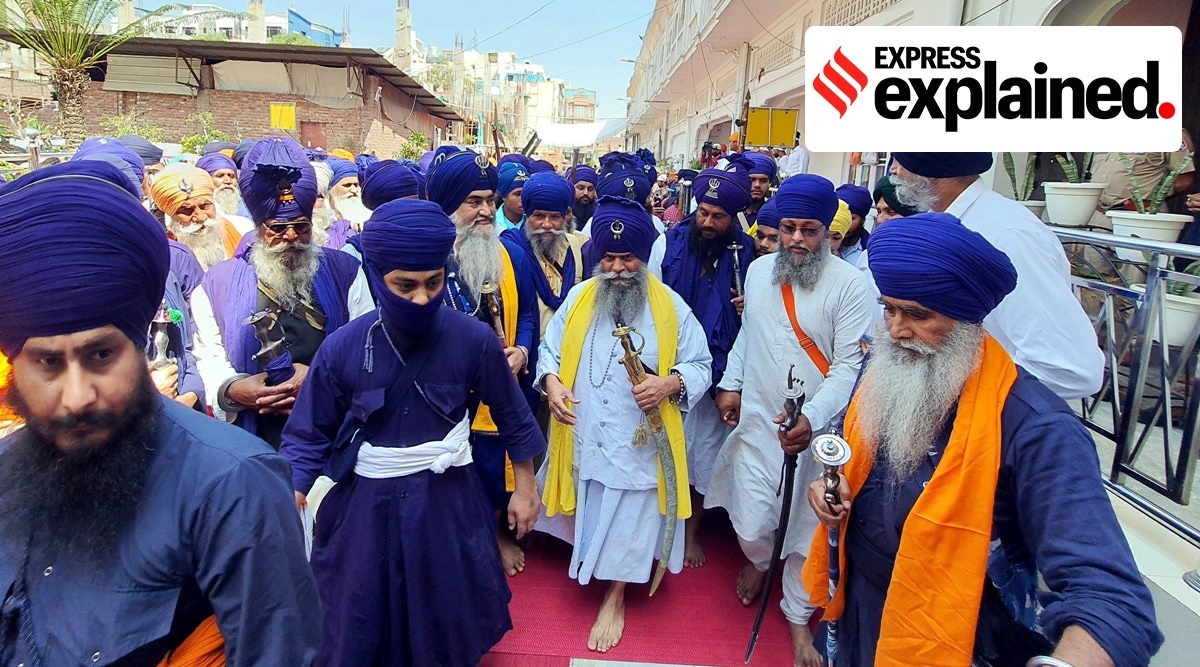
Amritpal Singh has asked Akal Takht Jathedar Giani Harpreet Singh to call the Sarbat Khalsa on Baisakhi Day (April 14) at the Takht Sri Damdama Sahib in Talwandi Sabo. (Express photo by Rana Simranjit Singh)
Listen to this article
This Word Means: Sarbat Khalsa — the Sikh assembly that Amritpal Singh wants called
x
00:00
1x1.5x1.8x
In a video statement issued from hiding, Amritpal Singh, the head of Waris Punjab De, has asked Akal Takht Jathedar Giani Harpreet Singh to call the Sarbat Khalsa on Baisakhi Day (April 14) at the Takht Sri Damdama Sahib in Talwandi Sabo. Amritpal Singh has been on the run since March 18, when the Punjab Police moved to take him into custody.
Deliberative assembly
The word sarbat means ‘all’, and literally, the Sarbat Khalsa is an assembly of all factions of Sikhs (Khalsa). The idea of a deliberative assembly of Sikhs dates back to the 18th century.
Following the death of the tenth Guru, Guru Gobind Singh, the Sikh misls (military units) began to convene the Sarbat Khalsa to discuss political, social, and religious issues of great importance to the community, which was then in the midst of its struggle against the Mughals.
These gatherings, called twice a year on the occasion of Baisakhi and Diwali, had the power to issue directions to all Sikhs. The Sarbat Khalsa was first institution of Sikhs that took shape after the tradition of Guru in human form came to end, and turned out to be very effective amid the internal conflicts among the misls.
The historian Henry Prinsep, who wrote one of the earliest histories of the Sikhs in the first half of the 19th century, recorded that despite their fierce sense of independence, all the Sikh misls sat together at the Sarbat Khalsa without any conflict.
Nawabi to a stableman
After the Mughals executed Baba Banda Singh Bahadur, the commander of the Khalsa army, in 1716, the Sikhs began a guerrilla war that caused considerable damage to the state. To stop the Sikh raids, Zakarya Khan, the Mughal governor of Lahore, offered them the title of Nawab.
There was resistance to accepting this offer among the Sikhs, and the issue was discussed at the Sarbat Khalsa. After long deliberation, it was decided to accept the offer — however, instead of someone in the top leadership, a stableman named Kapur Singh was asked to take the title. The intention was to send a message to Zakarya Khan that the title of Nawab does not mean much for Sikhs.
Story continues below this ad
Nawab Kapur Singh proved to be a very capable leader of the community, who combined the various Sikh militias into the Dal Khalsa. Subsequently, Sardar Jassa Singh Ahluwalia was appointed by the Sarbat Khalsa to lead the Dal Khalsa.
Fading of the practice
The establishment of the Sikh kingdom by Maharaja Ranjit Singh in 1799 ended the era of the Sikh misls, and also the primary need for the institution of the Sarbat Khalsa. This was also the beginning of a period in which Sikhs experienced independence for the first time, which solved most of their issues.
In the 20th century, the formation of the Shiromani Gurdwara Parbandhak Committee (SGPC) further reduced the need for an institution like the Sarbat Khalsa. Over the years, the SGPC has set up a well-oiled mechanism for taking decisions on behalf of the community.
A few exceptions
In 1920, the Sarbat Khalsa was called to discuss control over gurdwaras and subsequently, the SGPC was born.
Story continues below this ad
After the Army action at the Golden Temple in 1984, some organisers called the Sarbat Khalsa, but prominent Sikh bodies including the SGPC were not part of the call. One of the most important of these gatherings was called on January 26, 1986, when radical Sikhs sought to discuss kar sewa at the Akal Takht, which had been damaged in Operation Bluestar. A panthic committee that was formed to decide on the future of the Sikh struggle later that year, gave a call for Khalistan.
More recently, Sikh bodies opposed to the Shiromani Akali Dal (Badal) called the Sarbat Khalsa on November 10, 2015. Resolutions were passed to remove Jathedars of the Akal Takht, Takht Damdama Sahib, and Takht Kesgarh Sahib, and to appoint other, parallel Jathedars. This Sarbat Khalsa impacted Punjab politics in a number of ways.
Kamaldeep Singh Brar is a Principal Correspondent at The Indian Express, primarily covering Amritsar and the Majha region of Punjab. He is one of the publication's key reporters for stories involving the Akal Takht, the Shiromani Gurdwara Parbandhak Committee (SGPC), and the sensitive socio-political issues of the border districts.
Core Beats & Specializations
Religious & Panthic Affairs: He has deep expertise in the internal workings of the Akal Takht and SGPC, frequently reporting on religious sentences (Tankhah), Panthic politics, and the influence of Sikh institutions.
National Security & Crime: His reporting covers cross-border drug smuggling, drone activities from Pakistan, and the activities of radical groups.
Regional Politics: He is the primary correspondent for the Majha belt, covering elections and political shifts in Amritsar, Tarn Taran, and Gurdaspur.
Recent Notable Articles (Late 2025)
His work in late 2025 has been centered on judicial developments, local body elections, and religious controversies:
1. Religious Politics & Akal Takht
"Akal Takht pronounces religious sentences against former Jathedar Giani Gurbachan Singh" (Dec 8, 2025): Covering the historic decision to hold the former Jathedar guilty for granting a pardon to Dera Sacha Sauda chief Gurmeet Ram Rahim in 2015.
"YouTube suspends SGPC’s channel for a week over video on 1984 Army action" (Nov 20, 2025): Reporting on the digital friction between global tech platforms and Sikh religious bodies.
"As AAP govt grants Amritsar holy tag, a look at its fraught demand" (Nov 28, 2025): An analytical piece on the long-standing demand for declaring Amritsar a "holy city" and its political implications.
2. Crime & National Security
"Mostly Khalistanis on Amritpal’s hit list: Punjab govt to High Court" (Dec 16, 2025): Reporting on the state government's claims regarding jailed MP Amritpal Singh orchestrating activity from prison.
"Punjab man with links to Pakistan’s ISI handlers killed in encounter" (Nov 20, 2025): Detailing a police operation in Amritsar involving "newly refurbished" firearms likely sent from across the border.
"15 schools in Amritsar get bomb threat emails; police launch probe" (Dec 12, 2025): Covering the panic and police response to mass threats against educational institutions.
3. Political Analysis & Elections
"AAP wins 12 of 15 zones in SAD stronghold Majitha" (Dec 19, 2025): Highlighting a significant shift in the 2025 rural elections where the Akali Dal lost its grip on a traditional fortress.
"Tarn Taran bypoll: woman faces threats after complaining to CM Mann about drug menace" (Nov 9, 2025): A ground report on the personal risks faced by citizens speaking out against the illegal drug trade in border villages.
"AAP wins Tarn Taran bypoll, but SAD finds silver lining" (Nov 14, 2025): Analyzing the 2025 assembly by-election results and the surprising performance of Independents backed by radical factions.
4. Human Interest
"Two couples and a baby: Punjab drug addiction tragedy has new victims" (Nov 20, 2025): A tragic investigative piece about parents selling an infant to fund their addiction.
"Kashmiri women artisans debut at Amritsar’s PITEX" (Dec 8, 2025): A feature on financial independence initiatives for rural women at the Punjab International Trade Expo.
Signature Beat
Kamaldeep is known for his nuanced understanding of border dynamics. His reporting often highlights the "drug crisis in the underprivileged localities" (like Muradpur in Tarn Taran, Nov 9, 2025), providing a voice to marginalized communities affected by addiction and administrative neglect.
X (Twitter): @kamalsbrar ... Read More


 5 min read