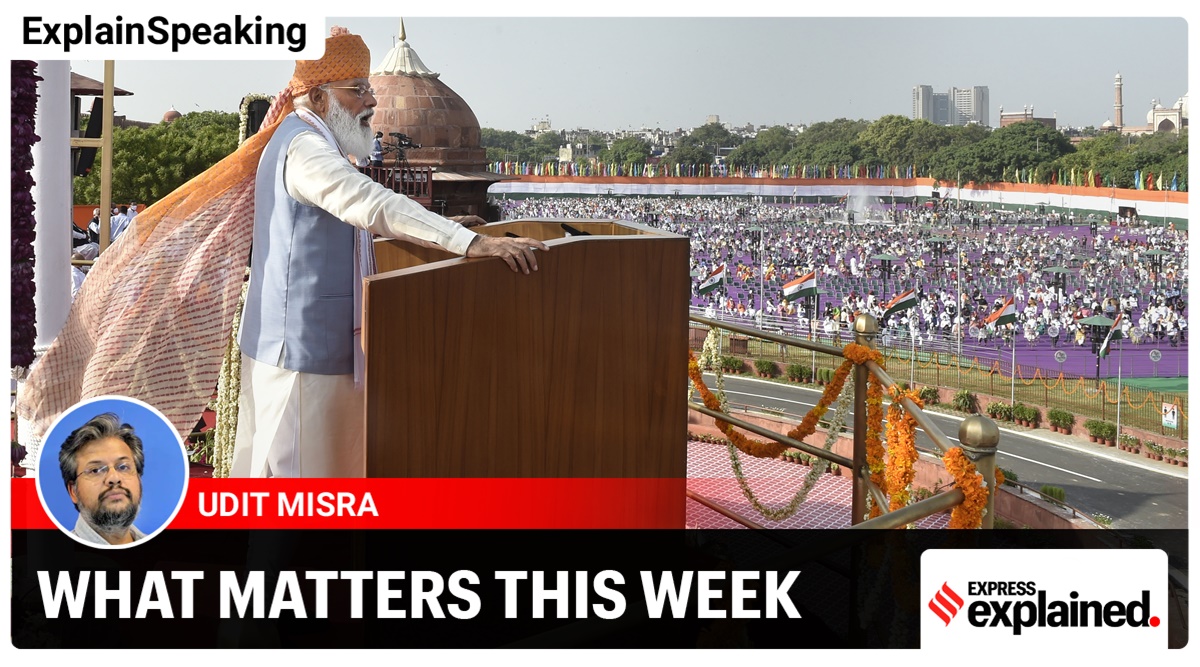
On the face of it, it looked like an out-and-out political speech. As such, the response can vary between being very enthused about India’s future prospects (if you are a supporter of PM Modi) and berating the speech as yet another “jumla” (if you are opposed to his politics). But the speech was not just political. It had clear economic roots as well. What’s more, its success would depend on how many believe in what the PM says.
But before we unpack the economic underpinnings, let’s also look back at what Revenue Secretary Tarun Bajaj said at the CII Annual Session last week where he was addressing the country’s top business leaders. “I want to understand from you one thing which I still see missing from the corporate sector is the animal spirits, I don’t see the private investment happening as much. I want to understand as to what you expect from us, to do, so that we can also start,” Bajaj said.
There’s a link between Bajaj’s query and Modi’s exhortation. While Bajaj was asking what can be done further to fire up India’s animal spirits, PM Modi was trying to boost them.
What are animal spirits?
In simplest terms, it is a catch-all phrase to explain the behaviour that isn’t always captured by traditional economic theory. Look at the table below. Traditional economic theory assumes that people make rational decisions and for economic reasons.
Story continues below this ad
Source: Akerlof and Shiller
But this combination of assumptions only explains the actions under just one of the four boxes. What about rational decisions but those which are taken for non-economic reasons? Or, those decisions that are taken for economic reasons but are irrational? Or irrational decisions taken for non-economic reasons?
All these can be clubbed as “animal spirits”. In their book titled “Animal Spirits”, George Akerlof and Robert Shiller (both Nobel prize-winning economists) describe five different aspects of animal spirits and how they affect economic decisions. These five are: Confidence, fairness, corruption and antisocial behaviour, money illusion, and stories.
Possibly the most important one is “confidence”. For instance, you would have often heard about political leaders and top officials trying to “restore confidence” among the people. This “confidence” is essentially about trust and thus, by definition, goes beyond rational behaviour. The economic prospects of a country can alter depending on how many economic agents (or people) truly believe in a policy or policymaker’s promise.
Story continues below this ad
 PM Modi takes salute before inspecting the guard of honour at Red Fort (PTI)
Similarly, “stories” or narratives are important. Sample what the authors say about stories: “It is generally considered unprofessional for economists to base their analyses on stories…The news media are, after all, in the business of creating stories that people would like to hear. Thus there is a tendency toward overexplanation of economic events… Just look at the theories offered by pundit after pundit on a slow news day when stocks have moved by a fair amount. Thus economists are rightly wary of stories and of the reality they seek to define. But what if the stories themselves move markets? … What if they themselves are a real part of how the economy functions?” write Akerlof and Shiller. The “confidence of a nation, or of any large group, tends to revolve around stories,” they state.
In the same light, when we decide things based on “fairness” — say when we are deciding on wages — even that falls out of rational behaviour. The same hold for corruption’s impact on decision making. Often “corruption” undermines our rational choice. For instance, when deciding on which firm should get a loan and for how much and how often. The last one is the notion of “money illusion”. The traditional economic theory believes people do not suffer from money illusion and that they can see past inflation. But this may not be true. For instance, data suggests that very few wage contracts are indexed to inflation. The question is: Why would people rationally get into a wage contract which is not indexed to inflation?
The upshot being that there are many ways in which “animal spirits” tends to alter the behaviour of each one of us and, consequently, the whole economy.
Let’s take the example of what Bajaj was bothered about: The lack of investments by businesses even when, as the government believes, it has provided the conducive policy landscape for it.
Story continues below this ad
If you assume rational behaviour, it is not a puzzle why investments haven’t taken off.
Here’s a quick explanation.
It is no secret that since coming back to power in 2019, the Modi government has clearly stated that it expects the private sector to lead India’s economic recovery. In other words, the government wants to reduce its role in the economy and let the private sector create new jobs by making fresh investments.
To this end, the government sharply reduced the corporate tax rates in 2019. Its hope was that businesses will find it very profitable to make fresh investments in India.
Prime Minister Narendra Modi waves at the audience during the 75th Independence Day function at the historic Red Fort, in New Delhi (PTI)
To further incentivise such investments, the government also tried to cut back on several key welfare programmes — even healthcare expenditure and that too smack in the middle of a global pandemic — while ramping up capital expenditure. Boosting “capex” essentially means the government making more roads, railways, airports and seaports etc. and thus improving the efficiency of the investments made by the private sector in the long term. For example, a new road or a bridge or an airport cuts down transport or travel time and thus makes all the concerned businesses more efficient and profitable.
Story continues below this ad
Newsletter | Click to get the day’s best explainers in your inbox
So what went wrong?
The problem was a misdiagnosis of what ails with India’s economic growth. Most of the data suggested that India’s economic growth momentum was fast decelerating between 2017 and 2019 because the overall demand in the economy was falling.
As a result, what was needed was for the government to boost aggregate demand in the economy. In the absence of adequate demand, most businesses were running on low levels of capacity utilisation.
But the government’s approach to boosting growth was to look at the supply side. On its own, the cut in corporate tax rate is a great idea but given the nature of deceleration in India’s economic growth (i.e. lack of demand), it was badly timed.
Story continues below this ad
Not surprisingly, corporations simply pocketed the money saved from lower tax rates and, instead of using it to make fresh investments, either paid off their past debts or increased their profits.
Things became worse when the Covid pandemic hit us in March 2020. The resulting lockdowns, job and income losses completely destroyed the already weak demand in the Indian economy.
For the most part, the government’s response to the pandemic was less a “stimulus” to the economy and more a “relief” package — in the form of minimum foodgrain availability etc and credit guarantees.
PM Modi waves as he leaves after addressing the nation on Independence Day celebrations, in New Delhi (AP)
The point being: It is hardly surprising that investments by businesses have remained weak for the past several years despite several incentives by the government. That’s because rationally speaking, there is no reason why businesses should ramp up investments when demand is still not back to even the pre-Covid levels, which incidentally were already quite worryingly low.
Story continues below this ad
That is what explains the reference to “animal spirits” by the Revenue Secretary. He is wondering what can be done to ignite that spark among the businesses.
This desire to ignite the spark of animal spirits also lies at the heart of PM Modi’s latest speech. But, as explained above, the success of his words will depend on whether a large number of Indians — not just his core voter base — trusts them.
Will India be able to achieve the “Amrut Kaal” goals laid out in the PM’s speech? Share your views and queries at udit.misra@expressindia.com
Stay safe
Udit


 9 min read



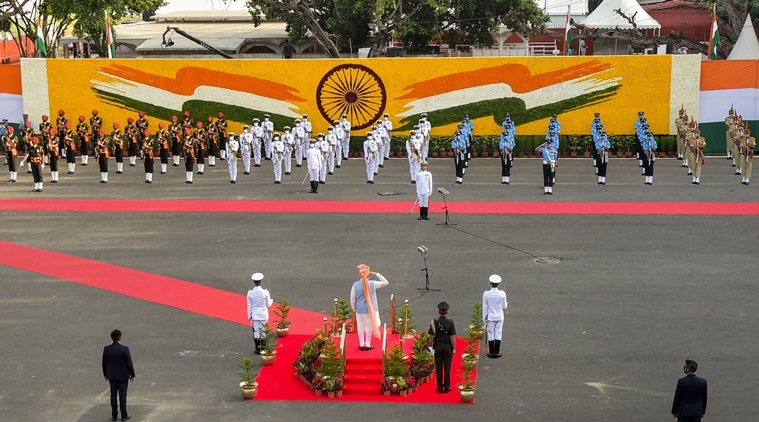 PM Modi takes salute before inspecting the guard of honour at Red Fort (PTI)
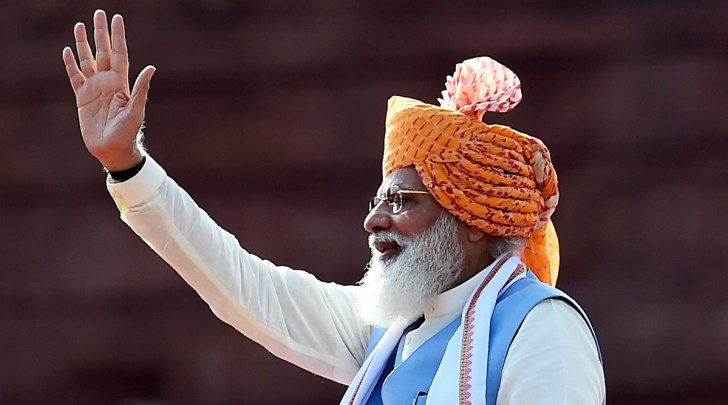 Prime Minister Narendra Modi waves at the audience during the 75th Independence Day function at the historic Red Fort, in New
 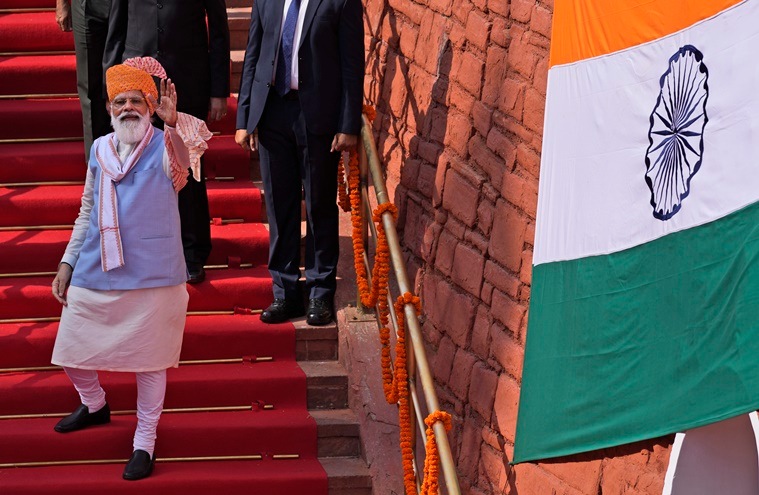 PM Modi waves as he leaves after addressing the nation on Independence Day celebrations, in New Delhi (AP)