Premium
This is an archive article published on June 29, 2022

Explained: How India’s first mRNA vaccine for Covid-19 was created

As the Covid-19 pandemic spread, an mRNA vaccine candidate was the first to enter human trials globally. The first two vaccines that were made available for use in the US were based on mRNA technology.

mRNA VaccineUnlike vaccines that put a weakened or inactivated virus in your body to activate an immune response, these two Covid-19 vaccines (Pfizer-BioNTech and Moderna) used messenger RNA or mRNA to deliver a message to your immune system. (AP Photo)

The country’s first home-grown mRNA Covid-19 vaccine — GEMCOVAC-19 — developed at Pune’s Gennova Biopharmaceuticals has got a ‘restricted emergency use’ nod for the 18-and-above age group. As mRNA vaccines are required to be kept at sub-zero temperatures, it was a mammoth task for Gennova scientists to develop a thermostable mRNA Covid-19 vaccine. Scientists had to innovate to suit local needs to make it affordable and deployable. The new vaccine can now be stored at the temperature of a standard medical refrigerator.

The mRNA platform

As the Covid-19 pandemic spread, an mRNA vaccine candidate was the first to enter human trials globally. The first two vaccines that were made available for use in the US were based on mRNA technology.

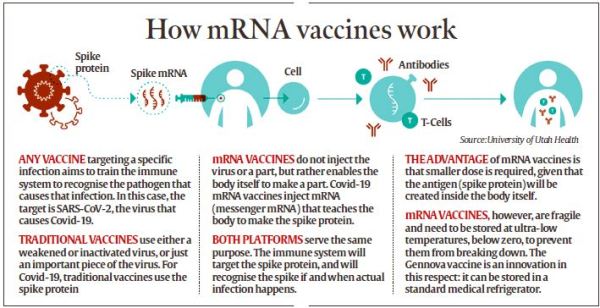
Unlike vaccines that put a weakened or inactivated virus in your body to activate an immune response, these two Covid-19 vaccines (Pfizer-BioNTech and Moderna) used messenger RNA or mRNA to deliver a message to your immune system.

Basically, the technology uses genetically engineered mRNA to instruct cells to make the S-protein found on the surface of the Covid-19 virus. According to reports from US-based Mayo Clinic, after vaccination, the muscle cells begin making S-protein pieces and displaying them on cell surfaces. This causes the body to create antibodies.

But these vaccines have to be stored at sub-zero temperatures as mRNA is fragile and breaks down easily.

Thermostable vaccine

“Unlike in the West, where the vaccine has to be stored at sub-zero temperatures, the challenge in India was to be able to store the vaccine between 2-8 degree Celsius. We had to innovate to suit our local needs as to what is affordable and deployable. GEMCOVAC-19 can now be stored at the temperature of a standard medical refrigerator,” says Dr Sanjay Singh, CEO of Gennova Biopharmaceuticals.

Story continues below this ad

The conversion from liquid to powder form of the vaccine takes place via Lyophilisation — this is freeze-drying, a process where the water is removed from the product after it is frozen and placed under a vacuum allowing the ice to change directly from solid to vapor without passing through a liquid phase.

However, just removing water by Lyophilisation of the mRNA vaccine does not work. So, the surrounding pressure has to be tweaked and then kept stable to ensure the characteristics of the vaccine are the same as before Lyophilisation. For this to be achieved, the key was to add an external agent which at a certain critical concentration keeps it stable under lyophilized conditions. The Lyophilisation technology is not new, but a lyophilized mRNA vaccine is unique.

“We performed hundreds of trials before arriving at the right formulation and right condition to ensure a heat-stable mRNA vaccine,” Dr Singh said.

Trials and safety

Story continues below this ad

Freeze-drying the large and unstable mRNA molecule with the nanoparticle was a daunting challenge. However, Gennova invested countless man-hours in the hope of lyophilizing the mRNA vaccine in a single vial within a year. This thermostable vaccine was thoroughly tested in various animal models to ensure its safety and immunogenicity before entering human clinical trials. Phase 1 and 2 trial data across 480 participants had been submitted earlier, and data from Phase 3 trial across 4,000 participants was then presented to the Central Drugs Standard Control Organisation (CDSCO). During the Phase 3 trials, 3,000 participants were administered the mRNA Covid-19 vaccine and 1,000 were given Covishield.

According to officials at Gennova, the trial data showed that the vaccine was safe and well-tolerated. Immunogenicity measured at 2 weeks post-dose showed that GEMCOVAC-19 is non-inferior to Covishield.

The two-dose vaccine will have to be administered intramuscularly, 28 days apart.

Newsletter | Click to get the day’s best explainers in your inbox

Fight against emerging variants

Story continues below this ad

For the first time, the mRNA platform has been used to develop a Covid-19 vaccine in India. This total process may have taken one-and-a-half years, but for Dr. Singh, a biochemist who had worked on malaria vaccines at the US-based National Institutes of Health, and the team, designing an mRNA vaccine against the Omicron variant barely took 60 days.

Notably, this technology platform provides flexibility to quickly tweak the vaccine for any existing or emerging variants of the virus.

“A pandemic-ready platform technology has been created that can be used to quickly develop a vaccine should a variant-of-concern emerge due to the rapid mutation of the SARS-CoV-2 virus. Clinical trials need to be done to ascertain the effectiveness of the GEMCOVAC-19 against Omicron and sub-variants,” said Dr. Singh.

A short clinical trial will also be conducted with the Omicron-specific vaccine, which has also been designed for use as a booster and a protocol submitted to the DCGI.

Story continues below this ad

He added: “The learning curve was steep not only in terms of production but also in conducting the clinical trials. The approval of the nation’s first mRNA vaccine will pave the way for the development of new-variant specific mRNA vaccines that can be used as future booster doses. It was absolutely necessary to establish the safety and immunogenicity of the new vaccine platform technology in the Indian population.”

Ready for roll-out

Gennova already has a license to manufacture and sell from the CDSCO.

Gennova Biopharmaceuticals Chief Operating Officer Samit Mehta said that talks are underway with the government on whether they would like to procure and deploy or whether the firm can reach out to the private market. On pricing, he added: “Compared to our peers we will be competitive.”

Story continues below this ad

Authorities at Gennova said that they are actively engaged in talks with at least 25-30 countries that had evinced interest in the new vaccine.

“Gennova produced 70 lakh doses taking a risk….Now that we have received the EUA, we can ship the material soon after completing all formalities. The current production capacity is around 40-50 lakh doses per month which will be upgraded to 2-3 fold soon,” Dr Singh said.

Anuradha Mascarenhas is a Senior Editor at The Indian Express, based in Pune. With a career spanning three decades, she is one of the most respected voices in Indian journalism regarding healthcare, science and environment and research developments. She also takes a keen interest in covering women's issues . Professional Background Education: A gold medalist in Communication and Journalism from Savitribai Phule Pune University and a Master’s degree in Literature. Author: She authored the biography At The Wheel Of Research, which chronicles the life and work of Dr. Soumya Swaminathan, the former Chief Scientist at the WHO. Key Focus: She combines scientific accuracy with storytelling, translating complex medical research into compelling public and human-interest narratives. Awards and Recognition Anuradha has won several awards including the Press Council of India's national award for excellence in journalism under the gender based reporting category in 2019 and the Laadli Media award (gender sensitivity -2024). A recipient of the Lokmat journalism award (gender category-2022), she was also shortlisted for the RedInk awards for excellence in journalism-2021. Her debut book At The Wheel Of Research, an exclusive biography of Dr Soumya Swaminathan the inaugural chief scientist of World Health Organisation was also nominated in the Popular Choice Category of JK Paper AUTHER awards. She has also secured competitive fellowships including the Laadli Media Fellowship (2022), the Survivors Against TB – New Research in TB Media Fellowship (2023) and is part of the prestigious 2025 India Cohort of the WomenLift Health Leadership Journey.” Recent Notable Articles (Late 2025) 1. Cancer & Specialized Medical Care "Tata Memorial finds way to kill drug-resistant cancer cells" (Nov 26, 2025): Reporting on a breakthrough for triple-negative breast cancer, one of the most aggressive forms of the disease. Discipline, diet and purpose; How a 97-year-old professor defies ageing'' (Nov 15, 2025) Report about Prof Gururaj Mutalik, the first Head of Department at Pune's B J Government Medical College who at 97 credits his longevity to healthy habits and a strong sense of purpose. 2. Environmental Health (The "Breathless Pune" Series) Long-term exposure even to 'moderate' air leads to chronic heart, lung, kidney issues" (Nov 26, 2025): Part of an investigative series highlighting that even "safe" pollution levels are damaging to vital organs. "For every 10 µg/m3 increase in PM2.5 level, there was 6-8% jump in medicine sales" (Nov 23, 2025): Using commercial data to prove the direct link between air quality and respiratory illnesses in Pune. 3. Lifestyle & Wellness News "They didn't let cancer, diabetes and heart disease stop them from travelling" (Dec 22, 2025): A collaborative piece featuring survivors who share practical tips for traveling with chronic conditions. At 17, his BP shot up to 200/120 mmHG; Lancet study flags why child and teen hypertension doubled between 2000 and 2020'' (Nov 12,2025)--A report that focusses on 17-year-old-boy's hypertensive crisis and reflects the rising global trend of high blood pressure among children and adolescents. 4. Scientific Recognition & Infrastructure For promoting sci-comm, gender diversity: IUCAA woman prof highlighted in Nature" (Nov 25, 2025): Covering the global recognition of Indian women scientists in gender studies and physics. Pune researchers find a spiral galaxy like the Milky Way from early universe'' (December 3, 2025)- A report on how Indian researchers discovered a massive galaxy that existed when the universe was just 1.5 billion years old , one of the earliest to have been observed so far. Signature Beat: Health, Science & Women in Leadership Anuradha is known for her COVID-19 reportage, where she was one of the first journalists to provide detailed insights into the Covishield and Covaxin trials. She has a dedicated interest in gender diversity in health and science, often profiling women researchers who are breaking the "leaky pipeline" in STEM fields. Her writing style is scrupulous, often featuring interviews with top-tier scientists and health experts from various institutions.   ... Read More


Latest Comment
Post Comment
Read Comments
Advertisement
Advertisement
Advertisement
Advertisement