Premium
This is an archive article published on July 26, 2020

ExplainSpeaking – Economy: Why everyone expects NPAs to rise in India

Explaining what to expect next week, every Sunday morning: Not a single respondent in RBI latest systemic risk survey expected a V-shaped economic recovery

The RBI comes out with the FSR twice each year — once in June or July and the next time in December. The FSR provides one of the most authoritative accounts of the state of India’s financial stability.
Dear Readers,

This was a week dominated by the Reserve Bank of India and its Governors. In particular, we heard a lot about the growing threat of Non-Performing Assets (NPAs) in the Indian economy.

First came the comment from Raghuram Rajan, former RBI Governor, highlighting the limits of the RBI monetising government debt. In other words, the RBI cannot be expected to directly or indirectly fund government borrowings without risking a sharp spike in inflation.

Rajan also said that once economies like India open up fully, a lot of damage wrecked on the corporate sector by the lockdowns will be uncovered. In other words, Rajan suspects many firms may default on paying back their loans.

Then came the news of Rajan’s successor at RBI, Urjit Patel, launching his book, titled “Overdraft”. Here, too, the issue of defaults dominated.

According to Patel, the Insolvency and Bankruptcy Code (IBC), which was supposed to speed up and simplify the resolution of defaulting firms, created a rift between the RBI and the central government, as the latter sought to dilute the IBC.

In Patel’s view, resolution of firms failing to pay back their dues will be adversely affected. “Since the time-bound threat of insolvency application is not credible anymore, it is unclear what threat points will compel resolution in 180 days (or, for that matter, even 365 days),” Patel has written in his book.

Story continues below this ad

Alongside came the news a new book by Viral Acharya, former deputy Governor of RBI. “Attempts to alter the governance structure of the RBI to institutionalise such outcomes in future would have meant crossing the Rubicon and had to be foiled. As a result, the RBI lost its governor (Patel) on the altar of financial stability,” stated Acharya.

Then came the release of the Financial Stability Report by the RBI.

The RBI comes out with the FSR twice each year — once in June or July and the next time in December. The FSR provides one of the most authoritative accounts of the state of India’s financial stability.

In the latest FSR, Patel’s successor and current RBI Governor, Shaktikanta Das, stated that Gross NPAs could rise from 8.5% (of gross loans and advances) at the end of March 2020 to as much 14.7% by March 2021 — a two-decade high.

Story continues below this ad

The FSR is a veritable goldmine of information across various sectors. Each FSR also carries with it the results of a Systemic Risk Survey (SRS). This SRS — this one is the 18th in the series — was conducted during April-May 2020 to capture the perceptions of experts, including market participants, on the major risks faced by the financial system.

📣 Express Explained is now on Telegram. Click here to join our channel (@ieexplained) and stay updated with the latest

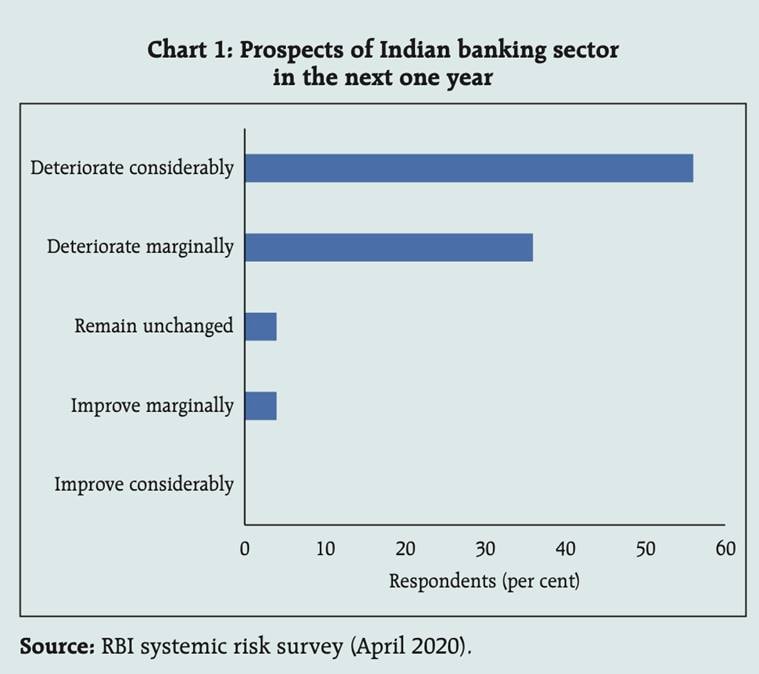
56% of the respondents opined that the prospects of Indian banking sector are going to deteriorate in next one year
According to the survey results, all major risk groups viz., global risks, risk perception on macroeconomic conditions, financial market risks and institutional positions were perceived as ‘high’ risks affecting the financial system.

A detailed rendering of the SRS explains why all the RBI Governors — past and present — have cautioned about a rise in NPAs in the economy.

Story continues below this ad

For instance, as Chart 1 shows, 56% of the respondents opined that the prospects of Indian banking sector are going to deteriorate considerably in the next one year.

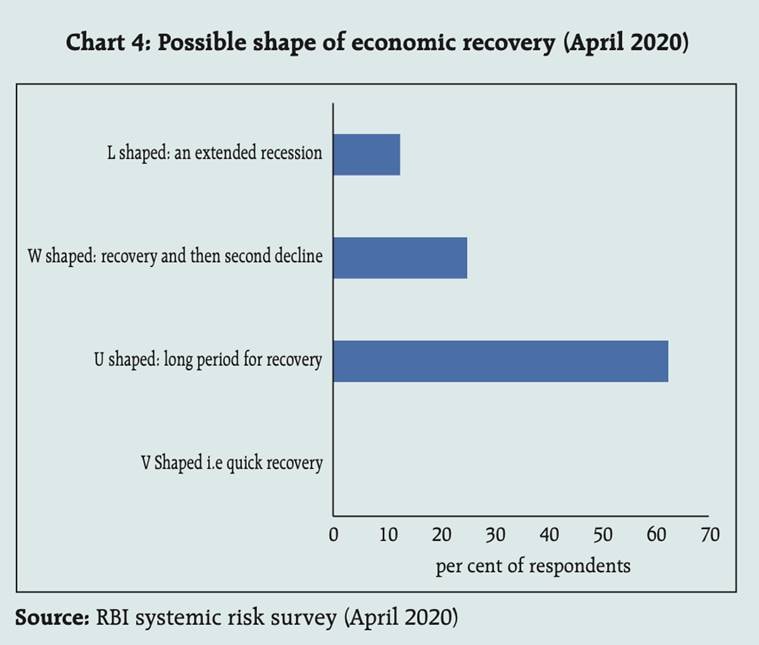
Absolutely no one expects a “V-shaped” economic recovery

A central reason for this is that absolutely no one expects a “V-shaped” economic recovery

Lastly, Table 1 alongside points to those sectors of the economy that are likely to be the worst affected by this downturn.

Where does all this leave the RBI?

Sectors of the economy that are likely to be the worst affected by this downturn

India’s central bank has much on its plate. Many have argued that the RBI’s autonomy and independence have been undermined in the past few years. Others question the wisdom in the RBI solely targeting retail inflation level. Shouldn’t the RBI be targeting growth or unemployment levels instead, they ask. Then, of course, there is the challenge of NPAs that simply refuses to go.

Story continues below this ad

Between August 2 to 4, the RBI’s Monetary Policy Committee will come together to answer some of these questions, albeit in their own way.

Till then, stay safe.

Udit

Udit Misra is Senior Associate Editor at The Indian Express. Misra has reported on the Indian economy and policy landscape for the past two decades. He holds a Master’s degree in Economics from the Delhi School of Economics and is a Chevening South Asia Journalism Fellow from the University of Westminster. Misra is known for explanatory journalism and is a trusted voice among readers not just for simplifying complex economic concepts but also making sense of economic news both in India and abroad. Professional Focus He writes three regular columns for the publication. ExplainSpeaking: A weekly explanatory column that answers the most important questions surrounding the economic and policy developments. GDP (Graphs, Data, Perspectives): Another weekly column that uses interesting charts and data to provide perspective on an issue dominating the news during the week. Book, Line & Thinker: A fortnightly column that for reviewing books, both new and old. Recent Notable Articles (Late 2025) His recent work focuses heavily on the weakening Indian Rupee, the global impact of U.S. economic policy under Donald Trump, and long-term domestic growth projections: Currency and Macroeconomics: "GDP: Anatomy of rupee weakness against the dollar" (Dec 19, 2025) — Investigating why the Rupee remains weak despite India's status as a fast-growing economy. "GDP: Amid the rupee's fall, how investors are shunning the Indian economy" (Dec 5, 2025). "Nobel Prize in Economic Sciences 2025: How the winners explained economic growth" (Oct 13, 2025). Global Geopolitics and Trade: "Has the US already lost to China? Trump's policies and the shifting global order" (Dec 8, 2025). "The Great Sanctions Hack: Why economic sanctions don't work the way we expect" (Nov 23, 2025) — Based on former RBI Governor Urjit Patel's new book. "ExplainSpeaking: How Trump's tariffs have run into an affordability crisis" (Nov 20, 2025). Domestic Policy and Data: "GDP: New labour codes and opportunity for India's weakest states" (Nov 28, 2025). "ExplainSpeaking | Piyush Goyal says India will be a $30 trillion economy in 25 years: Decoding the projections" (Oct 30, 2025) — A critical look at the feasibility of high-growth targets. "GDP: Examining latest GST collections, and where different states stand" (Nov 7, 2025). International Economic Comparisons: "GDP: What ails Germany, world's third-largest economy, and how it could grow" (Nov 14, 2025). "On the loss of Europe's competitive edge" (Oct 17, 2025). Signature Style Udit Misra is known his calm, data-driven, explanation-first economics journalism. He avoids ideological posturing, and writes with the aim of raising the standard of public discourse by providing readers with clarity and understanding of the ground realities. You can follow him on X (formerly Twitter) at @ieuditmisra           ... Read More


Latest Comment
Post Comment
Read Comments
Advertisement
Advertisement
Advertisement
Advertisement