Premium
This is an archive article published on January 29, 2022

Explained: The joy of Wordle, and the secret of its global appeal

What is Wordle, the viral sensation that has everyone from Trevor Noah to Richard Osman hooked to it? What makes it so popular?

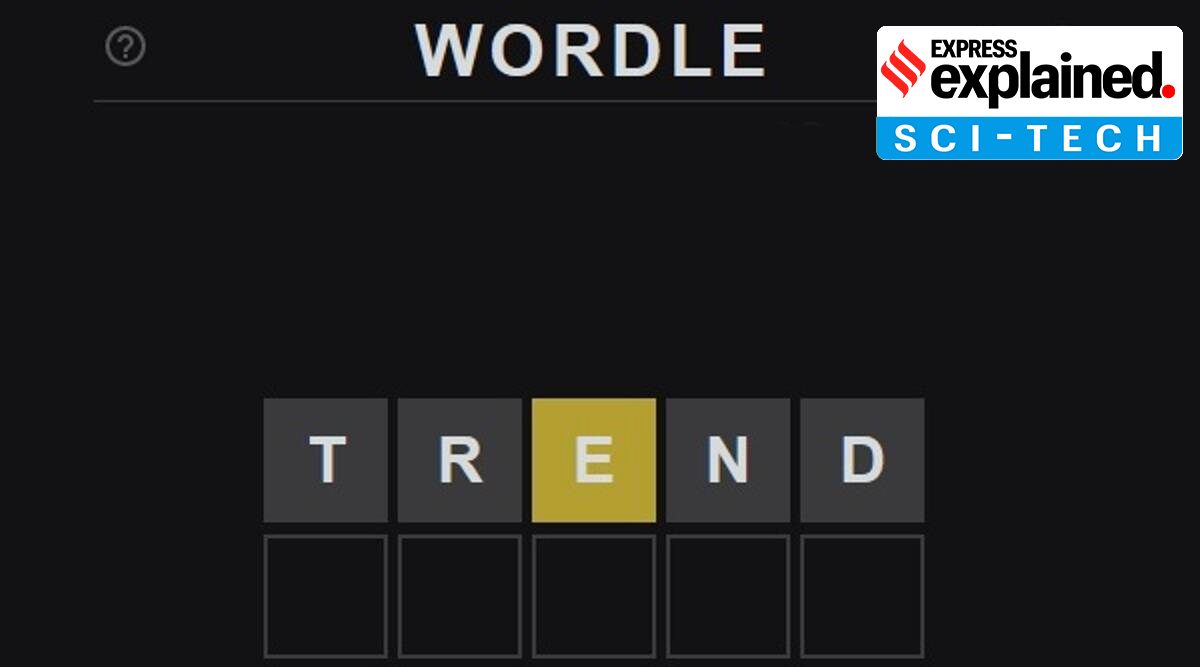
Wordle is an online word puzzle where players have to guess the five-letter word of the day within six tries. (Express Photo)Wordle is an online word puzzle where players have to guess the five-letter word of the day within six tries. (Express Photo)

Last week, word-game enthusiasts heaved a collective sigh of relief when Twitter announced the suspension of the bot @wordlinator that had been throwing a spanner in their Wordle aspirations.

After a software engineer with GitHub, Robert Reichel, reverse-engineered the algorithm to explain that the solutions to the wildly popular game’s puzzles are stored in the game’s source code, the bot had taken to using the formula to disruptive ends — every time a player announced his or her score on Twitter, it responded by giving away the next day’s solution.

Is it Scrabble? Is it Jumble? No, it’s Wordle

So what is Wordle, the viral sensation that has everyone from Trevor Noah to Richard Osman hooked to it?

Wordle is an online word puzzle where players have to guess the five-letter word of the day within six tries. When you log on to https://www.powerlanguage.co.uk/wordle/ the first time, a neat pop-up explains the rules of the game — when you guess a word, if the letters are in the right place — that is same as in the word of the day — the box turns green.

If the letter features in the word, but it is in the wrong place, the box will turn yellow. And if the letter doesn’t occur in the word at all, it will turn grey.

Unlike in a crossword, there are no clues. You are allowed six attempts, and your bragging rights depend on how quickly you can guess the word. The New York Times has likened it to the popular guessing game Mastermind.

Story continues below this ad

In a throwback to days that allowed you to take things slow and savour them at your own pace, there is only one puzzle available each day across the world. So, once you have finished it, you have to wait a day for the next one to appear.

What makes it so popular?

Wordle is accessed easily and for free on the Web, and does not require you to download an app on your phone. According to a recent report in the BBC, in the three months since it was launched, over 300,000 people — and counting — have been playing the game daily.

Since the beginning of this year, grids featuring grey, yellow, and green boxes have been proliferating on social-media accounts, with players showing off how few or how many attempts they have needed to complete the word of the day. Wordle has become an instant conversation starter, given how the grids come without spoilers, and only reveal your route to success or failure.

Story continues below this ad

The share option has spiralled the game’s popularity, since players can now display the results without giving the game away. In the repeated shut-ins caused by the ongoing pandemic, it has generated a sense of community among players. This is also the reason why @wordlinator was considered a killjoy for his spoilers.

Meet Wardle, the developer of Wordle

In October last year, Josh Wardle, a software engineer and former Reddit employee who was raised in the UK and is now based in the US, created Wordle — a pun on his surname — for his partner Palak Shah, a word-game enthusiast.

Soon, the game spilled over to his family, friends, and beyond. The launch of a “share” option in December 2021 turbocharged the game’s popularity.

In an interview with BBC Radio4’s Today programme earlier this month, Wardle said that his aim is to keep the game simple and ad-free: “I am a bit suspicious of mobile apps that demand your attention and send you push notifications to get more of your attention… I like the idea of doing the opposite of that — what about a game that deliberately doesn’t want much of your attention? … There are also no ads and I am not doing anything with your data — and that is also quite deliberate.”

Story continues below this ad

Wardle, who now works for the Brooklyn art collective Mschf, had earlier created a collaborative art project called ‘Place’ in 2017, and another popular game called ‘The Button’ in 2015, both for Reddit.

Happy hours: access the back issues

While the success of Wordle has created a number of spin-offs — and a few accusations of inspiration, too, including by the host of popular UK-based ’80s game show Lingo — all is not lost for those who are late to the brain-game fun fest. An intrepid fan has created an archive of Wordle’s past puzzles at https://www.devangthakkar.com/wordle_archive/. This means that in addition to the daily one, one can now work one’s way through the over 200 word puzzles at one’s own pace and leisure.

Newsletter | Click to get the day’s best explainers in your inbox

Paromita Chakrabarti is Senior Associate Editor at the  The Indian Express. She is a key member of the National Editorial and Opinion desk and  writes on books and literature, gender discourse, workplace policies and contemporary socio-cultural trends. Professional Profile With a career spanning over 20 years, her work is characterized by a "deep culture" approach—examining how literature, gender, and social policy intersect with contemporary life. Specialization: Books and publishing, gender discourse (specifically workplace dynamics), and modern socio-cultural trends. Editorial Role: She curates the literary coverage for the paper, overseeing reviews, author profiles, and long-form features on global literary awards. Recent Notable Articles (Late 2025) Her recent writing highlights a blend of literary expertise and sharp social commentary: 1. Literary Coverage & Nobel/Booker Awards "2025 Nobel Prize in Literature | Hungarian master of apocalypse" (Oct 10, 2025): An in-depth analysis of László Krasznahorkai’s win, exploring his themes of despair and grace. "Everything you need to know about the Booker Prize 2025" (Nov 10, 2025): A comprehensive guide to the history and top contenders of the year. "Katie Kitamura's Audition turns life into a stage" (Nov 8, 2025): A review of the novel’s exploration of self-recognition and performance. 2. Gender & Workplace Policy "Karnataka’s menstrual leave policy: The problem isn’t periods. It’s that workplaces are built for men" (Oct 13, 2025): A viral opinion piece arguing that modern workplace patterns are calibrated to male biology, making women's rights feel like "concessions." "Best of Both Sides: For women’s cricket, it’s 1978, not 1983" (Nov 7, 2025): A piece on how the yardstick of men's cricket cannot accurately measure the revolution in the women's game. 3. Social Trends & Childhood Crisis "The kids are not alright: An unprecedented crisis is brewing in schools and homes" (Nov 23, 2025): Writing as the Opinions Editor, she analyzed how rising competition and digital overload are overwhelming children. 4. Author Interviews & Profiles "Fame is another kind of loneliness: Kiran Desai on her Booker-shortlisted novel" (Sept 23, 2025): An interview regarding The Loneliness of Sonia and Sunny. "Once you’ve had a rocky and unsafe childhood, you can’t trust safety: Arundhati Roy" (Aug 30, 2025): A profile on Roy’s recent reflections on personal and political violence. Signature Beats Gender Lens: She frequently critiques the "borrowed terms" on which women navigate pregnancy, menstruation, and caregiving in the corporate world. Book Reviews: Her reviews often draw parallels between literature and other media, such as comparing Richard Osman’s The Impossible Fortune to the series Only Murders in the Building (Oct 25, 2025). ... Read More

 

Latest Comment
Post Comment
Read Comments
Advertisement
Loading Taboola...
Advertisement
Advertisement
Advertisement