Explained: Importance of Nobel winner Abdulrazak Gurnah’s writing on refugee experience
Most of Abdulrazak Gurnah's books feature African Arab protagonists trying to come to terms with dislocation and estrangement, looking in on societies and cultures on which their holds are tenuous.
Ahead of the declaration of this year’s Nobel Prize for Literature, the prestigious award — mired in controversy in recent years — was called out for its lack of inclusivity and recognition of women writers and writers of colour. On Thursday, Abdulrazak Gurnah, 72, who was born in Zanzibar and now lives in the UK, became the fifth African writer to win the Nobel Prize for Literature, after Nigerian writer Wole Soyinka (1986), Egyptian Naguib Mahfouz (1988), and South African writers Nadine Gordimer (1991) and John M Coetzee (2003).
In its citation, the Nobel committee lauded Gurnah’s “uncompromising and compassionate penetration of the effects of colonialism and the fate of the refugee in the gulf between cultures and continents.”
You’ve Read Your Free Stories For Now
Sign up and keep reading more stories that matter to you.
The author of 10 novels and several short stories and essays, including Memory of Departure (1987), Pilgrims Way (1988), Paradise (1994), By the Sea (2001), Desertion (2005), Gravel Heart (2017) and, most recently, Afterlives (2020), Gurnah’s writing explores the immigrant experience and how exile and loss shape identities and cultures.
Most of his books feature African Arab protagonists trying to come to terms with dislocation and estrangement, looking in on societies and cultures on which their holds are tenuous. For instance, Paradise, shortlisted for the Booker Prize, references British modernist writer Joseph Conrad’s Heart of Darkness (1902), as its protagonist Yusuf comes of age at a time of violent colonial expansion in East Africa in the late 19th century.
In most of his works, Gurnah eschews nostalgia and upends genre tropes to show the tension and insecurity latent in the constantly shifting sands of displacement. In By the Sea, another novel nominated for the Booker Prize, he explores the refugee’s struggle to both remember and to forget.
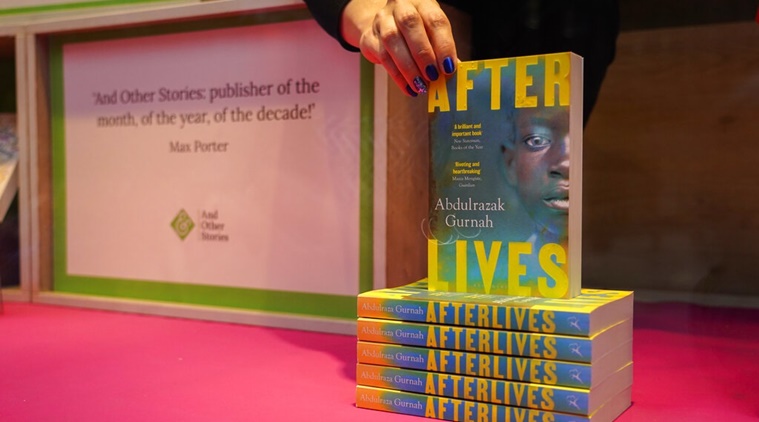
A member of staff displays a pile of copies of “Afterlives” by Zanzibar-born novelist Abdulrazak Gurnah in a book shop’s window in London. (AP)
“It is difficult to know with precision how things became as they have, to be able to say with some assurance that first it was this and it then led to that and the other, and now here we are. The moments slip through my fingers. Even as I recount them to myself, I can hear echoes of what I am suppressing, of something I’ve forgotten to remember, which then makes the telling so difficult when I don’t wish it to be,” says one of the narrators, Saleh, a Muslim man from Tanzania who seeks asylum in the UK with a forged visa in the name of his sworn enemy.
Story continues below this ad
In a twist of fate, the person delegated to help him settle down in the new country is that man’s son, and in their bitter, acerbic quarrels, the tension between the old world and the new takes shape.
Set in the early 20th century, before German rule over East Africa ended in 1919, Afterlives, Gurnah’s last work, takes off from the premise of Paradise and explores the fate of Hamza, an African Arab youth who is enlisted to fight for the Germans in World War I.
Gurnah was born in Zanzibar on the Indian Ocean in December 1948, when it was still ruled by the British. In 1963, as the archipelago gained independence, it would enter into a phase of civil unrest and internal strife between its Arab minority that was in power and the African majority. In 1964, the Zanzibar Revolution would see the overthrow of the constitutional monarch, Sultan Jamshid Bin Abdullah, and his predominantly Arab functionaries by African Left-leaning revolutionaries.
Story continues below this ad
In its bloody aftermath, as Zanzibar became the United Republic of Tanzania, Arabs and other minorities were ruthlessly persecuted, with some estimates putting the death toll to about 20,000.
Gurnah left the island in 1968 as an 18-year-old and moved to Britain, a refugee in search of a safe haven. He would be unable to return home and meet his family until 1984, when he would meet his father shortly before the latter died.
Even though Swahili is his mother tongue, when he began writing at 21, Gurnah gravitated towards English, the language of his education. He earned his PhD from the University of Kent, Canterbury, where he was the professor of English and Postcolonial Literature until his recent retirement. His academic work focused on post-colonial and diasporic literature, with particular emphasis, mentions the Nobel website, on writers such as Soyinka, Ngũgĩ wa Thiong’o and Salman Rushdie.
Tanzanian writer Abdulrazak Gurnah arrives back at his home in Canterbury. (AP)
In his writings and his interviews, Gurnah has spoken at length of having drawn inspiration from the cosmopolitan Zanzibar of his childhood, where a multitude of languages, religions and cultures thrived side by side, and which find expression through the smattering of Swahili, Arabic, Hindi and German that appear in his work.
Inspiration
Story continues below this ad
In his 2004 essay “Writing and Place”, Gurnah writes, “…at the time I left home, my ambitions were simple. It was a time of hardship and anxiety, of state terror and calculated humiliations, and at 18, all I wanted was to leave and find safety and fulfilment somewhere else. I could not have been more remote from the idea of writing. Starting to think differently about writing in England a few years later was to do with being older, thinking and worrying about things that had seemed uncomplicated before, but in a larger part it was to do with the overwhelming feeling of strangeness and difference I felt there.
There was something hesitant and groping about this process. It was not that I was aware of what was happening to me and decided to write about it. I began to write casually, in some anguish, without any sense of plan but pressed by the desire to say more. In time, I began to wonder what the thing was that I was doing, so I had to pause and deliberate. Then I realised I was writing from memory, and how vivid and overwhelming that memory was, how far from the strangely weightless existence of my first years in England.
That strangeness intensified the sense of a life left behind, of people casually and thoughtlessly abandoned, a place and a way of being lost to me for ever, as it seemed at the time. When I began to write, that lost life was what I wrote about, the lost place and what I remembered of it.”
Importance now
At a time when the global refugee crisis is exponentially on the rise, Gurnah’s work draws attention to how racism and prejudice against targeted communities and religions perpetuate cultures of oppression.
In his bio-bibliographical note, Anders Olsson, chairman of the Nobel Committee, The Swedish Academy, writes, “Gurnah’s dedication to truth and his aversion to simplification are striking. This can make him bleak and uncompromising, at the same time as he follows the fates of individuals with great compassion and unbending commitment.
His novels recoil from stereotypical descriptions and open our gaze to a culturally diversified East Africa unfamiliar to many in other parts of the world. In Gurnah’s literary universe, everything is shifting – memories, names, identities. This is probably because his project cannot reach completion in any definitive sense.”
Paromita Chakrabarti is Senior Associate Editor at the The Indian Express. She is a key member of the National Editorial and Opinion desk and writes on books and literature, gender discourse, workplace policies and contemporary socio-cultural trends.
Professional Profile
With a career spanning over 20 years, her work is characterized by a "deep culture" approach—examining how literature, gender, and social policy intersect with contemporary life.
Specialization: Books and publishing, gender discourse (specifically workplace dynamics), and modern socio-cultural trends.
Editorial Role: She curates the literary coverage for the paper, overseeing reviews, author profiles, and long-form features on global literary awards.
Recent Notable Articles (Late 2025)
Her recent writing highlights a blend of literary expertise and sharp social commentary:
1. Literary Coverage & Nobel/Booker Awards
"2025 Nobel Prize in Literature | Hungarian master of apocalypse" (Oct 10, 2025): An in-depth analysis of László Krasznahorkai’s win, exploring his themes of despair and grace.
"Everything you need to know about the Booker Prize 2025" (Nov 10, 2025): A comprehensive guide to the history and top contenders of the year.
"Katie Kitamura's Audition turns life into a stage" (Nov 8, 2025): A review of the novel’s exploration of self-recognition and performance.
2. Gender & Workplace Policy
"Karnataka’s menstrual leave policy: The problem isn’t periods. It’s that workplaces are built for men" (Oct 13, 2025): A viral opinion piece arguing that modern workplace patterns are calibrated to male biology, making women's rights feel like "concessions."
"Best of Both Sides: For women’s cricket, it’s 1978, not 1983" (Nov 7, 2025): A piece on how the yardstick of men's cricket cannot accurately measure the revolution in the women's game.
3. Social Trends & Childhood Crisis
"The kids are not alright: An unprecedented crisis is brewing in schools and homes" (Nov 23, 2025): Writing as the Opinions Editor, she analyzed how rising competition and digital overload are overwhelming children.
4. Author Interviews & Profiles
"Fame is another kind of loneliness: Kiran Desai on her Booker-shortlisted novel" (Sept 23, 2025): An interview regarding The Loneliness of Sonia and Sunny.
"Once you’ve had a rocky and unsafe childhood, you can’t trust safety: Arundhati Roy" (Aug 30, 2025): A profile on Roy’s recent reflections on personal and political violence.
Signature Beats
Gender Lens: She frequently critiques the "borrowed terms" on which women navigate pregnancy, menstruation, and caregiving in the corporate world.
Book Reviews: Her reviews often draw parallels between literature and other media, such as comparing Richard Osman’s The Impossible Fortune to the series Only Murders in the Building (Oct 25, 2025). ... Read More