The attached properties include land and a factory building at Dindigul District, Tamil Nadu, plant and machinery, vehicles, bank accounts and fixed deposits. Immovable and movable properties account for Rs 411.83 crore of these properties, and bank balances in 36 accounts for the remaining Rs 345.94 crore.

What is the ED case about?
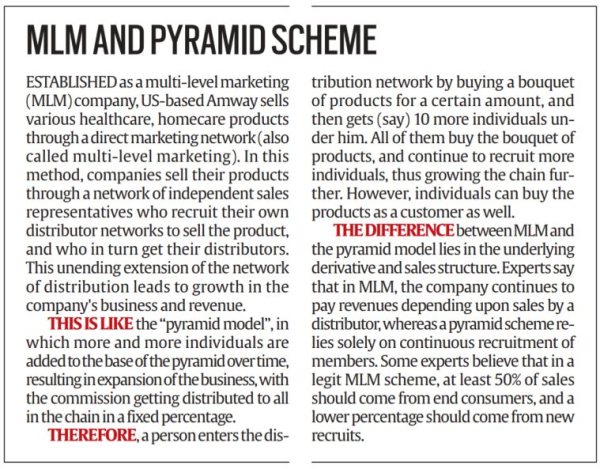
It is based on an FIR registered by Hyderabad police against the company under the Prize Chits and Money Circulation Schemes (Banning) Act. According to the ED, its probe has revealed that Amway is running a pyramid fraud in the guise of a direct selling multi-level marketing network.
“It is observed that the prices of most of the products offered by the company are exorbitant as compared to the alternative popular products of reputed manufacturers available in the open market. Without knowing the real facts, the common gullible public is induced to join as members of the company and purchase products at exorbitant prices and are thus losing their hard-earned money. The new members are not buying the products to use them, but to become rich by becoming members as showcased by the upline members,” the ED said in a statement. It said the commissions received by the “upline members” contribute enormously to the high prices of the products.
What is the magnitude of the alleged fraud?
The ED said Amway collected Rs 27,562 crore from its business operations from 2002-03 to 2021-22, out of which it paid commission of Rs 7,588 crore to its distributors and members in India and the US. “The entire focus of the company is about propagating how members can become rich by becoming members. There is no focus on the products.”
The ED said Amway brought Rs 21.39 crore as share capital in India in 1996-97, and remitted Rs 2,859.10 crore until 2020-21 in the name of dividend, royalty and other payments to investors and parent entities. “M/s Britt Worldwide India Private Limited and M/s Network Twenty One Private Limited also played a major role in promoting pyramid scheme of Amway by conducting seminars for joining members under the guise of sale of goods by enrolment of members…,” it said.
How long has Amway been under probe in India?
Between 2006 and 2014, the Andhra Pradesh Police filed several cases against Amway under the Prize Chits and Money Circulation Schemes (Banning) Act, 1978 and IPC Section 420 in cities including Hyderabad, Vijayawada, Kurnool, Warangal and Khammam. The FIRs were based on complaints from Amway associates who felt cheated, lawyers and activists, who alleged Amway of running a pyramid fraud and an illegal money laundering scheme in the name of MLM. The police shut down all corporate offices associated with Amway.
Story continues below this ad
One of the first complaints was filed in September 2006 by a Hyderabad-based businessman, A V S Satyanarayana, with the CID Police Station. He said two Amway distributors had approached and invited him to join the scheme by paying Rs 4,000 and enrolling more members, and he would earn commission quickly. In August 2005, he joined by paying Rs 5,200. He alleged that the scheme was a chain, where each member was asked to enrol more. The CID registered this case under IPC Sections 385 and 480.
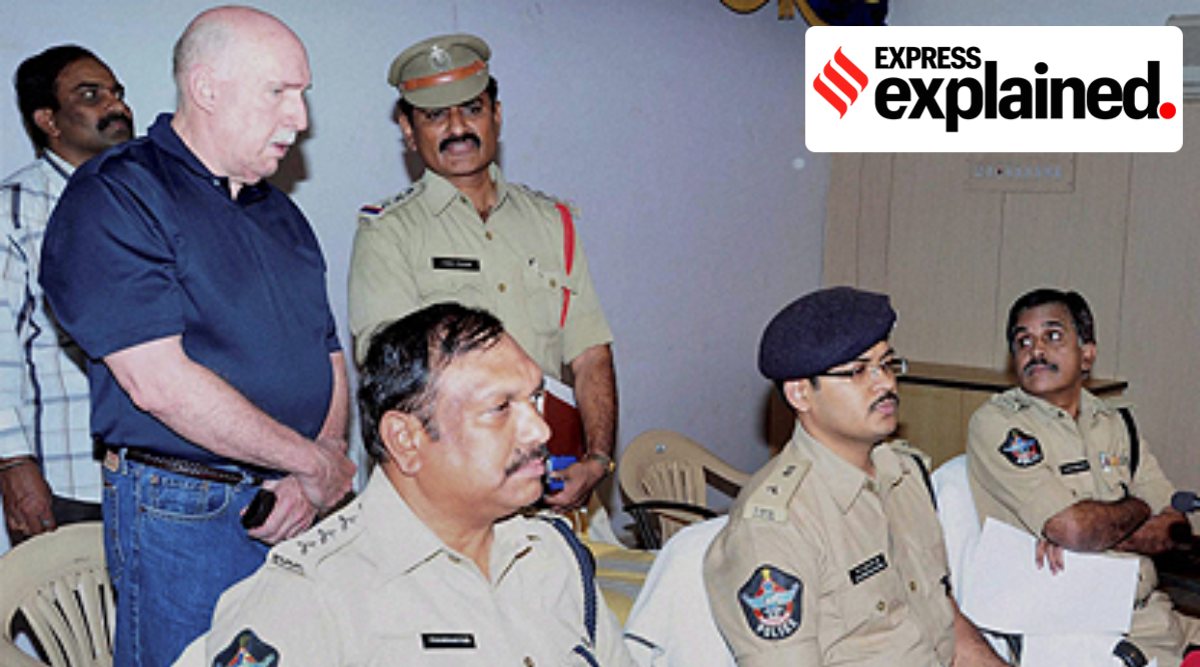
In May 2014, based on a complaint lodged at Kurnool, the Andhra Pradesh CID arrested Amway India chairman and CEO William S Pinckney from Gurgaon. He was subsequently taken into custody by Khammam Police too.
A year earlier, in May 2013, he had been arrested by Kerala Police based on a complaint in Wayanad, after which the Andhra CID took over all cases against him following a plea in the High Court.
In August 2011, Kerala Police had sealed offices of Amway at Kozhikode, Kannur, Kochi, Kottayam, Thrissur, Kollam and Thiruvananthapuram. In November 2012, the Economic Offences Wing of Kerala Police conducted searches at Amway offices, seized products valued at Rs 2.14 crore and arrested some officials. On June 8, 2013, a Kozhikode court lifted the freeze on Amway offices in Kerala.
Story continues below this ad
In 2017, a Chandigarh court framed charges under IPC Section 420 and the Prize Chits and Money Circulation Scheme (Banning) Act, against two directors of Amway India — Pinckney and Prithvai Raj Bijlani. This was based on a cheating case filed by eight complainants in 2002. A revision plea by the two was dismissed in 2018.
Has it faced such allegations abroad?
On November 3, 2010, Amway announced it had agreed to pay $56 million — $34 million in cash and $22 million in products — to settle a class action filed in Federal District Court in California in 2007. The class action alleged fraud, racketeering, and that the defendants operated as an illegal pyramid scheme.
Amway, while noting that the settlement is not an admission of wrongdoing or liability, acknowledged it had made changes to its business operations as a result of the lawsuit. The economic value of the settlement, including the changes Amway made to its business model, totals $100 million.
A 2009 class action case lodged in Canada was rejected by the Federal Court. Following an appeal, the Federal Court of Appeal directed the costs awarded to arbitration.
Story continues below this ad
Newsletter | Click to get the day’s best explainers in your inbox


 6 min read