Premium
This is an archive article published on January 25, 2022

Covid-19 pandemic now in community transmission stage in India: what does this mean?

India has acknowledged that the Covid-19 pandemic is now in the community transmission stage. How is this stage defined, and what are its implications? What changes in strategies to contain the spread?

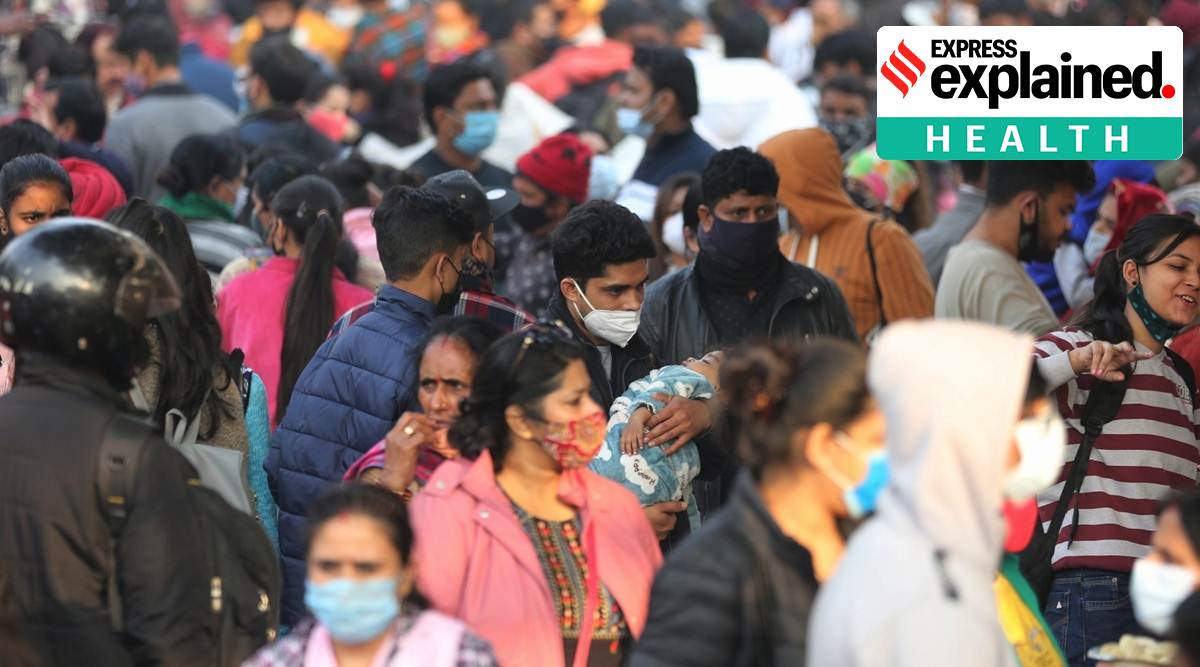
Covid-19, Community spread, Omicron, Community explained, India news, Indian express, Indian express news, current affairs, Indian express explainedA crowd in New Delhi's Sarojini Nagar market last month, by when the Omicron variant of the coronavirus was already spreading. (Express Photo: Tashi Tobgyal)

In the third wave of the coronavirus epidemic, India has acknowledged that the disease is now in the community transmission stage. While it is no more than a statement of the obvious, and has little operational implication at this stage of the epidemic, this acknowledgment has attracted attention because this is the first time India has officially done so.

What it means

In all regions except the origin of the outbreak, the virus is introduced into the population by travellers. In the initial stages of an epidemic, all further transmissions of the disease can be linked, directly or through a chain, to these travellers. But after some time, as more and more people get infected, they pass on the virus to many more, several of whom are never detected because they might be asymptomatic or did not get tested. But even these undetected cases would have transmitted the disease to others. Very soon, it results in a situation where the chain of infections can no longer be traced to the original travellers, and most of the infections become locally acquired. It is this stage of the epidemic that is classified as one of community transmission.

In simple terms, it is a stage where it becomes difficult to establish the chain of infections, or determine who infected whom. This has implications for deciding containment strategies and response measures to deal with the epidemic.

Community transmission is the final stage of classification of the epidemic on this basis. The World Health Organization (WHO) has three more classifications ahead of community transmission — no active cases, sporadic cases and cluster of cases. If no new cases are detected in 28 days, a country or region is said to have no new active cases. A situation where all the known infections in the previous two weeks can be linked to an imported case is classified as being in the second category.

India had so far been maintaining that the epidemic in the country was in the stage where it was witnessing a cluster of cases. According to the WHO classification, this is the stage where cases detected in the previous two weeks are “predominantly limited to well-defined clusters that are not directly linked to imported cases, but which are all linked by time, geographic location and common exposures”. It is assumed that there are a large number of unidentified cases, but this is still considered a low-risk situation.

The manner in which the transmissions are happening is key to deciding actions to be taken to contain further spread of the disease. In the initial stage for example, when only sporadic cases are detected, aggressive testing and contact tracing is supposed to be among the most effective strategies to halt or slow down the spread of the disease. As all direct contacts of an infected person are identified, tested and isolated, the number of virus-carrying people in the population gets reduced significantly, and so does the number of transmissions.

However, such a strategy might not yield much in terms of slowing down the spread in the community transmission stage. In such a situation, it is considered more beneficial to focus attention on measures like hospital management, access to critical care facilities or genomic surveillance.

Story continues below this ad

Current situation

The recent acknowledgment, made in the latest bulletins released by INSACOG, a network of laboratories that is tasked with genome surveillance, does not reveal anything new. India is known to have entered the community transmission phase within a couple of months of the start of the pandemic in 2020 itself.

From the speed at which the Omicron variant has spread, there never was any doubt that community transmission was taking place. Even before Omicron, India was detecting only one of about 30 infections. Now, this ratio would have shot up even further. At this stage of the epidemic, a discussion on community transmission is largely an academic one, and is unlikely to trigger any change in the kind of response measures that are being taken at the central, state or local levels.

Looking ahead

Story continues below this ad

Since the current wave is producing mostly mild disease, experts argue that a containment strategy might not yield much, especially since the infection was spreading at such a fast rate, and mainly through asymptomatic cases. Instead, it would be better to focus attention on surveillance, with the objective of keeping an eye on future dangerous mutations.

“We should change the strategy of sample collection for genome sequencing. There is no point in focusing on airports. A close watch should, instead, be kept on clinical samples from the ICU or those with serious symptoms to check if there is further mutation of the SARS-CoV-2 virus and whether it is changing a bit. There is a need to keep an eye on clusters at localities or parties or any gathering in case there is a sudden eruption of cases and also ensure a randomised sampling in large areas,” said Rakesh Mishra, former director of Centre for Cellular and Molecular Biology.

Implications

Mishra said testing and tracking contacts could not prevent the further spread of the Omicron variant at this stage, even though it was still important to test as many as possible. “But the main focus must be on the hospitalised cases, and those who have developed severe illnesses,” said Mishra, who is director of Tata Institute of Genetics and Society.

Several states have already changed their testing strategy and have not been aggressively doing contact tracing, especially those who are not showing symptoms.

Story continues below this ad

Dr Shashank Joshi, member of Maharashtra’s Covid-19 task force, said the focus must be on saving lives, because such a large number of cases can overwhelm hospitals. “What is known from the current wave is that it has come in a very explosive and tsunami-like proportion. It is more like a cyclone and not a wave. As 80-90% people are asymptomatic, our focus is directed on symptomatic patients. Those who are unvaccinated, or only partially vaccinated, are in the high-risk category. And so are people with chronic underlying diseases like cancer, heart transplantation or lung disease. The focus clearly is to save lives and ensure health systems are prepared,” Dr Joshi said.

Maharashtra surveillance officer Dr Pradeep Awate said health authorities were no longer tracking every contact of an infected person. “We are already moving on to the endemic stage. Genomic sequencing however will be necessary as Omicron may not be the last variant,” he said.

Newsletter | Click to get the day’s best explainers in your inbox

Anuradha Mascarenhas is a Senior Editor at The Indian Express, based in Pune. With a career spanning three decades, she is one of the most respected voices in Indian journalism regarding healthcare, science and environment and research developments. She also takes a keen interest in covering women's issues . Professional Background Education: A gold medalist in Communication and Journalism from Savitribai Phule Pune University and a Master’s degree in Literature. Author: She authored the biography At The Wheel Of Research, which chronicles the life and work of Dr. Soumya Swaminathan, the former Chief Scientist at the WHO. Key Focus: She combines scientific accuracy with storytelling, translating complex medical research into compelling public and human-interest narratives. Awards and Recognition Anuradha has won several awards including the Press Council of India's national award for excellence in journalism under the gender based reporting category in 2019 and the Laadli Media award (gender sensitivity -2024). A recipient of the Lokmat journalism award (gender category-2022), she was also shortlisted for the RedInk awards for excellence in journalism-2021. Her debut book At The Wheel Of Research, an exclusive biography of Dr Soumya Swaminathan the inaugural chief scientist of World Health Organisation was also nominated in the Popular Choice Category of JK Paper AUTHER awards. She has also secured competitive fellowships including the Laadli Media Fellowship (2022), the Survivors Against TB – New Research in TB Media Fellowship (2023) and is part of the prestigious 2025 India Cohort of the WomenLift Health Leadership Journey.” Recent Notable Articles (Late 2025) 1. Cancer & Specialized Medical Care "Tata Memorial finds way to kill drug-resistant cancer cells" (Nov 26, 2025): Reporting on a breakthrough for triple-negative breast cancer, one of the most aggressive forms of the disease. Discipline, diet and purpose; How a 97-year-old professor defies ageing'' (Nov 15, 2025) Report about Prof Gururaj Mutalik, the first Head of Department at Pune's B J Government Medical College who at 97 credits his longevity to healthy habits and a strong sense of purpose. 2. Environmental Health (The "Breathless Pune" Series) Long-term exposure even to 'moderate' air leads to chronic heart, lung, kidney issues" (Nov 26, 2025): Part of an investigative series highlighting that even "safe" pollution levels are damaging to vital organs. "For every 10 µg/m3 increase in PM2.5 level, there was 6-8% jump in medicine sales" (Nov 23, 2025): Using commercial data to prove the direct link between air quality and respiratory illnesses in Pune. 3. Lifestyle & Wellness News "They didn't let cancer, diabetes and heart disease stop them from travelling" (Dec 22, 2025): A collaborative piece featuring survivors who share practical tips for traveling with chronic conditions. At 17, his BP shot up to 200/120 mmHG; Lancet study flags why child and teen hypertension doubled between 2000 and 2020'' (Nov 12,2025)--A report that focusses on 17-year-old-boy's hypertensive crisis and reflects the rising global trend of high blood pressure among children and adolescents. 4. Scientific Recognition & Infrastructure For promoting sci-comm, gender diversity: IUCAA woman prof highlighted in Nature" (Nov 25, 2025): Covering the global recognition of Indian women scientists in gender studies and physics. Pune researchers find a spiral galaxy like the Milky Way from early universe'' (December 3, 2025)- A report on how Indian researchers discovered a massive galaxy that existed when the universe was just 1.5 billion years old , one of the earliest to have been observed so far. Signature Beat: Health, Science & Women in Leadership Anuradha is known for her COVID-19 reportage, where she was one of the first journalists to provide detailed insights into the Covishield and Covaxin trials. She has a dedicated interest in gender diversity in health and science, often profiling women researchers who are breaking the "leaky pipeline" in STEM fields. Her writing style is scrupulous, often featuring interviews with top-tier scientists and health experts from various institutions.   ... Read More


Latest Comment
Post Comment
Read Comments
Advertisement
Advertisement
Advertisement
Advertisement