5 min read
© The Indian Express Pvt Ltd



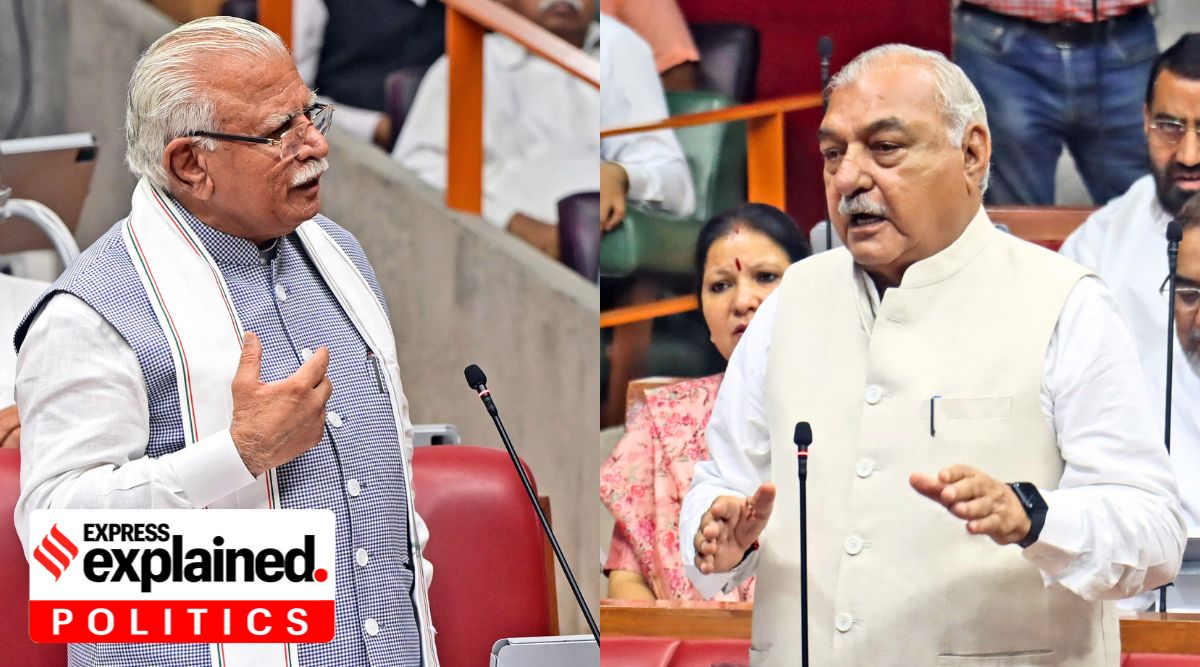 LOP and former CM Bhupinder Singh Hooda (R) and CM Manohar Lal Khattar (L) during the Monsoon session Haryana Vidhan Sabha in Chandigarh on Tuesday, August 29, 2023. (Express Photos by Jasbir Malhi)
 Haryana’s Leader of Opposition Bhupinder Singh Hooda has announced that if the Congress comes to power in the state elections next year, it will scrap the current government’s flagship Parivar Pehchan Patra (PPP) scheme.
In the recently concluded monsoon session of the Vidhan Sabha, the Opposition raised strong objections against the PPP, terming it the ‘Permanent Pareshani Patra (permanent inconvenience document)’.
The PPP was introduced in 2020 and implemented in September 2021. The Opposition has criticised it stridently, alleging discrepancies in the data collection and flagging privacy concerns.
What is the Parivar Pehchan Patra, how is the scheme being implemented, and why has it faced criticism?
Under the PPP, a unique eight-digit Identity number is issued to each family as a single unit. Any family residing in Haryana is required to enroll in the PPP to avail various government services and social security schemes.
Currently, the PPP ID can be made through three channels — Common Service Centers managed by Village Level Entrepreneurs, SARAL Kendras managed by the state government, and through PPP operators registered for data collection. The data for a family is collected on the basis of a signed self-declaration made by an adult member. Each data field is then separately verified through customised and defined procedures.
Linked to it is the delivery of various public welfare schemes, such as subsidised rations to Below Poverty Line households, Old Age Samman Allowance, Divyang Pension, Mukhyamantri Vivah Shagun Yojana, Mukhyamantri Antyodyay Parivar Utthan Yojana, admissions to educational institutions, government recruitment examinations, Scheduled Caste certificates, compensation to farmers, etc.
What data does the PPP collect?
Besides the family members’ names, the PPP collects Aadhaar numbers, age, house number, street number, PIN Code, district, block/town, ward/ village, gender, date of birth, proof of date of birth, email, place of birth, mobile number, voter ID card, occupation, bank account number, IFSC code, for how long has one lived at a particular place, annual income, complete details of immovable property owned by each member of the family, marital status, caste, educational qualification, etc. It also asks if the individual has a PAN card, is an Income Tax payee, a freedom fighter, a government employee, a BPL card holder, divyang, etc.
How is the PPP different from the Aadhaar card?
Chief Minister Manohar Lal Khattar had said in the Assembly that “PPP draws from the digital infrastructure and principles created by Aadhar. However, it is many times more complicated than Aadhar in its delivery. Aadhar primarily keeps unique identity information, whereas PPP goes far beyond to maintain socio-economic information besides the unique identity information.”
The CM also said that Aadhar does not verify any data except identity, but the PPP verifies “every information field available with it through specific procedures.”
What are the Opposition’s objections?
Former CM Bhupinder Singh Hooda said glitches in data collection had led to people missing out on government subsidies and benefits.
“It is just a Permanent Pareshani Patra. The agencies used by the government to collect people’s data are filling in erroneous data. Based on the wrong information, people are losing their social security benefits. People are running from pillar to post to get their information corrected. This government is solely dependent on portals and is losing connect with the people,” Hooda said.
Congress’ senior legislator BB Batra listed detailed objections to the scheme, while also alleging that the government was using the data for voter profiling.
“There are 25 columns one has to fill to get a PPP card. The very first column is Aadhaar, which is mandatory. A nine-judge Supreme Court judgement dated August 24, 2017, said Aadhaar card is not mandatory. The judgement said the right to privacy is a fundamental right. How can the state then ask for my Aadhaar number? Another column asks for caste. Social security benefits are given from the Consolidated Fund of the State, and don’t require the beneficiary’s caste. If the government wants a caste census, it should be done as per proper legal procedures and should be a public document,” Batra said.
“Then they [the government] ask for the PAN card, bank account number, property details etc. Why should the government be asking all these personal details? The real purpose of the BJP government is to collect caste-based data and socio-economic profile of the people, and then use it to their benefit in the upcoming elections,” he added.