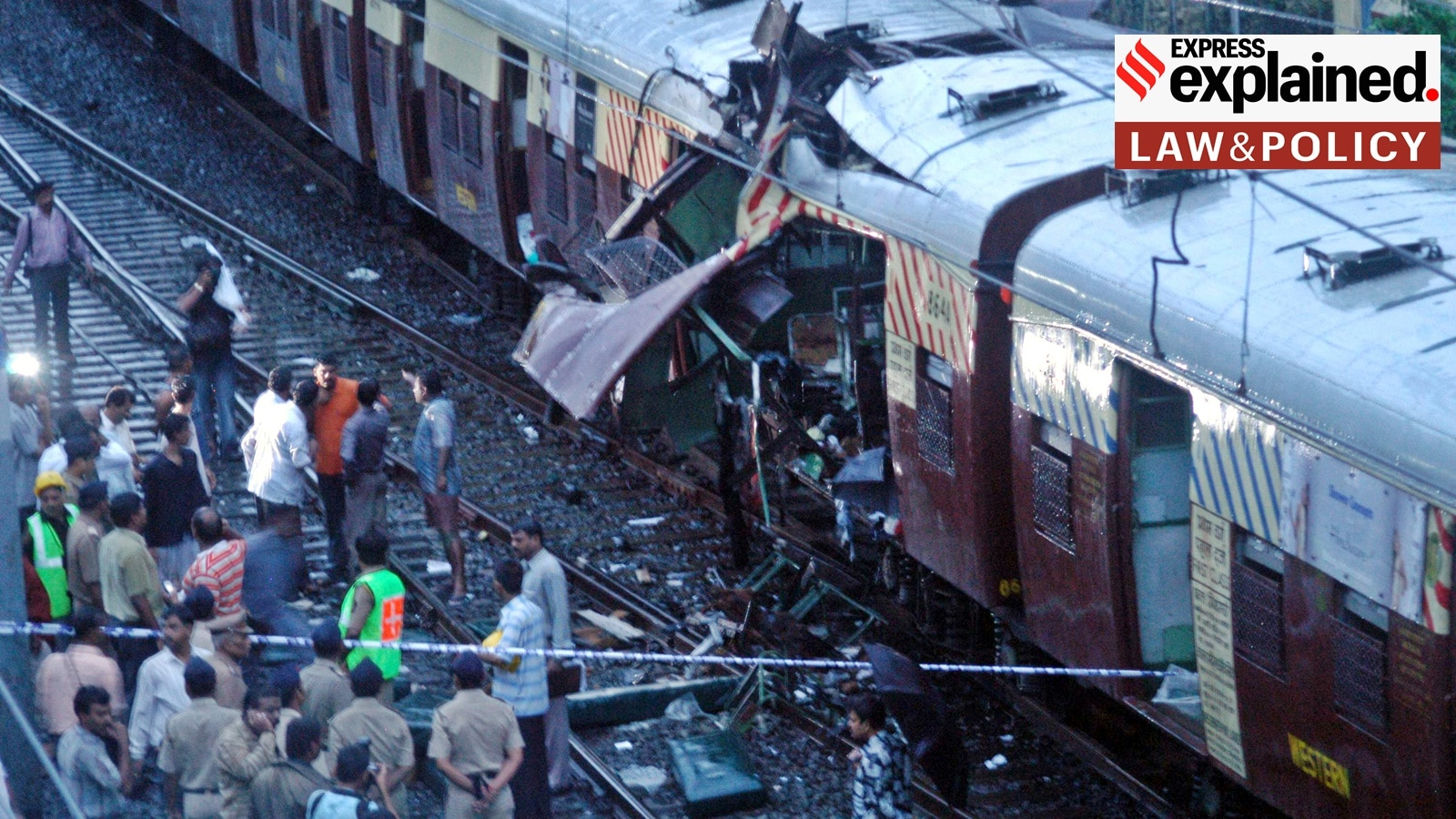
More than nine years after a special court convicted the accused in the 2006 Mumbai train blasts case, the Bombay High Court on Friday (January 31) concluded hearings concerning the death sentences awarded in the case.

What is the 2006 Mumbai train blast case?
On July 11, 2006, a series of bombs ripped through seven Western Suburban Railway or Mumbai local train coaches, killing 189 people and injuring 824. The case was investigated by the Maharashtra Anti-Terrorism Squad (ATS) of the state police.
Following an eight-year-long trial, a designated special court under the Maharashtra Control of Organised Crimes Act (MCOCA) awarded death sentences to five of the 13 convicts on September 30, 2015. Seven others were given life imprisonment while one was acquitted.
The five death row convicts found guilty of planting the bombs were Kamal Ansari, Mohammad Faisal Ataur Rahman Shaikh, Ehtesham Qutubuddin Siddiqui, Naveed Hussain Khan and Asif Khan. They were convicted under the MCOCA provisions of murder, criminal conspiracy and spreading terror.
The seven convicts sentenced to life term were Tanveer Ahmed Mohammed Ibrahim Ansari, Mohammed Majid Mohammed Shafi, Shaikh Mohammed Ali Alam Shaikh, Mohammed Sajid Margub Ansari, Muzammil Ataur Rahman Shaikh, Suhail Mehmood Shaikh and Zameer Ahmed Latiur Rehman Shaikh. The special court acquitted Wahid Shaikh after he spent nine years in jail.
Why are High Courts required to confirm death penalty sentences?
Death sentence or capital punishment is the highest penalty given to an individual when the court finds the case falls under the “rarest of the rare” category.
Story continues below this ad
As per section 366 of the Criminal Procedure Code (CrPC), a death sentence passed by a sessions court must be submitted to the High Court. The death penalty cannot be executed unless the court confirms the sentencing. The High Courts are required to dispose of confirmation pleas expeditiously. Under the Bharatiya Nagarik Suraksha Sanhita (BNSS), 2023, that replaced the CrPC, Section 407 states the same.
Why did it take over nine years for the HC to conclude hearings?
Soon after the trial court verdict, the Maharashtra government in October 2015 filed pleas in the Bombay High Court, seeking confirmation of the death sentences. The five men then filed appeals against their convictions. Those awarded life imprisonment also challenged the verdict.
When the matter first came up before the HC in January 2019, the bench observed that an intimation was issued by the Nagpur Jail Superintendent to the convicts in October 2015, seeking their response if they intended to file an appeal against the special court judgment. However, the pendency of their death confirmation pleas was not mentioned. Therefore, the HC directed that fresh notices be served to the convicts, following which they filed appeals.
Story continues below this ad
Several other events further added to the delay. In January 2022, the prosecution submitted that the matter could not be heard by a bench consisting of Justice P K Chavan as its member. Then in November of that year, Justice A S Gadkari, who presided over the division bench, recused himself from hearing the pleas.
On July 11, 2022, a bench led by Justice R D Dhanuka adjourned hearing the pleas as the bench assigned to the matter was “overburdened with work”.
While the confirmation pleas earlier came up before three benches, including former judges Justices Naresh Patil, B P Dharmadhikari and S S Jadhav, the hearings could not happen since the judges were due to retire.
On September 6, 2023, Justice Nitin W Sambre-led bench pulled up the state government for “lack of seriousness” in conducting the proceedings, after they were informed that the government was yet to appoint a special public prosecutor (SPP). The bench expressed displeasure that time and again the pleas had to be adjourned for the state’s “default” in taking positive steps to appoint the SPP.
Story continues below this ad
Summoning the Additional Chief Secretary of the Home Department, it warned the government that if the SPP had to be appointed in two days. Senior advocate Raja Thakare was thus appointed as SPP on September 8.
While the Justice Sambre-led bench heard the pleas till December 2023, the matters were listed before another bench due to his transfer to the Nagpur bench of HC. They were not taken up for another few months until one of the accused sought early disposal of the matter through a special bench.
How did special bench hearings proceed?
In July 2024, a special bench of Justices Anil S Kilor and Shyam C Chandak was formed to hear the pleas at length. It conducted regular hearings over the next six months through more than 75 sittings. The case files include 92 prosecution witnesses and more than 50 defence witnesses. Evidence in the case ran over 169 volumes and the death sentence judgments come close to 2,000 pages.
The defence lawyers representing the convicts sought the special court verdict to be set aside and claimed that the investigating agency obtained confessions through torture, resulting in the accused being in jail for over 18 years under a “false” case. The state government argued that it had sufficient evidence against the convicts and that the death punishment be confirmed as the case fell in the “rarest of the rare” category.
Story continues below this ad
After noting the evidence on record, the bench will give its verdict on confirmation pleas and appeals in due course. The aggrieved parties will have an opportunity to approach the Supreme Court if they want to challenge the same.


 6 min read