3 min read
© The Indian Express Pvt Ltd



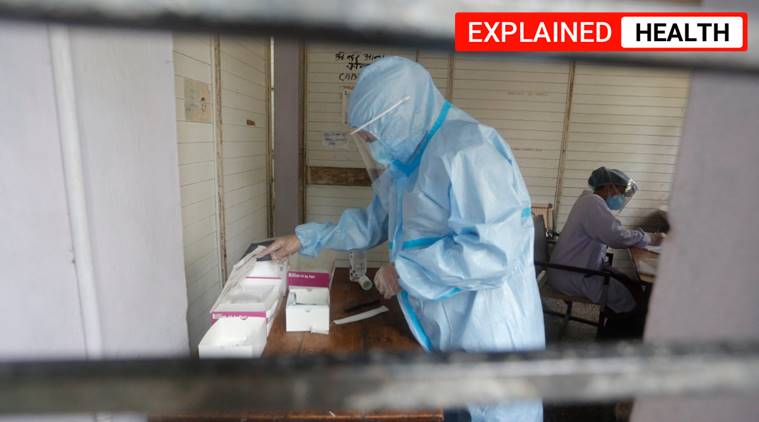 A health worker conducts Covid-19 rapid antigen tests in New Delhi, Saturday, July 11, 2020. (Express Photo: Amit Mehra)
Scientists in Germany have reported a novel method for detecting SARS-CoV-2. Using mass spectrometry on gargle solutions of Covid-19 patients, pharmacists at Martin Luther University Halle-Wittenberg (MLU) succeeded in detecting small amounts of the coronavirus.
The novel method is currently undergoing improvements; initial results have been published in the Journal of Proteome Research.
The researchers suggests the method might supplement conventional tests, and be available as standard diagnostic tool for Covid-19 in the future.
Mass spectrometry allows molecules to be precisely identified based on their mass and charge.
Professor Andrea Sinz, a mass spectrometry expert at the Institute of Pharmacy at MLU, and her colleagues developed a method to look for components of SARS-CoV-2 viruses. They measured the proteins of the virus, not the genetic material.
The experiments were done on gargle solutions of three Covid-19 patients. The research group developed a method to detect virus components in these highly diluted samples.
The test is highly specific for the virus since the corresponding proteins are only present in SARS-CoV-2. In addition, the test can be used in the early stages of the disease when many viruses are present in the mouth and throat.
📢 Express Explained is now on Telegram. Click here to join our channel (@ieexplained) and stay updated with the latest
The test currently takes about 15 minutes. The research group is now trying to further reduce the analysis time using artificially produced virus components. The novel diagnostic method relying on mass spectrometry will, however, not be available immediately.
Sinz said in a statement: “I am in close contact with colleagues worldwide, some of whom have had a far worse experience of the pandemic than we have.” She is also a founding member of the COVID-19 Mass Spectrometry Coalition, a research association that relies on mass spectrometry for a better understanding of the disease.
Source: Martin Luther University Halle-Wittenberg