2 min read
© The Indian Express (P) Ltd



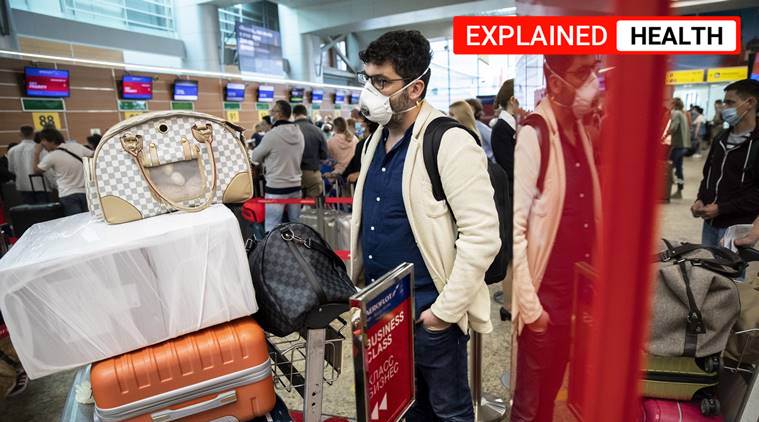 A man wearing face mask to protect against coronavirus waits in line to check-in at Sheremetyevo international airport, outside Moscow, Russia, Saturday, Aug. 1, 2020. (AP Photo/Pavel Golovkin)
Amid concerns about possible aerosol transmission of Covid-19, a new study has stressed the importance of a better understanding of different droplet behaviours, and their different dispersion mechanisms based on size.
The study, in the American Institute of Physics journal Physics of Fluids, presents a mathematical model that clearly demarcates small-, intermediate- and large-sized droplets. Simple formulas can be used to determine a droplet’s maximum range.
The researchers said Covid-19 has revealed gaps in knowledge about the physics of transmission, including a simple description of where individual droplets go when ejected.
As a person breathes, they emit droplets of various sizes that don’t necessarily follow the airflow faithfully.
The researchers said the study provides a general framework to understand the droplet dispersion. They provide formulas to predict when droplets will have short ranges.
Source: American Institute of Physics