4 min read


© The Indian Express Pvt Ltd



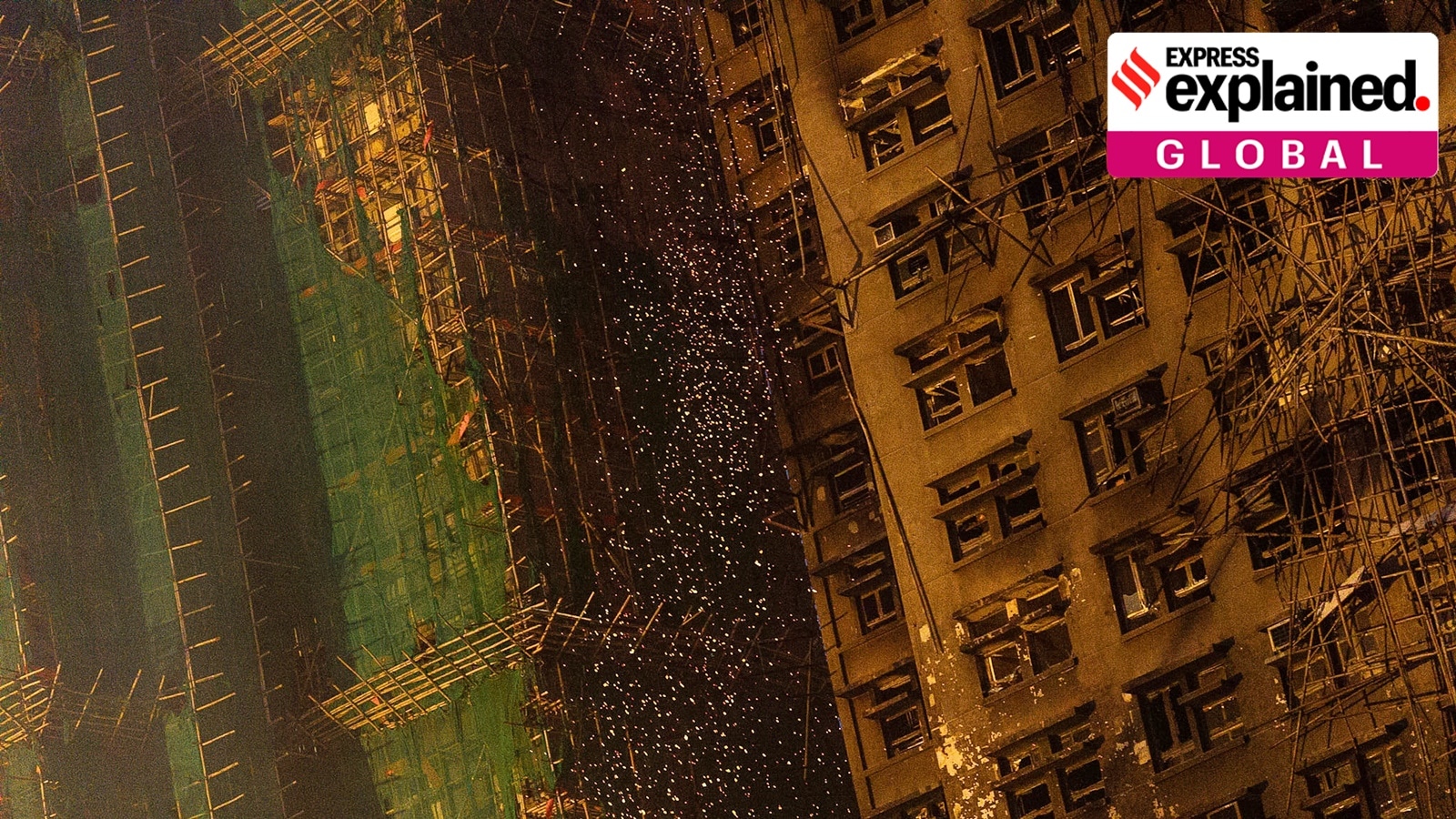 Fire sparks coming off from the burned building at the fire scene at Wang Fuk Court in Hong Kong on Thursday, Nov. 27. Bamboo scaffolding can be spotted. (AP Photo/Chan Long Hei)
Hong Kong Apartment Fire Explained: A fire that broke out at the Wang Fuk Court building complex in the Tai Po region of Hong Kong on Wednesday afternoon (November 26) led to over 90 deaths as of Friday, with several others still reported missing.
The fire was the worst in Hong Kong in terms of casualties in around 30 years. The complex was undergoing renovations when construction materials and bamboo scaffolding (temporary support structures for workers) caught fire, according to the Associated Press.
Officials are investigating the reasons for the fire incident, but several aggravating factors are believed to have aided the spread of the blaze. One such component, cited in several media reports, is the bamboo scaffolding that has been used for construction activity in Hong Kong and mainland China for hundreds of years.
In a 2012 paper published by a University of Hong Kong researcher named Frankie Lee Hong La, it was noted that “Bamboo scaffolding was drawn into Hong Kong from China in 1930s and was in vogue in the 1960s and 70s.” Unlike most Western and Asian nations that switched to metal scaffolding over time, bamboo remains in use in Hong Kong, the paper said.
The material’s popular usage in construction was a result of increased labour supply, thanks to migration from mainland China, growth in the construction of high-rise buildings and public housing in the ’60s, and the easy availability of the locally sourced, sturdy and lightweight plant. It is also more environmentally friendly.
Today, the government issues specific guidelines on the kind of bamboo scaffolding to be used and how. For instance, they mention two ideal varieties of the plant, which are “3 to 5 years old and air-dried in vertical positions under indoor condition for at least 3 months before use.” They further mandate certain safety requirements and qualifications for the workmen.
Ehsan Noroozinejad, a Senior Researcher at the Urban Transformations Research Centre, Western Sydney University, wrote in The Conversation that fire is a major risk factor for bamboo scaffolding.
“Dry bamboo is combustible, and the green plastic mesh often draped over scaffolds can also quickly burn. In the Tai Po fire, footage and reports indicate the fire quickly raced up the scaffolding and mesh, and across the facade of the buildings. This is why there are calls for non-combustible temporary works on occupied towers – or at minimum, flame-retardant nets, treated bamboo, and breaks in the scaffold so fire can’t easily jump from bay to bay,” he wrote.
Notably, the official guidelines state that the protective screens used to cover the façade of the buildings undergoing construction or renovation should have fire-retardant properties.
An official memo earlier this year also ordered a shift towards metal scaffolding, stating that “Bamboo scaffolds have the advantages of being flexible, efficient and economical, (but) they have their intrinsic weaknesses such as variation in mechanical properties, deterioration over time and high combustibility, etc., giving rise to safety concerns.”
Calls for ending the use of bamboo have been made from time to time. According to a CNN report, data from the Labour Department showed 24 deaths related to bamboo scaffolding from January 2018 to August 2025. However, proponents argued that accidents are still rare and consider the technique as a part of the city’s culture and history.
Noroozinejad wrote, “The lesson from Hong Kong is not that bamboo is “good” or “bad” for scaffolding – it’s about context. It has clear advantages for small-scale, short-duration, ground-anchored work where streets are tight and budgets are lean. But on tall, occupied residential blocks, especially with mesh-wrapped facades, its fire risk and variability demand much stronger controls.”
He added, “Bamboo scaffolding helped build Hong Kong’s skyline because it was fast, clever and affordable. The science behind fire and the realities of high-rise living now demand a tighter line: use the right tool for the job, and when the risks climb, switch to non-combustible systems.”