4 min read

Journalism of Courage



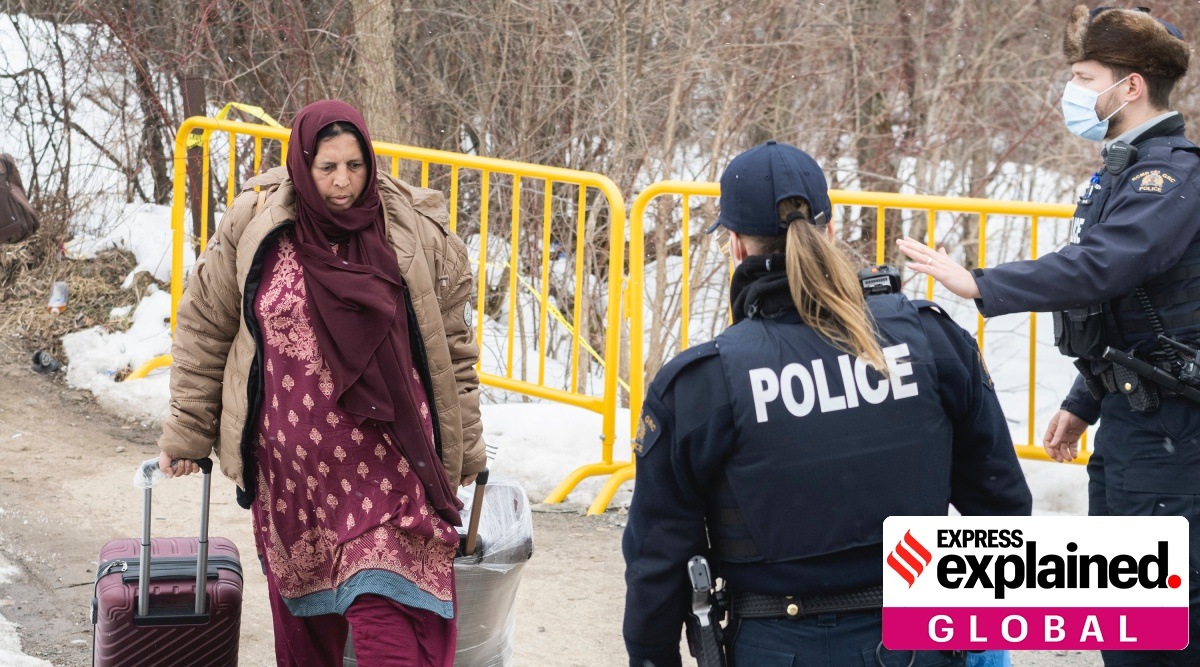 RCMP officers approach a woman as enters Canada via Roxham road on the Canada/US border on Saturday, March 25, 2023. (Graham Hughes /The Canadian Press via AP)
By Anna Mehler Paperny and Ted Hesson
Canada and the United States have reached a deal to return asylum seekers who cross the border via unofficial crossings, Canadian and U.S. officials told Reuters on Thursday, marking a major development at a time of record irregular crossings into Canada.
The deal will allow either country to return asylum seekers who cross the border irregularly, expanding the current Safe Third Country Agreement (STCA) to include migrants crossing between ports of entry, U.S. and Canadian officials said.
According to a final rule set to be published in the U.S. Federal Register, the revised agreement will apply to anyone who “make an asylum or other protection claim” in either country within 14 days of crossing the border. The U.S. government notification did not specify when the revised ruling would come into force, saying it would happen when each side tells the other it has completed the necessary domestic procedures.
In addition, Canada will open 15,000 slots for migrants from the Western Hemisphere to apply to enter the country legally as part of the agreement, the U.S. official said. A Canadian government official said these would be resettled refugees.
Canadian Prime Minister Justin Trudeau and U.S. President Joe Biden will discuss the issue during a meeting in Ottawa on Friday. The announcement will likely come afterwards although some details are being worked out. Trudeau has been under political pressure as irregular crossings into Canada have spiked and said in February that he would raise the issue during the Biden visit.
The existing STCA was signed in 2002 and took effect in 2004. Under the agreement, asylum seekers trying to cross from the U.S. into Canada or vice versa at formal border crossings are turned back and told to apply for asylum in the first “safe” country they arrived in.
Asylum seekers have been crossing at Roxham Road, a path linking New York state to the province of Quebec, because the STCA does not apply at such spots, only at formal border crossings. Once people cross, Royal Canadian Mounted Police apprehend them but they are allowed to file and pursue refugee claims in Canada.
Growing numbers of asylum seekers have been crossing: 40,000 last year and 5,000 in January alone. Quebec’s premier and opposition politicians have called for Roxham Road to be “closed.” In response to Quebec leaders saying the province cannot support more migrants, Canada’s government has been transporting them to other provinces.
Canada has been saying it wants to renegotiate the STCA so it applies across the length of the border, not just at formal crossings. This would allow Canadian officials to turn back asylum seekers trying to cross at Roxham Road or anywhere else.
The broader effects of expanding the Canada-U.S. asylum bar across the entire 6,416 km (3,987-mile) land border are unclear. Migrant crossings at Roxham Road may decrease in the short term but refugee advocates say people hoping to evade detection might take riskier routes.
The number of migrants crossing illegally from Canada into the U.S. also has risen sharply in recent months. U.S. Border Patrol apprehended nearly 2,900 people crossing illegally from Canada since October, more than all of fiscal year 2022. About half of those were Mexicans, who do not need a visa to travel to Canada.