Long before the language of “rights”, “safety nets” or “social protection” entered policy discourse, Indian rulers confronted a stark and recurring reality: droughts meant destitution and unrest. A response to this challenge was the use of public works as famine relief — not charity, but work that preserved dignity while sustaining livelihoods.

This idea resurfaced repeatedly in colonial India through relief works, canals and roads, though with mixed motives. In independent India this old insight was eventually codified into law — first, at the state level in Maharashtra, and decades later at the national level.
Then President Pratibha Patil releasing the commemorative postal stamp on Vitthal Sakharam Page at Rashtrapati Bhavan in New Delhi on July 21, 2011. Then Minister of State (Independent Charge) of Corporate Affairs and Communication and IT Sachin Pilot (left) is also seen. (Wikipedia)
Today, as parties spar over the Viksit Bharat-Guarantee for Rozgar and Ajeevika Mission (Gramin) Act (VB-G RAM G Act) replacing the 2005 Mahatma Gandhi National Employment Guarantee Scheme (MGNREGS), it is important to look back at how the latter, in effect, nationalised a Maharashtrian idea refined over four decades.
S. Page and the birth of EGS
The intellectual architect of this transformation was Vitthal Sakharam Page, a modest, deeply Gandhian public figure and a freedom fighter, who was also a scholar, poet and a trained lawyer. He served as the chairman of the Maharashtra Legislative Council for a record 18 years from 1960 to 1978. Page was neither a technocrat nor a theoretician. He was, above all, a practitioner of public affairs who believed in learning from the ground. At the dawn of India’s constitution in 1949 he wrote an article in Marathi magazine Mauli, passionately arguing for codifying a right to employment, which became a reality years later.
In the mid-1960s, amid famine-like conditions in parts of western Maharashtra, Page initiated a small experiment in Tasgaon taluka of Sangli district. He calculated that Rs 700 could provide 20 days of work to 15 labourers. In a now-famous four-line letter to then Chief Minister Vasantrao Naik, Page asked a question that would change policy history: “If Rs 700 can support 15 people, how many could Rs 100 crore support?”
An undated photo of Maharashtra Chief Minister Vasantrao Naik with Prime Minister Indira Gandhi. (Express)
Eleven villages, including Visapur, became the testing ground. Wages were deliberately kept below prevailing market rates — around Rs 3 per day for men, lower for women — not to exploit labour, but to ensure that people came to public works only when no alternative employment was available. That was the Page scheme, meant as a last resort, not a permanent substitute for agriculture. Its principle was summed up in a simple Marathi phrase: magela tyala kama (whoever asks, shall get work). The Employment Guarantee Scheme (EGS) was launched in Maharashtra in July 1969. Women and men were paid equal wages for works like land levelling, digging wells, percolation tanks and soil conservation.
The results were persuasive. Data showed that distress migration slowed, local assets were created, that it was possible to combat drought and famine, and to also alleviate poverty. Crucially, the programme demonstrated that an open-ended, unconditional employment guarantee was administratively feasible and fiscally manageable, even in a poor, drought-prone economy.
Scaling up against scepticism
Despite its success, the idea faced resistance, especially from New Delhi. The Planning Commission was initially sceptical of an uncapped employment promise. Yet Page’s credibility, the backing of leaders like Naik, and the quiet support of figures such as D R Gadgil, then vice-chairman of the Planning Commission, ensured that Maharashtra pushed ahead. In July 1969 the scheme was rolled out across the state.When multi-year droughts struck in the early 1970s, Naik and Page met with Prime Minister Indira Gandhi seeking central assistance to run public works for famine relief. She denied aid, pleading fiscal constraints following the Bangladesh war. Upon which Page proposed a solution, an idea whose seed lay in his 1949 essay: financing rural employment through a dedicated tax on urban salaried workers. Thus, was born the profession tax earmarked for the EGS. Funds were ring-fenced, rolled over across years and fiercely protected from diversion as long as Page remained at the helm. In 1978 after a decade of experimentation and political consensus cutting across party lines, Maharashtra enacted the Employment Guarantee Act. Few state laws anywhere in the developing world went so far in recognising employment as a public obligation.
Legacy and nationalisation
EGS was studied extensively — by administrators, economists and sociologists. It revealed both strengths and tensions. By setting a wage floor, typically below market rates, it reduced labour’s dependence on landlords and altered local power relations, inviting resistance from landed interests. Yet even at its peak, EGS generated only a small fraction of total rural employment — enough to relieve distress, not to distort the labour markets.
A contrarian paper by Ronald Herrings and Rex Edwards (1983) argued that the EGS, though appearing as a pro-poor initiative, was designed and implemented in a way that primarily benefited the kulaks or the dominant rural class. They suggested the EGS was inferior to genuine land redistribution policies in terms of fundamentally altering the existing power structures and economic inequalities in rural society. But many other scholars including V M Dandekar and Madhusudan Sathe acknowledged the net benefits of EGS.
Why history matters now EGS showed that public works could be institutionalised as insurance against drought and rural unemployment, and not merely as ad hoc relief. When India enacted the MGNREGS in 2005, it was a proxy for genuine unemployment insurance. Job guarantees as a concept are not recent inventions nor ideological indulgences. They have existed from the pre-colonial era as famine works. The Page scheme, which became EGS, was an implementation of the Directive encoded as Article 41 in the Constitution. The idea of the state as an employer of last resort arose from lived experience of scarcity, not abstract theory.The writer is a Pune-based economist

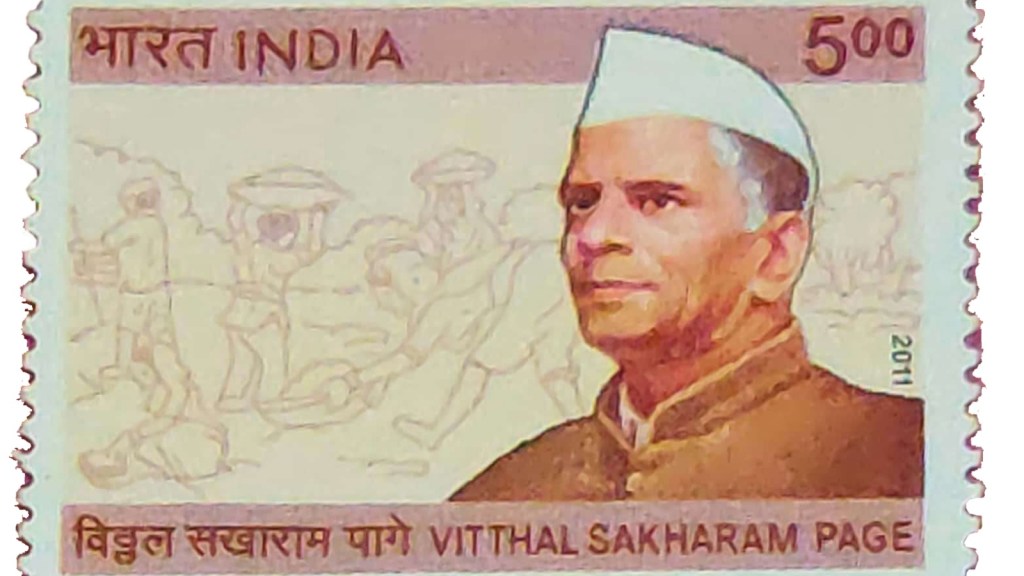 A commemorative postal stamp on Vitthal Sakharam Page was released in 2011. (Wikipedia)

 Then President Pratibha Patil releasing the commemorative postal stamp on Vitthal Sakharam Page at Rashtrapati Bhavan in New Delhi on July 21, 2011. Then Minister of State (Independent Charge) of Corporate Affairs and Communication and IT Sachin Pilot (left) is also seen. (Wikipedia)
 An undated photo of Maharashtra Chief Minister Vasantrao Naik with Prime Minister Indira Gandhi. (Express)

 Share


