Premium
This is an archive article published on June 20, 2023

ExplainSpeaking: Monsoon 2023 starts with a deficit: What is the likely impact?

Past analysis suggests that a deficit in June does not necessarily ruin the whole monsoon performance.

Monsoon in IndiaIslanders in Kochi commuting via country boats during rains. (Express photo by Nirmal Harindran)
Listen to this article
ExplainSpeaking: Monsoon 2023 starts with a deficit: What is the likely impact?
x
00:00
1x 1.5x 1.8x

Dear Readers,

The annual monsoon rainfall, which is spread between June, July, August and September, has started off with a deficit in 2023. This is significant since many suspect the occurrence of El Nino in 2023. El Nino is typically known to suppress monsoon rainfall.

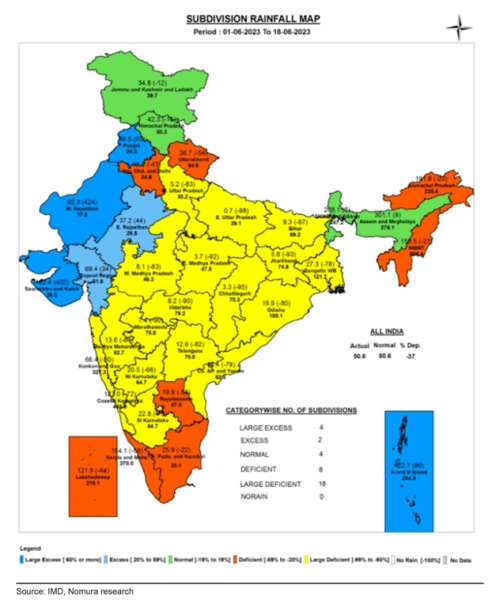
As the India map shows, large parts of India have experienced “deficient” (orange colour areas) and “large deficient” (yellow colour areas) in the first fortnight of June. Overall, the monsoon is 37% below the long period average (LPA). “Deficient” areas (orange) received anywhere between 20% to 59% less than LPA while “large deficient” (yellow) refers to rainfall being even lower.

Rainfall map india

The LPA of rainfall, according to the India Meteorological Department (IMD), “is the rainfall recorded over a particular region for a given interval (like month or season) average over a long period like 30 years, 50 years etc.” In other words, the LPA is an average level of rainfall received by an area and its calculation is based on data over many decades. The LPA acts as a benchmark while forecasting or assessing the rainfall in a particular season.

How crucial is this deficit? Will it derail the monsoon in 2023?

Both the main forecasters — the IMD and Skymet — believe rainfall is going to catch up in the second half of June.

But even if it stays in the deficit, past analysis suggests that a deficit in June does not necessarily ruin the whole monsoon performance.

Story continues below this ad

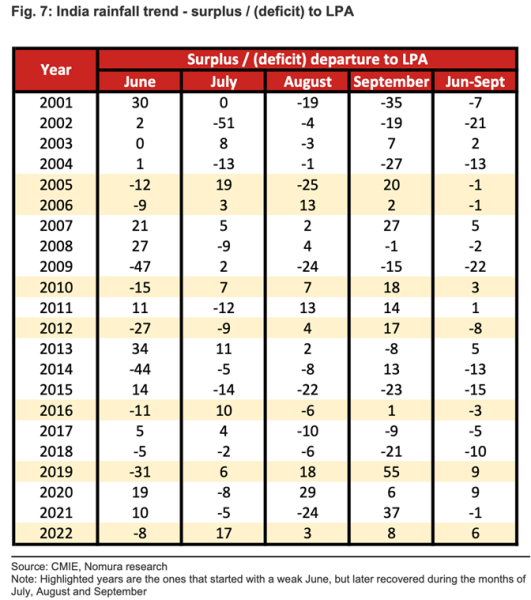
As the TABLE 1 alongside (sourced from a Nomura research note written by Mihir P. Shah and Anshuman Singh) shows, over the past 20 years (i.e. 2002-22), there have been 10 instances when the kickstart to monsoon was weak, with the month of June receiving rainfall below its LPAs. However, in seven of the 10 instances, the monsoon season was normal with good recovery in rainfall during the months of July and August.

India rainfall trend

What is the likely impact on the Indian economy?

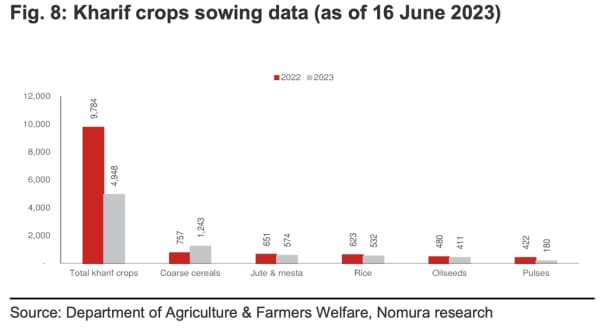
The first impact of a deficient monsoon is through the delays in sowing of Kharif crops. Nomura reports that there has been a delay but it is not alarming.

“In 2023, the agriculture season witnessed some delay in rabi harvest in April; the delayed onset of monsoon has also resulted in some delay in the sowing of kharif crops. While the kharif sowing data for the first fortnight of June is much below 2022 levels (SEE CHART 1), sowing activities are expected to pick up over the next 3-4 weeks with normalcy in monsoon conditions,” it notes.

Kharif crop sowing trends

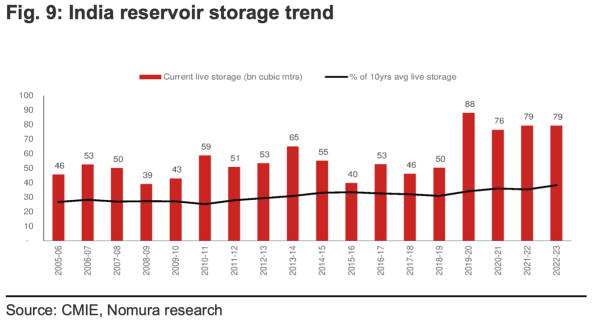
The second big concern when monsoon falters or gets delayed, is about the water reservoir levels since they need to support irrigation. On this count, India is well-placed. As CHART 2 shows, the reservoir levels are above the 10-year average.

Reservoir storage level

Story continues below this ad

Eventually, a poor monsoon first affects the rural economy and consumption levels. As things stand, the rural economy is still struggling when it comes to consumption levels. That is why monsoon rainfall is so critical for the fortunes of India, especially rural India.

Until tomorrow,

Udit

Udit Misra is Senior Associate Editor at The Indian Express. Misra has reported on the Indian economy and policy landscape for the past two decades. He holds a Master’s degree in Economics from the Delhi School of Economics and is a Chevening South Asia Journalism Fellow from the University of Westminster. Misra is known for explanatory journalism and is a trusted voice among readers not just for simplifying complex economic concepts but also making sense of economic news both in India and abroad. Professional Focus He writes three regular columns for the publication. ExplainSpeaking: A weekly explanatory column that answers the most important questions surrounding the economic and policy developments. GDP (Graphs, Data, Perspectives): Another weekly column that uses interesting charts and data to provide perspective on an issue dominating the news during the week. Book, Line & Thinker: A fortnightly column that for reviewing books, both new and old. Recent Notable Articles (Late 2025) His recent work focuses heavily on the weakening Indian Rupee, the global impact of U.S. economic policy under Donald Trump, and long-term domestic growth projections: Currency and Macroeconomics: "GDP: Anatomy of rupee weakness against the dollar" (Dec 19, 2025) — Investigating why the Rupee remains weak despite India's status as a fast-growing economy. "GDP: Amid the rupee's fall, how investors are shunning the Indian economy" (Dec 5, 2025). "Nobel Prize in Economic Sciences 2025: How the winners explained economic growth" (Oct 13, 2025). Global Geopolitics and Trade: "Has the US already lost to China? Trump's policies and the shifting global order" (Dec 8, 2025). "The Great Sanctions Hack: Why economic sanctions don't work the way we expect" (Nov 23, 2025) — Based on former RBI Governor Urjit Patel's new book. "ExplainSpeaking: How Trump's tariffs have run into an affordability crisis" (Nov 20, 2025). Domestic Policy and Data: "GDP: New labour codes and opportunity for India's weakest states" (Nov 28, 2025). "ExplainSpeaking | Piyush Goyal says India will be a $30 trillion economy in 25 years: Decoding the projections" (Oct 30, 2025) — A critical look at the feasibility of high-growth targets. "GDP: Examining latest GST collections, and where different states stand" (Nov 7, 2025). International Economic Comparisons: "GDP: What ails Germany, world's third-largest economy, and how it could grow" (Nov 14, 2025). "On the loss of Europe's competitive edge" (Oct 17, 2025). Signature Style Udit Misra is known his calm, data-driven, explanation-first economics journalism. He avoids ideological posturing, and writes with the aim of raising the standard of public discourse by providing readers with clarity and understanding of the ground realities. You can follow him on X (formerly Twitter) at @ieuditmisra           ... Read More


Latest Comment
Post Comment
Read Comments
Advertisement
Advertisement
Advertisement
Advertisement