6 min read

© The Indian Express Pvt Ltd



 A worker of a garment shop, covering the dresses with plastics, hanging in a garment stand for sale infront of the shop in a rainy morning at Agartala, capital of the Northeastern state of Tripura, India. (Express photo by Abhisek Saha)
Dear Readers,
As the general election approaches, one is likely to witness a sharp variance in the way everyday reality is described by the government, on the one hand, and the Opposition parties, on the other. Last week, for instance, the government had released a white paper on the Indian economy where it claimed that the past decade under BJP (2014-24) was much better than the decade under Congress-led UPA coalition (2004-2014).
Of course, one can look at the nitty-gritty of each issue to ascertain which view is a more accurate description of reality.
Take, for example, the issue of farm distress and India’s farm economy. This week, the nation’s capital is witnessing a fresh surge of farmer protests demanding Minimum Support Prices (or the prices at which the government offers to buy many crops) as a legal right.
One can look at the last key MSP announcement to ascertain if there is a trend. In October 2023 the government announced the MSPs for wheat — the main winter crop in India — for the current marketing year (2024-25).
 Chart 1 on MSP.
CHART 1 alongside shows the annual increase (in %) for wheat MSP since 1977. The data is sourced from Centre for Monitoring Indian Economy (CMIE), a private sector firm.
If one concentrates on the last two-and-a-half decades, it is clear that MSPs tend to follow an election cycle — higher announcements in the years leading up to the election and much lower increases immediately after elections. The only exception was the Atal Bihari Vajpayee-led NDA government that barely increased MSPs in the run-up to the elections. By sharp contrast, the UPA years saw much higher increases in the MSP of wheat.
But MSPs only tell one part of the story. To get a fuller picture about the farm economy one would have to look at a whole host of data — from incomes to inflation levels.
But there is an alternative.
Rural India low on optimism
Mapping consumer sentiments. These are arrived at by regular surveys and can provide a composite picture of how people “feel” about their current state and how optimistic or pessimistic they are.
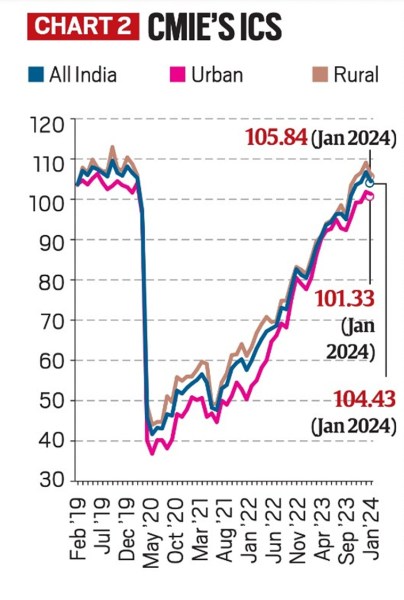 Chart 2. (CMIE data)
For instance, last week, CMIE reported that rural India was low on optimism. According to CMIE, consumer sentiments in India fell quite sharply in January 2024 after seeing a steady rise during the festive season. The 2.2 per cent fall in the Index of Consumer Sentiments (ICS) in January was the steepest monthly fall in over two years. (See CHART 2).
“The fall in consumer sentiments seen in January 2024 is marked by two distinct characteristics. First, consumer sentiments have weakened significantly on all accounts in rural India. The ICS in rural India fell by 3 per cent while urban India saw a smaller 0.5 per cent fall. Second, household perceptions about their current economic conditions debased in January 2024,” a research note on CMIE’s Economic Outlook.
CMIE’s consumer surveys suggest that by late 2023, consumer sentiments had largely recovered to the pre-Covid levels. The latest dip in rural sentiments can be attributed to the stagnation in commodity prices and reduced profits.
The story of Indian consumer sentiments
Last week, India’s central bank, the RBI, too, released its latest instalment of consumer confidence survey. RBI’s survey is a bi-monthly affair. It collects current perceptions (vis-à-vis a year ago) and one year ahead expectations of households on general economic situation, employment scenario, overall price situation, own income and spending across 19 major cities. The latest round of the survey was conducted during January 2-11, 2024, covering 6,058 respondents (with over 53% respondents being women).
The key variable to look for in RBI’s consumer confidence survey is the Current Situation Index (CSI). The CSI is compiled on the basis of net responses on the economic situation, income, spending, employment and the price level for the current period (as compared with one year ago). In other words, it is the upshot of how people feel (when all these variables are taken into account) relative to a year ago.
It is important to note here that a value of 100 is the neutral value. If the index value falls below the 100 mark, it implies that people are pessimistic, and a value higher than 100 conveys optimism.
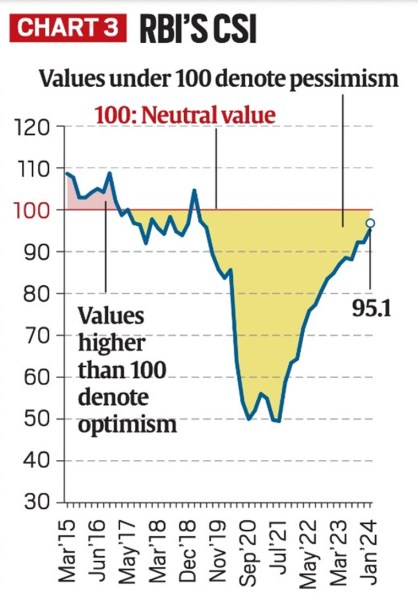 Chart 3. (RBI data)
CHART 3 shows the CSI values since they were first compiled in March 2015. Here are the main takeaways:
Consumer sentiment has been negative right through Prime Minister Modi’s second term. The index value was 104.6 in March 2019 — just before the last Lok Sabha election. But in May 2019, the index value went into the negative zone and has stayed there without a break.
In fact, the optimism of March 2019 itself stands out as a sudden and solitary occurrence. If one ignores it for a moment, then consumer sentiment has been pessimistic since June 2017 — that is, for the better part of the past seven years.
The highest consumer optimism was registered in November 2016 — that was the month when Prime Minister Narendra Modi announced demonetisation. Consumer sentiment has never recovered (let alone exceed) that level.
On a brighter note, though, consumer sentiment has been steadily recovering since the collapse in the wake of the Covid pandemic. Although, despite this recovery, the overall index is still stuck in the pessimism zone.
There is still a couple of months to go before the general elections. Do you think consumer sentiments can recover to break into the optimistic territory — just like they did before the 2019 elections?
Share your views and queries at udit.misra@expressindia.com
Until next time,
Udit