5 min read
© The Indian Express Pvt Ltd



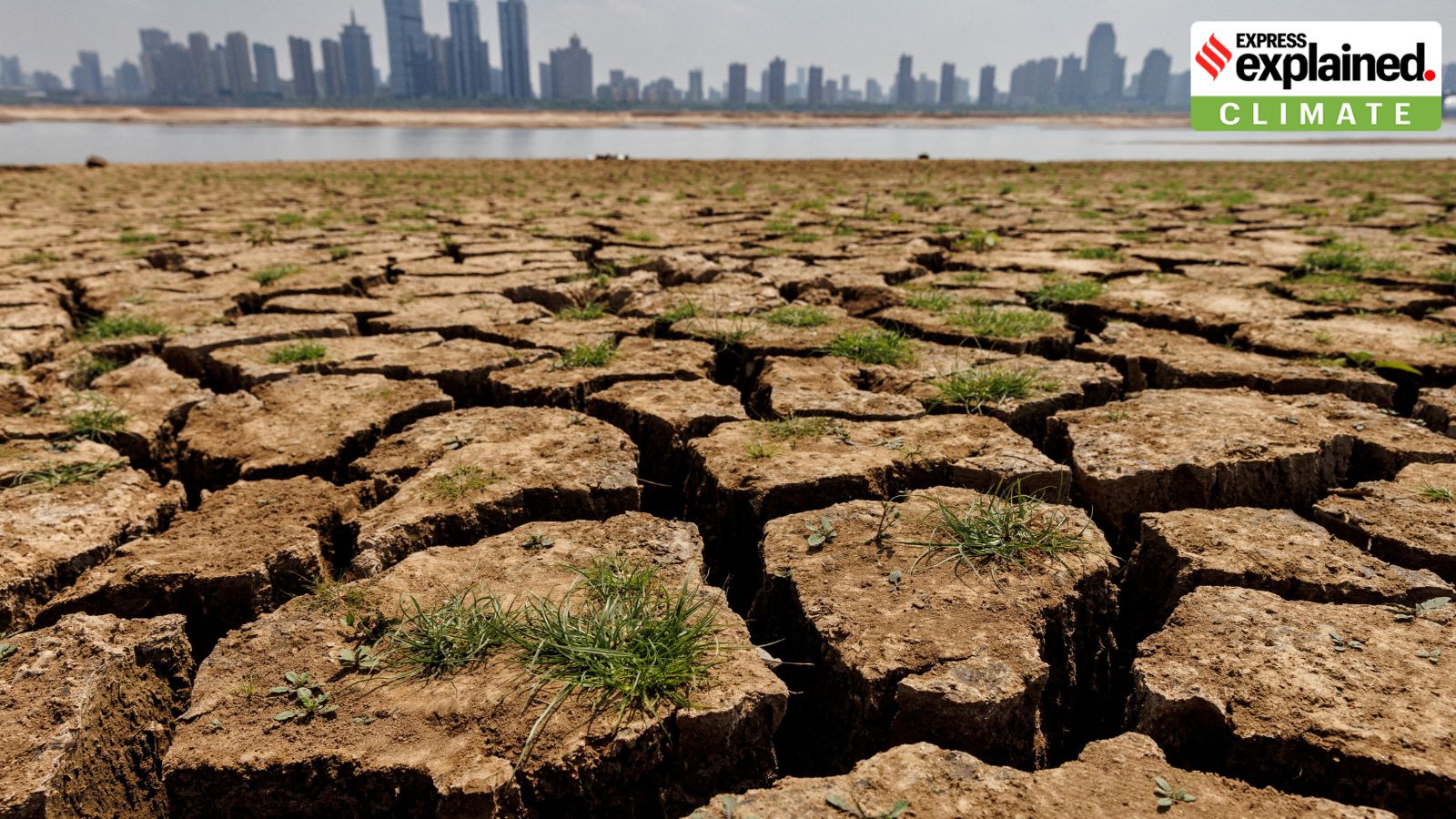 Cracks run through the partially dried-up river bed of the Gan River, a tributary to Poyang Lake during a regional drought in Nanchang, Jiangxi province, China, in August 2022. (Photo: Reuters)
The year 2025 was the third-warmest year on record, according to a new analysis by the Copernicus Climate Change Service, the European Union’s Earth observation programme. The global surface air temperature was 1.47 degrees Celsius above the pre-industrial level (1850-1900) in 2025.
The year was marginally cooler than 2023 — global surface temperature stood at 1.46 degrees Celsius — and 0.13 degrees Celsius cooler than 2024, the hottest year on record (mercury touched 1.60 degrees Celsius). This means that the average temperature in the past three years was 1.51 degrees Celsius, exceeding the 1.5-degree Celsius limit set by the 2015 Paris Agreement.
While the unabated accumulation of heat-trapping greenhouse gases (GHGs) was the primary driver of record-breaking heat witnessed in these years, several other factors also contributed to make temperatures warm.

REDUCED CO2 UPTAKE BY NATURAL SINKS
Historically, carbon sinks have played a crucial role in maintaining the Earth’s carbon cycle. That is because they absorb more carbon dioxide (CO2) from the atmosphere than they release. Forests and oceans are some of the most significant natural carbon sinks. Put together, all of the planet’s natural sinks remove about half of all human emissions.
However, in recent years, the amount of CO2 absorbed by these natural sinks has been decreasing. For instance, scientists estimated that the land carbon sink — a category including forest, plants and soil — absorbed almost no CO2 in 2023. This happened due to the rise in droughts and wildfires.
The dip in the amount of CO2 absorption by natural sinks means that higher levels of the GHG will remain in the atmosphere, which could accelerate global warming rapidly. Studies have shown that CO2 has contributed more than any other GHG to climate change. In fact, CO2 is responsible for about 70% of global warming, according to an analysis by Facts on Climate Change, a Czech Republic-based independent think tank.
REDUCED COOLING FROM AEROSOLS
The past few years have also witnessed a reduction in aerosol emissions, which has made the planet warmer. This is ironic, as a decrease in aerosol levels reduces air pollution. Aerosols are tiny solid and liquid particles suspended in the atmosphere, which are produced mainly by burning fossil fuels.
Although they consist of air pollutants, aerosols reflect incoming sunlight, resulting in less absorption of solar radiation by the Earth’s surface. They also help in the formation of clouds, which impact how much sunlight is reflected or absorbed.
With the world curbing its aerosol emissions, their cooling effect has drastically reduced. For example, in 2020, the International Maritime Organization introduced strict limits on the sulphur content of marine fuels. While this reduced sulfur dioxide (SO2) emissions, the move has already warmed the planet by an estimated 0.04 degrees Celsius.
A 2025 study, published in the journal Communications Earth & Environment, revealed that lower aerosol emissions from East Asia since 2010 have led to a warming of between 0.07 degrees Celsius and 0.05 degrees Celsius.
STRONG EL NIÑO & WEAK LA NIÑA
The year 2022 saw the onset of El Niño after seven years. It is a phase of what is known as the El Niño Southern Oscillation (ENSO), a climate phenomenon characterised by changes in sea temperatures along the central and eastern tropical Pacific Ocean, accompanied by fluctuations in the atmosphere overhead.
ENSO influences, alters, and interferes with global atmospheric circulation, which, in turn, influences the weather worldwide. It has three phases – warm (El Niño), cool (La Niña), and neutral — which occur in irregular cycles of two to seven years.
The years 2023 and 2024 experienced a strong El Niño event, which contributed to extremely warm temperatures. While the previous year saw the end of the El Niño event, the La Niña event, which was supposed to cool the temperatures, remained quite weak after it emerged. As a result, the anticipated cooling effect was relatively modest, at best.
EXCEPTIONALLY HIGH OCEAN TEMPERATURES
The past three years also witnessed unusually warm sea surface temperatures (SSTs) — the temperature of the water at the ocean surface. One reason for this is that the ocean has absorbed 90% of the extra heat trapped by the GHGs over the past century, causing ocean temperatures to rise.
The situation was exacerbated with the onset of the El Niño in 2022. However, even after the event ended in 2024, the SSTs remained exceptionally high throughout 2025. That’s why, apart from the El Niño, “a significant fraction of the additional warmth of the atmosphere in the last three years has been shown to originate from SSTs across oceanic regions other than the tropical Pacific,” said the Copernicus report.