6 min read

Journalism of Courage



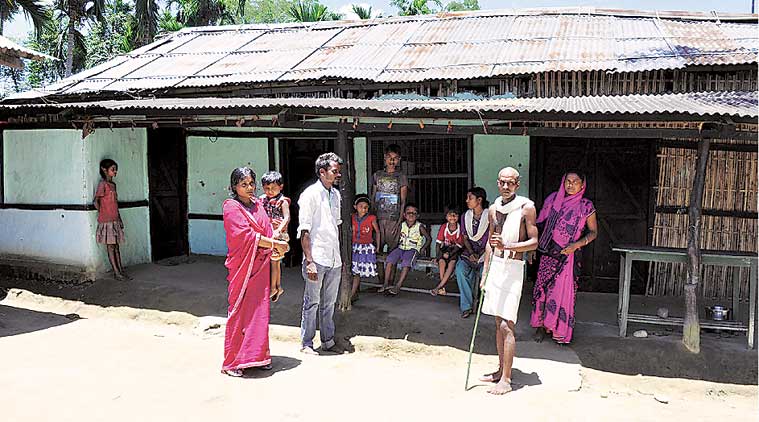 The family of the hindi-speaking trader Nandalal Shah, 65, and his daughter, Kajol, 18, in Bijuliban who were killed by suspected ULFA cadres when they opened fire on them at night in their home. (Source: Express photo by Dasarath Deka)
More than three weeks after the anti-talks faction of the United Liberation Front of Asom (Ulfa), headed by the dreaded Paresh Barua, attacked the home of Nandalal Shah in upper Assam’s Tinsukia district, killing two members of the family, including an 18-year-old girl, the Hindi-speaking population continues to live in fear.
Barua, who has ordered a “ban” on two organisations representing the community, has denied a hand in the killings, and accused police of having “created” the July 14 incident at Bijuliban village. Police have, meanwhile, arrested one of the three Ulfa “boys” who carried out the attack on Shah’s home.
READ: ULFA guns down Hindi-speaking trader
Language data from the 2011 Census for Assam is not available, but calculations based on data from 2001, when the Hindi-speaking population was 5.9 per cent of the state, would suggest there are between 15 lakh and 18 lakh Hindi-speakers in Assam today.
This significant number is the result of a flow of people from the Hindi belt to Assam for over five or six centuries. With the exception of the newer migrants who have arrived in, say, the last 40 or 50 years, the majority among the original Hindi-speakers are today as good as Assamese.
READ: Tinsukia killings: ‘We have nowhere to go… we no longer belong to Bihar or UP’
Take for instance, the family of Biswanath Mahato of Krishnapur village, barely 2 km from where the Ulfa attacked Nandalal Shah. Sixty-five-year old Mahato’s father, Jai Krishna Mahato, came to Assam from Chhapra, Bihar, and settled down in Sadiya at the far eastern end of the state. This was in 1926 — the same year in which the great Bhupen Hazarika was born in Sadiya.
Biswanath himself was born in Sadiya, went to an Assamese-medium school, and later moved to Krishnapur under a government scheme to rehabilitate families who had lost their land following the erosion of the Brahmaputra’s banks after the great earthquake of 1950.
READ: ULFA faction imposes ‘ban’ on Bhojpuri organisations
Biswanath’s four sons and daughter went to Assamese-medium schools, and so have all his grandchildren. The family’s links with Chhapra and Bihar disappeared long ago.
The Mahato family’s case is not unusual. 15,000 families with roots in Bihar and UP live in Tinsukia, spread over 300 of the district’s 1,100 villages. Tinsukia is also home to about 4,000 Marwari families, many of them permanent residents of interior villages, living side by side with families that are ethnically Assamese — like the Ahoms, Morans and Mataks. There are 100 ‘Bihari’ families in Gohain Krishnapur, for instance, and 150 in Bamungaon. Ten such families live in Sonowalgaon, 20 in Missimikota, 40 in Bormura Miripathar, and five in Ahomgaon. Several villages in the district are home to people with Chinese roots.
The indigenous communities had never thought of people like Biswanath Mahato or Nandalal Shah as “outsiders” until the Ulfa began targeting them in the early 1990s. “I had so many classmates from those families in Phillobari Middle School and Phillobari High School. Some of our teachers too were from this community, and many of us fondly remember R K Singh, our ‘Hindi Sir’. He would visit every student at home before exams to ask about their preparation,” says Sashikanta Saikia, a resident of Bijuliban and principal of DHSK College in Dibrugarh, one of the oldest and most reputed colleges of upper Assam.
“My grandfather Ram Bachan Singh came from Kachhua Chakuti, a village in Bihar’s Darbhanga district, around 1895, and settled in Doomdooma. My father Lalan Prasad Singh was born in Doomdooma, and became president of the All Assam Students’ Union in 1972, a post that Prafulla Kumar Mahanta occupied six years later,” says Bikash Singh, a journalist with The Economic Times in Guwahati. Ram Bachan was chairman of Doomdooma Town Committee for 25 years.
Lalan Prasad, who was arrested during the AASU movement for declaring Assamese as the sole medium of instruction in the state, also composed several patriotic songs and produced an Assamese film. Before his death in 1995, Lalan Prasad looked after Ananta Cinema in Doomdooma, which Ram Bachan built in the early 1960s.
“Migration of people from Bihar, Bengal, Uttar Pradesh, Rajasthan and Nepal to Assam is a very old story,” says Udayan Misra, a former Dibrugarh University professor and Fellow at the Indian Institute of Advanced Study, Shimla. “Those from Bihar and UP, who are nowadays referred to as ‘Bhojpuris’, had started coming from around 1826, when Assam became part of British India. They have now become such a part of the society in Assam that you can no longer separate them from the other Assamese communities,” Misra said.
So why does the Ulfa sometimes target the Hindi-speaking people?
“The Ulfa believes that an attack on a Hindi-speaking settler sends out signals to the central government. They know they will get a lot of media coverage, as well as reactions from the large number of MPs from the Hindi belt,” says Parshuram Dubey, president of the All Assam Bhojpuri Parishad.
Assam Police chief Khagen Sarma agrees. “Also,” he says, “Hindi-speaking persons are vulnerable because they are all over, even in the remotest of villages.”
Sunil Nath, who as Siddhartha Phukan was Ulfa’s publicity secretary until his surrender in 1992, sees a local socio-economic angle in the group’s hostility.
“In Tinsukia, I think this is a local problem of economic domination among different communities that the present set of Ulfa militants often take advantage of. The Bihari or Marwari settler is more hardworking and enterprising. This makes others envious of him, and the present set of Ulfa leaders, who lack political wisdom and ideology, take advantage of this,” Nath says.
Since its inception, Ulfa has killed at least 300 ‘Hindi-speaking’ people. Nearly 200 of them were killed between 2000 and 2007. Some of the original migrants have left Assam over the years. But the majority, like the families of Nandalal Shah or Biswanath Mahato or Lalan Prasad Singh have nowhere to go. They belong to Assam.
samudra.kashyap@expressindia.com