


Click here to follow Screen Digital on YouTube and stay updated with the latest from the world of cinema.
Premium
This is an archive article published on May 2, 2014
Mahanagar gets technically enhanced
Satyajit Ray’s film to re-release in India in digitally-restored version
Mumbai | Updated: May 2, 2014 11:39 AM IST 4 min read
4 min read


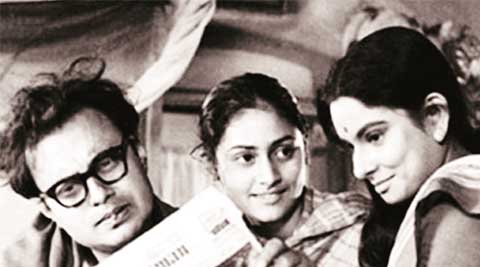 Mahanagar
By Shoma A. Chatterji
A digitally-restored version of Satyajit Ray’s Bengali classic Mahanagar (The Big City) released on April 18, in select theatres in Delhi, Mumbai, Kolkata, Chennai, Bengaluru, Ahmedabad and Pune, under the banner of PVR Director’s Rare. The film, which was originally released in September 1963, will be re-released with English subtitles.
Mahanagar was digitally-restored by the British Film Institute last year to mark the 50th anniversary of the film and was screened at a number of venues in the U.K. The timeless classic-based on Narendranath Mitra’s short story Abataranika stars Madhabi Mukherjee as Arati, a housewife who takes a job of a saleswoman and finds new meaning in life.
The timelessness and universality of Mahanagar can neither be denied, nor over-estimated. The real tension within Arati remains a perennial one. The inner conflict is not about whether she should or should not take up a job, but whether she should try and please everyone – husband, child and in-laws, boss, clients – or whether she should only please herself. For the Indian woman, the conflict can be particularly acute, because those close to her expect more than is expected of women in the West, writes Andrew Robinson. As Arati’s husband tells her, with an affectionate smile, “a woman’s place is in the home.” Expressed in English in the film, the line is a perfect example of a Victorian value system held within more orthodox circles in Calcutta during the time-frame of the film.For the first time, Ray deals with an ordinary woman, who, one fine day, finds herself thrown out into the world, trying to make both ends meet for the extended family she belongs to. The family is sandwiched between the social hypocrisies of the low middle-class and an impending financial crisis.
Mahanagar introduces the Indian audience perhaps, for the first time, to a woman who is awakened to the possibility of determining the direction her life is going to take. Chidananda Dasgupta strikes a note of dissent by pointing out how Arati loses her freedom when she quits her job because the push comes from the husband. “For men have been traditional liberators of women. But traditionally too, they have retracted when they have found the consequences of their action undermining their over lordship. When she hands in her resignation, it is not because her husband has told her to, but because of her rebellion against the injustice done to her Anglo-Indian colleague. It is her one act of protest against society, and she carries it out in a sphere where she has acquired a sense of self-esteem. Ironically this act itself makes her gives up the freedom she has won. Dasgupta goes on to point out that Ray’s closure showing the husband and wife meeting under the doorway where the husband says, “Do not worry. It is a vast city and one of us is bound to find a job” provides too pat a solution to a problem that will continue to plague us for a long time. Mahanagar lacks the strong, open-ended closures of Ray’s better films like Charulata.
Arati (played by Madhabi) proves that a woman has vast resources of inner strength, which she herself is unaware of. She draws upon these resources when the time is right, when she discovers that patriarchy, which defines a society dominated by men and internalised by women, has failed to solve emerging socio-economic problems that have a bearing on the family to begin with, then on the economy, and finally, on the culture. Ray once said: “somehow I feel that a common person – an ordinary person who you meet everyday on the street – is a more challenging subject for cinematic
exploration than persons in heroic moulds, either good or bad. It is the half-shades, the hardly inaudible notes that I want to capture and explore.”
Ray won the Silver Bear for Mahanagar at the 14th Berlin International Film Festival in 1964.
Advertisement
Loading Taboola...


More Entertainment




Advertisement
PHOTOS



PHOTOS





Top Stories











Must Read







Advertisement
- 01
- 02
- 03
- 04
- 05
Advertisement
