


Click here to follow Screen Digital on YouTube and stay updated with the latest from the world of cinema.
Premium
This is an archive article published on March 14, 2014
Little women
Real-life experiences of ordinary women inspire director Lokesh Jain’s play Bheegey Bheegey Se Pal
Mumbai | March 14, 2014 01:00 AM IST 4 min read
4 min read


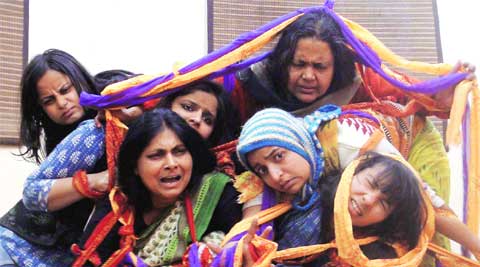 From fear to sorrow, the various faces
of women depicted in the play
“My house looks like it always does before a new play opens. I don’t think we’ve swept it this whole month,” says theatre director Lokesh Jain, 46, as he settles down at the canteen in Triveni Kala Sangam. He looks around at the lunchtime crowd and says, “There was a time, the canteen used to be overrun with artists, authors and film-makers.” In the early ’90s, Jain was training with veteran Ebrahim Alkazi. Even then, he would look for hidden stories of the unknown Dilliwala — migrants, homeless, tribals, labourers or refugees. That curiosity has culminated in his latest play, Bheegey Bheegey Se Pal, which will premiered in Delhi.
“The play draws from real-life experiences of women I have encountered in my 30 years in theatre. It is a story of their trials and triumphs, dreams and setbacks, and their positions in workplaces and homes,” says Jain. Bheegey Bheegey Se Pal is a fictional story of seven women, whose paths overlap at a paying-guest accommodation in Lajpat Nagar. One of these is the formidable owner of the PG accommodation, Jasvir Kaur. Another is her maid, Bahula, who represents a girl Jain had once met in Madhya Pradesh. “She had been raped and when she became pregnant, her mother turned her away and even the village midwife refused to help. She delivered her own child in a scene full of blood and trauma,” he says. The other characters include, a journalist, who doesn’t believe in marriage but cannot escape its shadow in her live-in relationship; a Bharatanatyam dancer who defines herself through art; a housewife who flees from her in-laws; and her 10-year-old daughter. The seventh character is missing. “She is called Afsana and nobody, neither her parents nor her landlady, knows where she has disappeared. Afsana symbolises the thousands of women who vanish from our city regularly,” says Jain.
Jain’s realistic subjects and stark treatment — theatre of the conscience that “open eyes and minds” — are preceded by research that has involved sleeping in night shelters and making plays with children from the streets. Nothing compares to the new play, he says, “This play took me two years to write and has been the toughest challenge of my life.”
Set designer Manish Kansara remembers the first impression of the script. “Such events and people are so common around us, we have turned blind to them. While designing sets, I wanted to reinforce the script so that the audience doesn’t stay immune,” he says. The stage is minimally decorated — alternating between an office and the PG, with a few scenes on the street.
The cast combines budding talents from the city’s theatre circuit such as Pankaj Tiwari with new actors such as Renu Anuj Singh. Jain’s wife Chavi and 11-year-old daughter Pakhi play mother and child in the play, too. An integral part of Jain’s plays are their innovative background and surround sound. Jain began to create music because he couldn’t find trained musicians to translate his edgy vision on the stage. In Bheegey Bheegey Se Pal, for instance, one can listen to the djembe and nagara as well as wooden sticks (“which recall the voice of catharsis”) and a collection of car, bike and bus horns (“songs of the city”). “Three scenes have no dialogues and are based only on music and action,” says Chavi.
Advertisement
Loading Taboola...

More Entertainment




Advertisement
PHOTOS


PHOTOS





Top Stories











Must Read







Advertisement
- 01
- 02
- 03
- 04
- 05
Advertisement
