This is an archive article published on July 10, 2018
Madras HC orders 196 grace marks for students who took NEET in Tamil
Saying that experts recommended by the respective state governments were engaged for the purpose of translation, CBSE said its role was limited to conducting the examination and declaring the results.
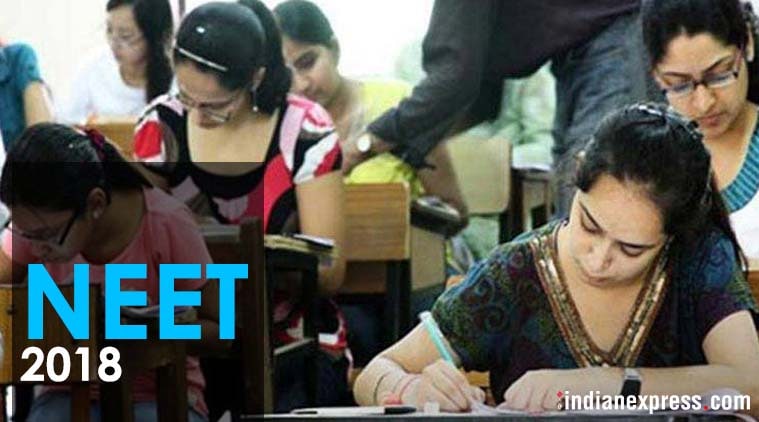
The NEET-2018 paper, for admission to medical and dental colleges, had 180 questions with total 720 marks.
The Madurai bench of the Madras High Court on Tuesday ordered the Central Board of Secondary Education (CBSE) to grant 196 marks — four marks each for 49 questions — to all students who appeared for the National Eligibility cum Entrance Test (NEET) in Tamil this year.
The division bench of Justices C T Selvam and A M Basheer Ahamed passed the order on a PIL filed by T K Rangarajan, CPI(M) MP, who sought full marks for the 49 questions, saying key words had been wrongly translated in the Tamil question paper.
The NEET-2018 paper, for admission to medical and dental colleges, had 180 questions with total 720 marks.
The court also directed the Board to bring out a fresh list of qualified candidates within two weeks. “Consequently, the Board should revise the list of qualified candidates and publish the same afresh. It shall then be open to the authorities concerned to go about counselling the eligible candidates,” it said.
“As a necessary corollary to the above, the list of qualified candidates shall be kept in abeyance as would the counselling sessions, pending publishing details of the qualified candidates afresh in keeping with the order of the court,” it said. The bench, however, said the authorities concerned were free to take a decision on whether to go ahead with the current counselling process (which is already on in Tamil Nadu).
Stating that the students who appeared for the exam in Tamil should be provided a level playing field, the court said: “The difficulty of a student in taking an examination of such importance, in understanding rightly a wrong question, be howsoever mild the error, is to be appreciated, placing ourselves in his shoes and not in the shoes of those having the leisure of easy chair reflection.”
It said that students from less-privileged backgrounds shouldn’t be deprived of an opportunity to pursue their studies. “Tens of thousands of children, having to support a mother, siblings, ailing parents and elders… by eking out a living, by earning an extra rupee, which keeps the home from burning… pursue their studies simply because they want to be educated. They want to lift themselves from the squalor their lives are in. Why are such students being deprived? It is because they do not put in ‘n’ number of fixed hours of study, or it is because science subjects require practical training which they are not exposed to,” said the court.
Story continues below this ad
In his petition, Rangarajan said the Tamil translation of 49 questions was either wrong or ambiguous. Citing errors, he said ‘cheetah’ had been translated as ‘seetha’, and technical terms like ‘multiple alleles’ and ‘ureters’ had also been misinterpreted, causing confusion among students.
While CBSE did not challenge the charge that the paper had errors, it told the court that regional experts had translated the questions. Saying that experts recommended by the respective state governments were engaged for the purpose of translation, CBSE said its role was limited to conducting the examination and declaring the results. It said the question paper, which was set in English, was translated into 10 regional languages, but no other state had raised any complaints.
Arun Janardhanan is an experienced and authoritative Tamil Nadu correspondent for The Indian Express. Based in the state, his reporting combines ground-level access with long-form clarity, offering readers a nuanced understanding of South India’s political, judicial, and cultural life - work that reflects both depth of expertise and sustained authority.
Expertise
Geographic Focus: As Tamil Nadu Correspondent focused on politics, crime, faith and disputes, Janardhanan has been also reporting extensively on Sri Lanka, producing a decade-long body of work on its elections, governance, and the aftermath of the Easter Sunday bombings through detailed stories and interviews.
Key Coverage Areas:
State Politics and Governance: Close reporting on the DMK and AIADMK, the emergence of new political actors such as actor Vijay’s TVK, internal party churn, Centre–State tensions, and the role of the Governor.
Legal and Judicial Affairs: Consistent coverage of the Madras High Court, including religion-linked disputes and cases involving state authority and civil liberties.
Investigations: Deep-dive series on landmark cases and unresolved questions, including the Tirupati encounter and the Rajiv Gandhi assassination, alongside multiple investigative series from Tamil Nadu.
Culture, Society, and Crisis: Reporting on cultural organisations, language debates, and disaster coverage—from cyclones to prolonged monsoon emergencies—anchored in on-the-ground detail.
His reporting has been recognised with the Ramnath Goenka Award for Excellence in Journalism.
Beyond journalism, Janardhanan is also a screenwriter; his Malayalam feature film Aarkkariyam was released in 2021. ... Read More


 4 min read


 The NEET-2018 paper, for admission to medical and dental colleges, had 180 questions with total 720 marks.