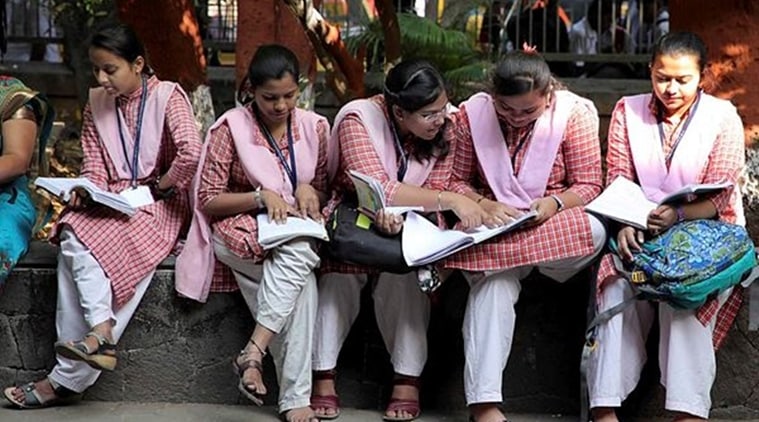
The results also recorded a sharp increase in the percentage point of students who scored above 90 per cent. (File Photo)
The Central Board of Secondary Education (CBSE) on Monday released results of class XII Board examinations, recording more than 5 percentage point increase in students who cleared the exams against last year.
The results also recorded a sharp increase in the percentage point of students who scored above 90 per cent. The CBSE adopted a modified marking scheme this year to assess students because all the papers could not be conducted due to the nationwide shutdown since March 25 in view of the coronavirus outbreak. After the examinations were interrupted, the Board had announced that it would conduct exams only for 29 “important” papers for classes X and XII between July 1 and 15.
The CBSE later decided not to conduct any pending examination and to assign marks for papers not taken on the basis of a formula. This formula involved taking the average of best three papers for students who had written four papers; of two best papers for those who had written three; and including internal marks for those students who had written two papers or less.
This year, 11,92,961 students took the class XII exams, of whom 10,59,080 — or 88.78 per cent — cleared. This is an increase of over 5 percentage points from last year’s 83.4 per cent.
The results also show more students have scored in the top brackets. Last year, out of total 12,05,484 candidates, 17,693 (1.47 percent) scored above 95 per cent. This year, the numbers more than doubled, with 38,686 of 11,92,961 students (3.24 per cent) getting a score in that topmost bracket.
Similarly, the number of candidates scoring over 90 per cent also went up significantly – from 7.82 per cent in 2019 to 13.24 per cent this time.
This year the CBSE decided against releasing a ‘merit list’ of toppers, in line with CISCE, which had announced its results last week without a merit list. The term “fail” will not be used in any student’s documents, or on results released on the website, the Board stated. Instead, students who could not pass will be marked as “Essential Repeat” candidates.
Some patterns continued from previous years, with girls faring better than boys — 92.15 per cent girl students passed, as opposed to 86.19 per cent boys. Transgender candidates registered a pass percentage of 66.67.
The CBSE stated that results of 400 candidates could not be computed even on the basis of the modified marking scheme; their results have not been declared.
Sukrita Baruah is a Principal Correspondent for The Indian Express, based in Guwahati. From this strategic hub, she provides comprehensive, ground-level coverage of India's North East, a region characterized by its complex ethnic diversity, geopolitical significance, and unique developmental challenges.
Expertise and Experience
Ethnic & Social Dynamics: Deep-dive coverage of regional conflicts (such as the crisis in Manipur) and peace-building efforts.
Border & Geopolitics: Tracking developments along India’s international borders and their impact on local communities.
Governance & Policy: Reporting on state elections, tribal council decisions, and the implementation of central schemes in the North East.
Specialized Education Background: Prior to her current role, Sukrita was a dedicated Education Correspondent for The Indian Express in Delhi. This experience provided her with a sharp analytical lens for:
Policy Analysis: Evaluating the National Education Policy (NEP) and university-level reforms.
Student Affairs: Covering high-stakes stories regarding campus politics, national entrance exams, and the challenges within the primary and secondary education sectors. ... Read More


 3 min read


 The results also recorded a sharp increase in the percentage point of students who scored above 90 per cent. (File Photo)