5 min read


© The Indian Express Pvt Ltd



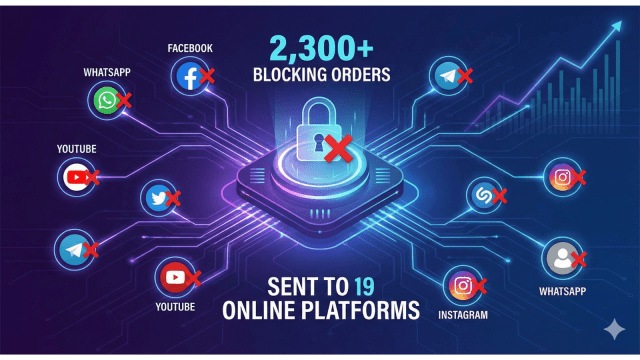 These orders cover a wide range of online links, including allegedly offensive or unlawful posts online, or entire accounts. (Image modified by AI)
 More than 2,300 blocking orders were sent to 19 online platforms, including WhatsApp, Facebook, YouTube and Instagram, between October 2024 and October 2025 through the Union Home Ministry’s Sahyog portal, according to data obtained by The Indian Express under the Right to Information (RTI) Act.
The period captures the first full year since Sahyog has been in operation — and the number of orders, for the first time, reveals how the contentious portal has rapidly become a central tool in India’s expanding online censorship framework. These orders cover a wide range of online links, including allegedly offensive or unlawful posts online, or entire accounts.
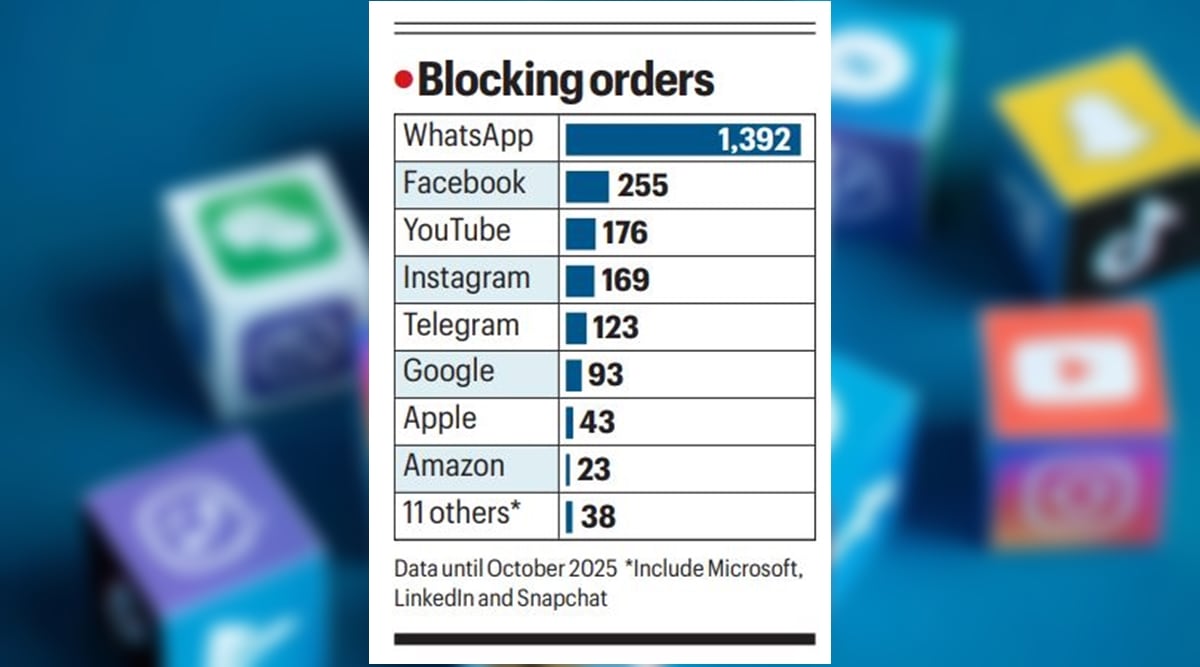
According to RTI data shared by the Home Ministry’s Indian Cybercrime Coordination Centre (I4C), which is responsible for the Sahyog portal, the Meta family of online services — WhatsApp, Facebook and Instagram — accounted for over 78 per cent of the total 2,312 blocking orders that were sent over the one-year period (see chart).
WhatsApp received the highest number of blocking orders by a huge margin, with 1,392, followed by Facebook, which received 255, and Instagram with 169. In total, these platforms received 1,816 blocking orders.
YouTube accounted for 176 blocking orders, and messaging app Telegram was issued 123 blocking requests. Google received 93, Apple 43 and Amazon 23. A further 38 orders were distributed across 11 other online intermediaries, including Microsoft (10), LinkedIn (2) and Snapchat (1), among others. Each order can contain multiple links that platforms are expected to act on.
The period covered under the RTI request also includes the flurry of content takedowns that took place during Operation Sindoor in May, when the Government acted on content and accounts it believed originated from Pakistan to neutralise online propaganda. For instance, Elon Musk-owned social media platform X had, at the time, said that it received orders to block more than 8,000 accounts by the Government, including those belonging to “international news organisations and prominent X users”.
A senior industry executive said the blocking orders may be more as companies also receive such orders through email, in cases where the Sahyog portal is down.
The I4C also revealed that more than 118 intermediaries have been onboarded to Sahyog, which suggests an expanding universe of platforms required to comply with state-issued takedown demands. The blocking orders were sent by Central, state and Union Territory (UT) agencies.
According to data shared by I4C with the Karnataka High Court earlier this year, between March 2024 and March 2025, the I4C had sent 426 such notices to various intermediaries, directing to block more than 1.1 lakh links and accounts for sharing unlawful content.
The difference in the volume of such blocking orders — from nearly one a day between March 2024-25 to more than six daily between October 2024-25 — suggests that the portal has aided government agencies in taking down more online content that they deem unlawful.
The Indian Express had previously reported that nodal officers from 33 states and UTs, along with representatives from seven Central agencies, had been onboarded to Sahyog.
The Home Ministry, Meta, Google, Microsoft, Apple, Amazon and Telegram did not not respond to requests for comment from The Indian Express on the takedown orders, including the grounds under which they were issued.
The blocking orders, issued in the form of notices, are sent under Section 79(3)(b) of the Information Technology (IT) Act, 2000. Under this section, online intermediaries can lose their safe harbour protections if they fail to block access to flagged content. These protections afford social media platforms legal immunity from hosting user-generated content.
These orders fall outside Section 69(A) of the IT Act, which has been commonly used to issue online censorship directives but is limited to national security and public order-related offences.
The Sahyog portal was operationalised in October 2024 as a single window platform for government agencies to issue blocking orders under Section 79 (3)(b). Before the platform existed, such orders had to be sent directly to individual online platforms by agencies via email.
Earlier this year, X had sued the Government over blocking orders sent under Section 79(3)(b) of the IT Act, arguing that the Centre was trying to establish a “parallel” content blocking regime, and had also called Sahyog a “censorship portal”. In September, the Karnataka High Court ruled in favour of the Central Government in the case, which X plans to appeal further.
In October, the IT Ministry amended the IT Rules to specify that blocking orders under Section 79(3)(b) could only be issued by senior officials at the Centre and states, and introduced additional safeguards, such as monthly reviews.