Stay updated with the latest - Click here to follow us on Instagram

Journalism of Courage
 4 min read


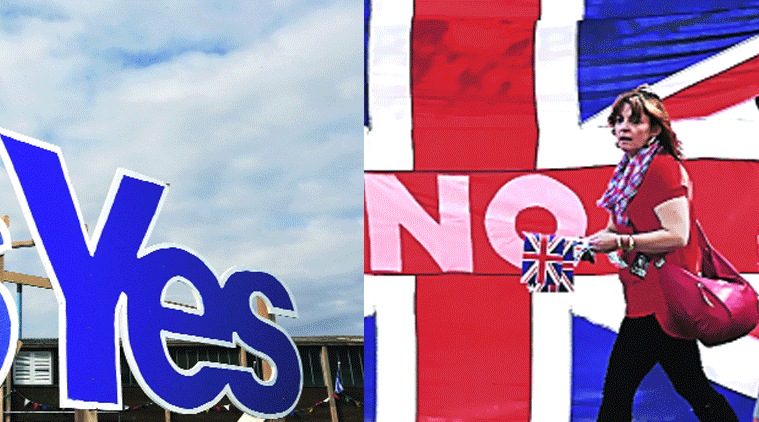 As the battle to decide the future of Scotland enters its final week, both sides have launched some of the largest ad campaigns in Scottish political history.
By Martin Benedyk & Danica Kirka
All Gavin Jones has to do is scan the shelves of his quaint shop on England’s border with Scotland to know he’ll have a big problem if the Scots declare independence next week. There are teddy bears in Campbell clan tartans and shelves of shortbread from Scotland — just above the red jams made in England. After independence, the Scottish goods would be subject to import duties, and customers would likely pay in two different currencies. Business in Berwick-upon-Tweed, England’s northernmost town, could soon be crushed by bank transaction costs. “If Scotland chooses independence, it changes our concept of local,” Jones said.
Berwickers like to think of themselves as neither English nor Scottish. Little wonder: this enclave has changed hands 13 times over the centuries. But there is no getting away from the fact that Berwick could be dramatically affected by the September 18 referendum.
In that way, they are like the rest of Britain. While the vote may alter the balance of power in British politics, increase the likelihood that the UK will leave the European Union and weaken the nation’s economy and currency, the people of England, Wales and Northern Ireland will have no say in the outcome.
Britain’s left-leaning Labour Party would be the biggest political victim of independence — it is often joked there are more pandas in Edinburgh’s zoo than there are Conservative Party lawmakers in Scotland. Scottish voters elected 41 Labour members of Parliament in the 2010 election and only one Conservative.
If the next general election due in May were held today, eliminating Scottish votes would give Prime Minister David Cameron’s Conservatives a 37-seat majority win.
That could drag Britain toward yet another high-stakes vote — on whether the country should leave the EU.
Leaving the EU could have huge consequences for Britain. The EU guarantees freedom of movement for people, goods and money, a big advantage for companies that want to do business across the bloc. If Britain were to leave the bloc, multinational companies that have their EU headquarters in London — from Starbucks to many of the world’s biggest banks — may seek to relocate.
“The UK has been united for 300 years and it’s been in the European Union since 1973. These two referenda, plus the general election all coming very close together… we’re going to have five years of constitutional chaos,” said Patrick Dunleavy, a professor of political science at the London School of Economics.
More immediately, the loss of Scotland could hurt Britain through the amount of financial uncertainty it would generate over the next 18 months — the time it would take Scotland to sever its ties with Britain. Policy makers would have to agree on whether Scotland would continue to use the pound as its currency as well as how to split British public debt and North Sea oil revenue.
The currency question is the murkiest. While independence leaders say they will continue to use the pound, politicians in London have ruled out a currency union. Foreign investors in Britain could delay big decisions until a time when they can better gauge the risks and costs.
“Our base view is the proposal will be defeated,” said Bill O’Neill, of UBS Wealth Management. “But clearly the market will be watching for the polls.”
Stay updated with the latest - Click here to follow us on Instagram