Stay updated with the latest - Click here to follow us on Instagram

Journalism of Courage
 3 min read


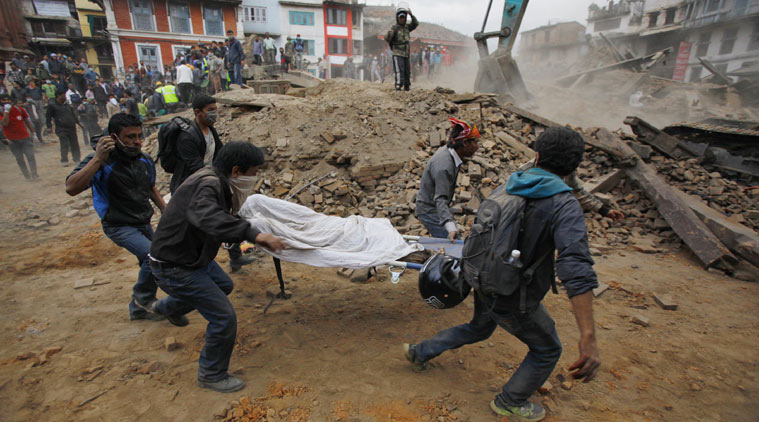 Officials here are already saying that the NDRF response makes a strong case.
By: Rakesh Sinha & Yubaraj Ghimire
In Kathmandu, they call it the India team.
From prime minister Sushil Koirala to the family of Sunita Sitoula who was plucked alive two days after she was buried in debris, all are applauding the stellar work of the National Disaster Response Force (NDRF).
Officials here are already saying that the NDRF response makes a strong case for a SAARC regional response centre given that member-countries are highly vulnerable to natural disasters. A response centre pools resources and deploys them swiftly in an emergency.
Of the 17 countries which sent search-and-rescue teams to Nepal, the NDRF has the largest presence on the ground with 16 teams, comprising 704 personnel. China is next with 168 personnel, followed by Bangladesh (140) and United States (120).
More than the numbers, it is the NDRF work on the ground that has people asking for the “India team”.
Of the 14 who have so far been rescued alive by international teams searching the debris mounds, 11 have been pulled out by NDRF personnel.
NDRF Director General O P Singh, who is also in Nepal, told The Sunday Express those chances are now dimming. “The golden rule is that after 90 hours, chances of finding live victims in the debris, rubble are very, very low. Beyond that period, you are more likely to come across bodies. Of course, a few miracle cases are always there.”
Singh said the priority now is relief and rehabilitation. “We will stay till there is need. We are working with the Nepal authorities. The Nepal Army is coordinating the operations here. We have teams, sniffer dogs working at several locations.”
The NDRF teams are equipped with listening devices, cutters, spreaders, chipping hammers, victim-location cameras, hydraulic bags and shoring equipment.
Singh added that this was the second international exposure for NDRF — the first was in 2011 in Fukushima, Japan.
India, he said, had its sight on the INSARAG External Classification (IEC). The INSARAG or International Search and Rescue Advisory Group, a network of over 80 countries and organisations under the United Nations, sets minimum international standards for urban search and rescue (USAR) teams in earthquake response.
According to Singh, one USAR heavy team of NDRF is to undergo classification in December 2016.
“If we have the classification, the United Nations can send us anywhere,” he said. The INSARAG facilitates coordination between international USAR teams which make themselves available for deployment.
The NDRF has 10 battalions and another two are likely to be added. It is developing infrastructure at Ghaziabad and Bhubaneswar. The Ghaziabad centre is being used for training manpower, rescue teams, logistics and management with the help of the Swiss Development Corporation. Sniffer dogs are being trained in Bhubaneswar.
Stay updated with the latest - Click here to follow us on Instagram