11 min read
Stay updated with the latest - Click here to follow us on Instagram

Journalism of Courage



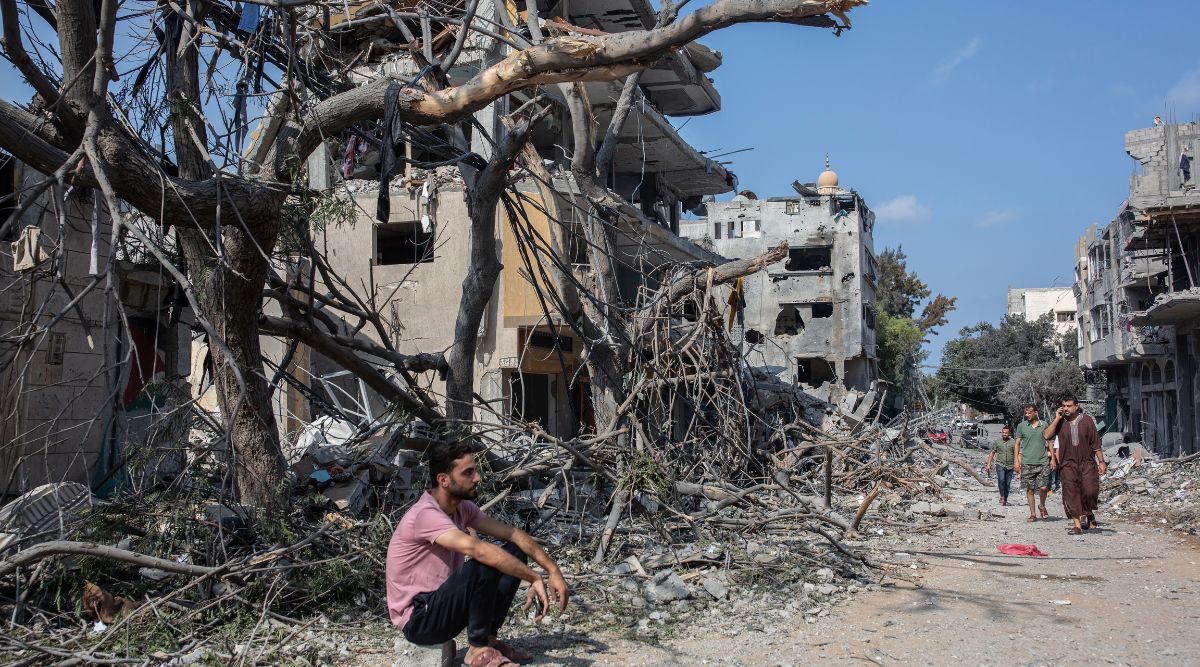 Local residents view the destruction following Israeli airstrikes on the Al-Rimal neighborhood of Gaza City on Tuesday. (NYT)
 Written by Steven Erlanger and Ronen Bergman
Israel, already bombing intensively in Gaza, is gearing up for a major military operation there unlike any in the past, warning the world that for Israel, after the massacre of its citizens by Hamas on Saturday, the rules have changed.
“Every Hamas member is marked by death,” Prime Minister Benjamin Netanyahu said Wednesday night, reflecting the government’s aggressive new vocabulary. On Thursday, standing with U.S. Secretary of State Antony Blinken, he compared Hamas to the Islamic State and said: “Hamas is ISIS, and just as ISIS was crushed, so too will Hamas be crushed.”
There is no disagreement in the new unity government, which must approve the military’s plans, on the need to dismantle Hamas — to ensure that it can never threaten Israel again and that those responsible for the killing of more than 1,200 Israeli civilians are hunted down, officials say.
That a major operation is coming is hardly in doubt. Already, near the border, there are massive, overt Israeli troop and tank deployments, and the country has called up 360,000 reservists.
But there are tactical arguments over how any operation should start, whether it will begin massively or with raiding parties, and how best to coordinate Israel’s overwhelming strength in land, sea and especially air power, said Yaakov Amidror, a retired major general who served as national security adviser to Netanyahu in an earlier government and has spoken to government officials.
Any invasion of Gaza, a small, densely populated territory of 2.3 million people, would be daunting. Hamas, the Islamist organization that has ruled the enclave for 17 years, knows the terrain exceedingly well, operates in a complex network of smugglers’ tunnels, has hidden weapons in centers of civilian life and has previously employed noncombatants as human shields.
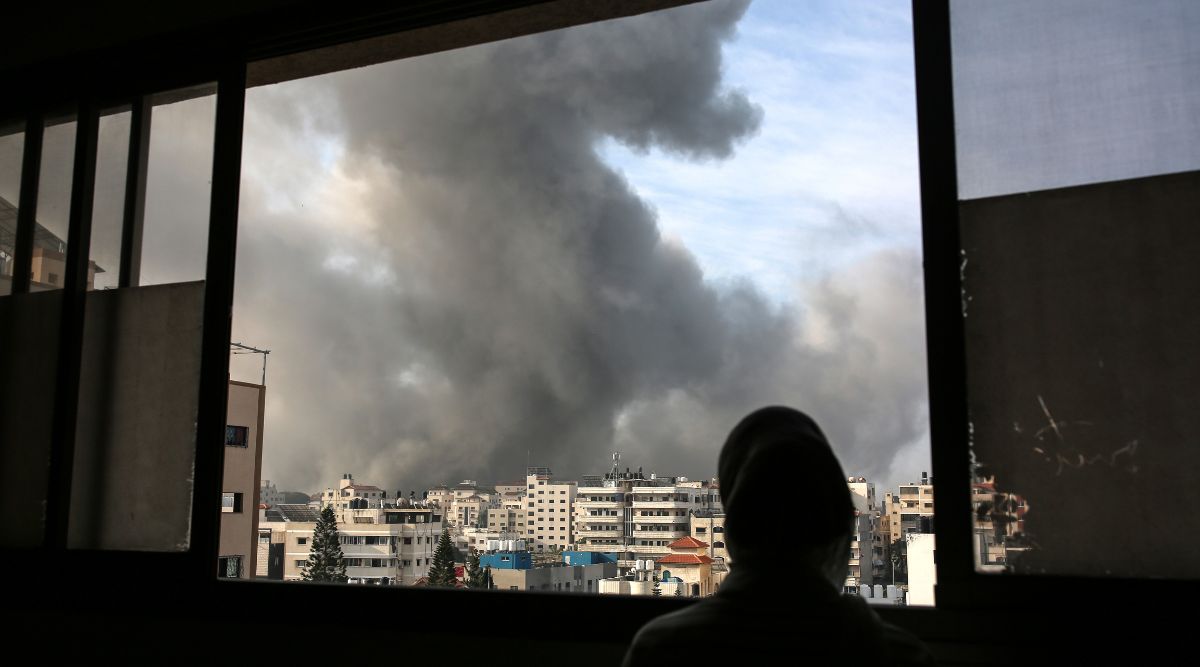 A woman watches from an apartment in Gaza City as smoke rises from Israeli airstrikes on Wednesday. (NYT)
Since turning Gaza over to the Palestinians, the Israelis have shown little appetite for a ground invasion. Before a more limited conflict nearly a decade ago, the military’s internal forecasts of major casualties were leaked to the news media — and the suspicion has long been that Netanyahu did it, to bring some realism to public debate over the cost of a Gaza reoccupation.
Amidror said there is also the issue of how best to encourage civilians to move out of the densely populated cities to safer ground. And hanging over everything is the question of how long Israeli forces would stay.
“There is not one member of the Cabinet who does not agree that Hamas must be smashed to ashes,” Amidror added. “How long it takes, the methods, how to minimize the number of civilian casualties, this is the dialogue.”
“If we have to take the whole Gaza Strip, we will do it slowly but surely, even if it takes six months,” he added, echoing what senior officers have said.
 Local residents view the destruction following Israeli airstrikes on the Al-Rimal neighborhood of Gaza City on Tuesday, Oct. 10, 2023. (NYT)
But there is little appetite for Israel to reoccupy the Gaza Strip, said Itamar Yaar, who helped plan Israel’s withdrawal of soldiers and citizens from Gaza in 2005 as deputy head of the National Security Council.
“Ground activity is not an end — it is a means” to achieve the political goal of ensuring that Hamas can never attack Israelis again, since that will be impossible only by air power, said Yaar, still a colonel in the reserves. But he warned that responsibility for governing the people of Gaza “is not good for us, and not for them.”
Ground operations will be varied, he suggested — taking over some territory, creating a buffer between different areas, doing raids based on intelligence and interrogations, trying to find and save hostages, and trying to find and kill Hamas soldiers.
It is also clear to everyone, he said, “that a ground operation will have a high price in Palestinian lives and in Israeli casualties.”
The failure of the vaunted Israeli intelligence services and military to predict and confront the Hamas invasion has provided an important cautionary note, according to two defense officials who took part in meetings about the possibility of a ground invasion and who spoke on condition of anonymity because of the sensitivity of the subject.
Some senior officials questioned whether the army is capable of effectively conducting a fierce war against a decently equipped and trained guerrilla movement in a built-up area that is their own, the defense officials said.
But a failure to respond effectively to Hamas could create an “existential danger” for Israel, losing its deterrence in the larger Mideast, one official said, let alone, the second official said, destroying the vital covenant the state has to protect its citizens.
“The IDF is responsible for the security of the country and its citizens,” the chief of general staff for Israel, Gen. Herzi Halevi, said Thursday, “and on Saturday, we did not live up to that.”
But the leap over the past is considerable. This time Israel must put aside some traditional values — that Israeli hostages must be protected and returned, that the lives of soldiers are precious, and that Israel as a democracy strives to avoid international prosecution and calumny.
This time, the officials suggest, Israel must defeat Hamas even at the cost of its hostages and its soldiers and an extensive bombing campaign that is already causing hundreds of civilian deaths in Gaza.
In previous conflicts with Hamas in Gaza, but especially in 2009, there were significant debates about whether to reoccupy the territory and destroy Hamas, said Ofer Shelah, a former legislator and a senior researcher at the Institute for National Security Studies in Tel Aviv.
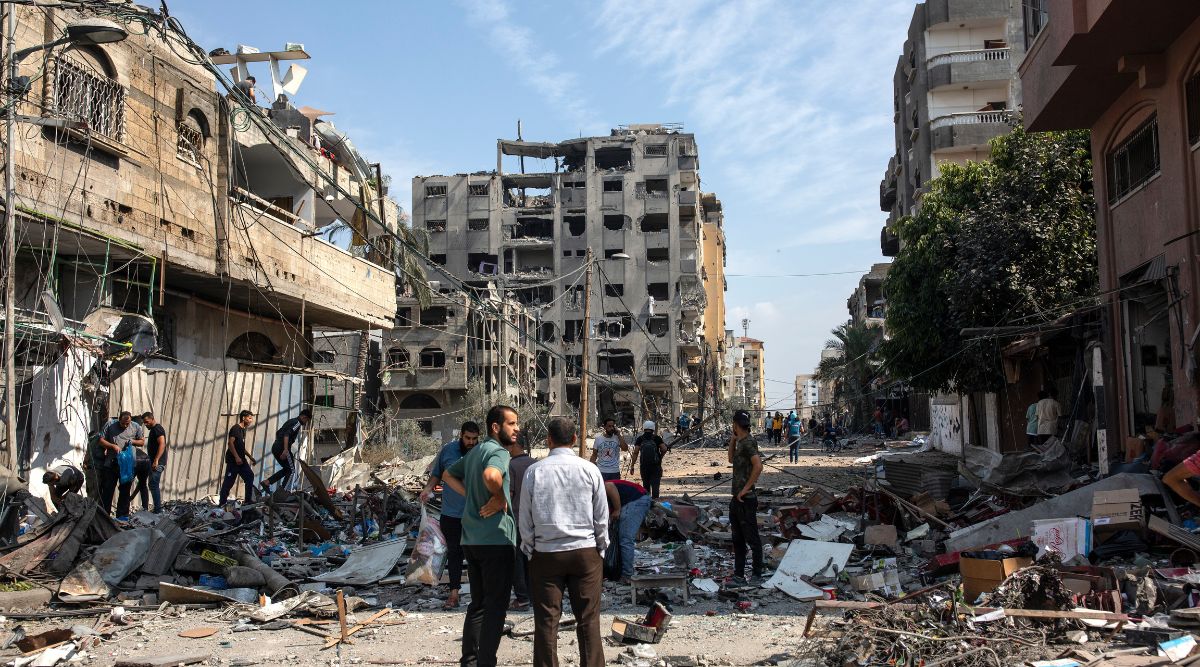 Residents evacuate their homes after a night of Israeli airstrikes and shelling in the Karama district north of Gaza City. (NYT)
In 2009, the Israeli infantry entered Gaza and progressed so well and with so few casualties that the government of Ehud Olmert, the prime minister at the time, split over whether to continue the operation.
Olmert and Yoav Gallant, then head of the Southern Command and now the current defense minister, wanted to continue, Shelah said. Others, like Ehud Barak, the defense minister at the time, successfully argued that enough damage had been done and that Israel did not want to retain responsibility for the welfare of the Palestinians there.
There was a similar debate in the 2014 conflict with Gaza, which also saw a ground invasion by Israel and cost more Israeli lives than in 2009, with pressure on the government to retake Gaza or parts of it.
The military briefed the security Cabinet then on the likely consequences. The predictions were many hundreds of dead soldiers and close to 10,000 dead Palestinians, said Udi Segal, the reporter who broke the story. The military said peace agreements with Egypt and Jordan could be at risk and the financial cost of controlling Gaza would be massive, Segal said in an interview.
Segal would not disclose his source, but many believe it to be Netanyahu in an attempt to temper the debate about reoccupying Gaza.
“I think the price today will be heavier than what was estimated then,” Segal said. “That still doesn’t mean that Israel won’t be forced to do it. All the previous moves were made with the thought that Hamas is not only a terrorist organization but also a government that can be reasoned with. Not anymore.”
The question is whether Israel will continue to try as hard as it has in the past — critics say, with little success — to obey the international rules of war against harming civilians.
President Joe Biden has cautioned Netanyahu to respect the Geneva Conventions and the rules of war, but Israel has already decided to cut off Gazans from electricity and water and bombed the official Rafah crossing to Egypt.
Israel has also announced that it will no longer alert residents of a building about to be bombed by dropping a nonexplosive projectile on the roof to warn them. Instead, it told Gazans to leave buildings that they know contain Hamas operatives or weapons, arguing that the convention permits the targeting of military objectives.
Israel is also being pushed to set up a humanitarian corridor to get urgently needed aid into Gaza, but that decision has not yet been made, according to Lt. Col. Richard Hecht, an army spokesman.
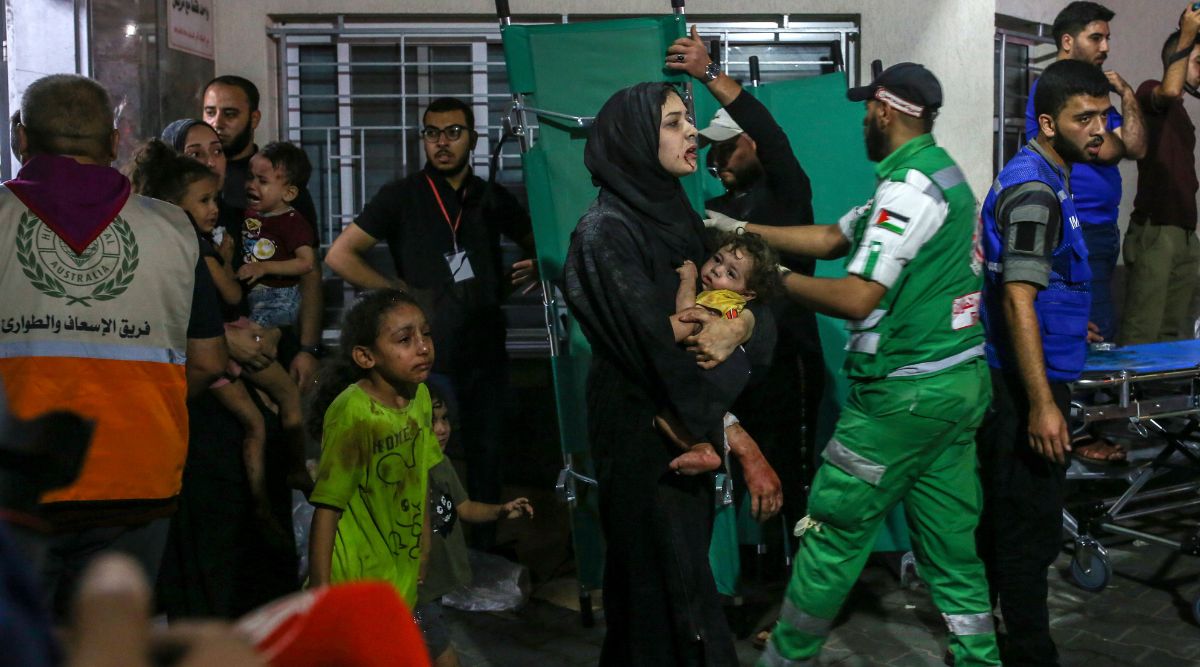 Injured people arrive for treatment at the Al-Shifa Hospital following Israeli airstrikes in Gaza City, Wednesday (NYT)
And Qatar, which has helped fund Gaza, is trying to set up a diplomatic channel to discuss the release of hostages by Hamas and a de-escalation. But a diplomat briefed on the talks, speaking on the condition of anonymity to avoid disrupting sensitive negotiations, said that neither side is interested in de-escalation now, and that the Israelis will not discuss anything until the women and children are released.
As for what may come afterward for Gaza, some point to 2002, when Israeli troops took over large areas of the occupied West Bank in difficult fighting during the second intifada, the largest Israeli military operation there since the 1967 war. Israeli troops finally withdrew from the cities and helped to strengthen the hold of the Palestinian Authority there.
But Gaza, said Amidror, is different; Israel has no interest in holding on to it and its population. Shelah suggests that it might be possible for the United States to organize a regional coalition to help Gaza including Egypt, the Gulf states and even Saudi Arabia, or to help restore the Palestinian Authority to power there.
But destroying Hamas entirely is a fool’s errand, said Yaar. “Hamas is a collection of people with religious faith, and this belief cannot be erased. What is possible is to damage their abilities.”
In 1956, Palestinian guerrillas attacked farmers in the fields of Nahal Oz, an Israeli kibbutz near Gaza, and killed and mutilated a young first lieutenant. The same kibbutz lost many people to Hamas last Saturday.
Then, Moshe Dayan, the prominent Israeli commander who was the chief of staff, gave a famous eulogy, in which he acknowledged that Israeli settlers were inspiring “potent hatred” among those “sitting in the refugee camps in Gaza,” because “before their eyes we have been turning the land and villages in which they and their forefathers lived into our own inheritance.”
 The Gaza Strip is visible in the distance beyond a sunflower field outside Nahal Oz, (Israel, 2015) Israel’s new unity government agrees that Hamas must be destroyed in the wake of its attacks on Israeli civilians in October 2023, but there is little appetite for a reoccupation of Gaza, and little agreement for now on how to proceed. (NYT)
He continued: “We are the generation of settlement, and without steel helmets and the maw of the cannon we will not be able to plant a tree or build a home.”
Their lives, more than anything, depended on their ability to defend themselves against the Arabs who wished to kill them, he said in summary. All the rest — development, the economy, society, and culture — were subordinate and must bend to the needs of security and survival.
Israel is today remembering his words.
Stay updated with the latest - Click here to follow us on Instagram