5 min read
Stay updated with the latest - Click here to follow us on Instagram

Journalism of Courage



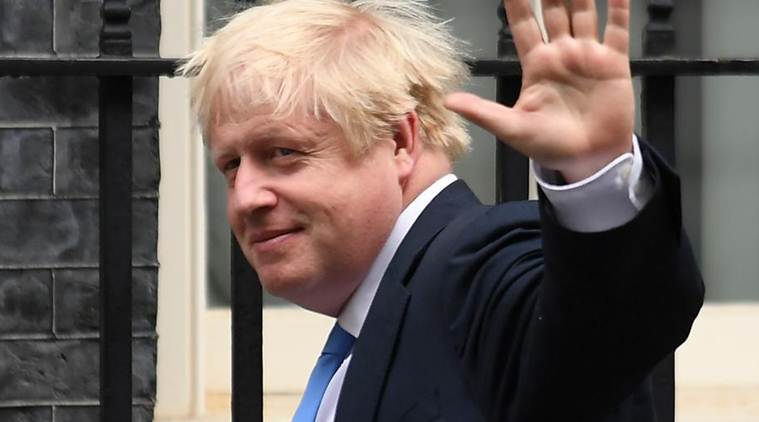 On Tuesday, Johnson appeared to disown some details of leaked British plans to resolve the central problem, an impasse over the Irish border. But he confirmed enough to suggest that the two sides remain far apart. (AP/A. Pezzali)
Written by Stephen Castle
As Prime Minister Boris Johnson readied the release of his final Brexit plan, politicians and diplomats on Tuesday were puzzling over a basic question: Is he more interested in reaching an agreement with the European Union, or averting blame for failure to get one?
A new proposal from Johnson is expected Wednesday, Britain is scheduled to leave the European Union at the end of October, and a deal with the bloc is needed urgently to avoid the risk of a disorderly, possibly chaotic and damaging rupture.
On Tuesday, Johnson appeared to disown some details of leaked British plans to resolve the central problem, an impasse over the Irish border. But he confirmed enough to suggest that the two sides remain far apart.
Optimists hope that the prime minister will produce an improved offer and that, with the clock ticking toward Oct. 31, an agreement can be clinched in the time-honored tradition of eleventh-hour European negotiations. But Johnson’s critics in Parliament and in Brussels say that he has no intention of offering a deal the bloc can accept.
They say he is more interested in positioning himself for a looming general election as the uncompromising champion of Brexit than in solving the cumbersome details of customs procedures for Ireland. “The blame game is underway,” said Anand Menon, professor of European politics and foreign affairs at King’s College London. “We are now in a territory where the political game is who is responsible for whatever outcome we have, rather than focusing on the outcome itself.”
Johnson said in a statement released late Tuesday by his office that he would outline a “fair and reasonable compromise” in his final plan when he presents it on Wednesday to a conference of his Conservative Party, underway in Manchester. Johnson also will repeat his insistence that he will not negotiate another delay.
“Voters are desperate for us to focus on their other priorities — what people want, what leavers want, what remainers want, what the whole world wants — is to move on,” Johnson said in the statement. “That is why we are coming out of the EU on October 31. Let’s get Brexit done — we can, we must and we will.”
But with a general election expected soon, the question of responsibility for the Brexit mess could be crucial. If talks collapse, Johnson could be forced by Parliament to break his word and seek another delay to Brexit. Or Johnson, who has said he would rather be “dead in a ditch” than seek such a delay, could try to defy or circumvent a law passed by Parliament prohibiting a no-deal Brexit.
In either outcome, Johnson would want to blame others — opposition parties and the European Union. In a sign of the growing tensions, the Irish prime minister, Leo Varadkar, suggested the leaked British plans were unacceptable.
The Conservatives have been meeting at a conference designed as a preelection showcase of Johnson’s policies, and hope to convince voters that once Britain leaves the European Union, the government would focus on domestic priorities like health care and crime. But there is no getting away from Brexit as Johnson approaches a critical moment in discussions with the European Union.
On Tuesday, Varadkar, speaking in the Irish Parliament, said he had welcomed Johnson’s words distancing himself from some ideas advanced in the leaked British papers, adding pointedly, “had he not, in my view, it would have been hard evidence of bad faith on behalf of the British government.”
“People in Northern Ireland don’t want a customs border between north and south,” he said.
British officials insist that the plans they are creating are workable and could produce a border that operates more securely than some of the European Union’s other external frontiers, for example the one with Russia.
Some progress has been made in discussions with the European Union. Johnson has already accepted that Northern Ireland could remain within the European Union’s trade umbrella for agricultural and some food products, even if he has refused to make the same concession for other goods.
British officials acknowledge, however, that their emerging proposals could violate some principles that European Union negotiators have set, and that both sides will have to compromise.
Speaking at the conference in Manchester, David Gauke, a former Cabinet minister who defied Johnson to support plans to prevent a no-deal Brexit — and was ejected from the Conservative Party for it — said that he was not optimistic about prospects for an agreement.
Though Johnson had been persuaded to pursue talks, Gauke said, “I fear that more recently the government has got to the position where it is all too difficult and there isn’t a solution.” His worry, he added, was that “we are not really after a deal but we want to show that it is not our fault.”
Stay updated with the latest - Click here to follow us on Instagram