© IE Online Media Services Pvt Ltd
 23 min read


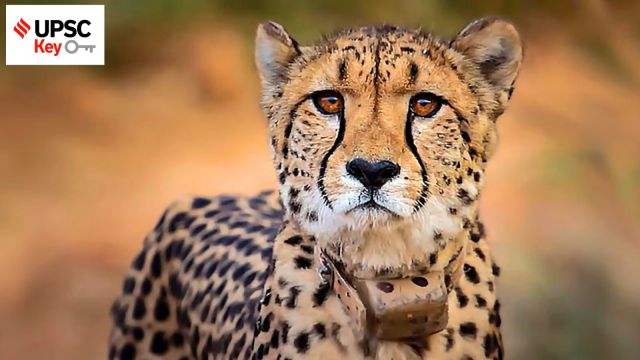 Cheetahs have been reintroduced from Kanha and other places to increase their population in the region. Know more in our UPSC Key.
🚨 Attention: UPSC Key is now all 7 Days a Week!🚨
Important topics and their relevance in UPSC CSE exam for June 12th, 2024. If you missed the June 11th, 2024 UPSC CSE exam key from the Indian Express, read it here.
🚨 The Indian Express UPSC Essentials brings to you the May edition of its monthly magazine. Click Here to read. Share your views and suggestions in the comment box or at manas.srivastava@indianexpress.com🚨
UPSC Syllabus:
Preliminary Examination: Current events of national and international importance
Mains Examination: GS-III: Environment
What’s the ongoing story- The Madhya Pradesh government has completed preparations for its ambitious cheetah reintroduction project at Gandhi Sagar Wildlife Sanctuary, which is slated to be the second home for cheetahs in India after Kuno National Park, an official said on Tuesday.
Prerequisites:
— What is Project Cheetah?
— What is the IUCN status of Cheetah?
— Location on Map: Satpura Tiger Reserve, Kanha National Park, Kuno National Park, and Gandhi Sagar Wildlife Sanctuary.
Key takeaways:
— Cheetahs have been reintroduced from Kanha and other places to increase their population in the region. 50 gaurs (Indian bisons) have also been successfully reintroduced from Kanha and Satpura Tiger Reserve to the Sanjay Tiger Reserve (in Sidhi district).
— On September 17, 2022, eight Namibian cheetahs – five females and three males – were released into enclosures at Kuno National Park in Sheopur district. In February 2023, 12 more cheetahs were brought from South Africa.
— Now, only 13 of the 20 adult cheetahs survive. Another 13 cubs born to these cheetahs put the total population of the animals in Kuno at 26 currently.
Points to Ponder:
— What caused the extinction of cheetahs in India?
— What are the challenges of the cheetah reintroduction project?
— What is the significance of the Project Cheetah?
— What is the IUCN status of Indian bison?
Post Read Question:
Consider the following: (UPSC CSE 2012)
1. Black-necked crane
2. Cheetah
3. Flying squirrel
4. Snow leopard
Which of the above are naturally found in India?
(a) 1, 2 and 3 only
(b) 1, 3 and 4 only
(c) 2 and 4 only
(d) 1, 2, 3 and 4
Other Important Articles Covering the same topic:
One year of Project Cheetah: Hits, misses and paradigm shift ahead
Developed as another home for cheetahs, Gandhi Sagar sanctuary in MP ready to welcome felines
UPSC Syllabus:
Preliminary Examination: Indian Economy
Mains Examination: GS-III: Indian Economy
What’s the ongoing story- India will remain the fastest-growing major economy recording a steady growth of 6.7 per cent in the next three years including the current financial year, said a world bank report released on Tuesday.
Prerequisites:
— Who publishes the Global Economic Prospects report?
— What is the World Bank?
— What are the major reports published by the World Bank?
Key takeaways:
— In India, growth is estimated to have picked up to 8.2 per cent in fiscal year (FY) 2023/24 (April 2023 to March 2024) — 1.9 percentage points higher than estimated in January, according to the World Bank’s latest Global Economic Prospects report.
— It further said global growth is projected to hold steady at 2.6 per cent in 2024 before edging up to an average of 2.7 per cent in 2025-26. That is well below the 3.1 per cent average in the decade before COVID-19.
— “India will remain the fastest-growing of the world’s largest economies, although its pace of expansion is expected to moderate. After a high growth rate in FY2023/24, steady growth of 6.7 per cent per year, on average, is projected for the three fiscal years beginning in FY2024/25,” the report said. This moderation is mainly due to a slowdown in investment from a high base.
Points to Ponder:
— What are the key factors driving economic growth in India?
— What are the present challenges that India is facing in terms of its growth trajectory?
— What are the World Bank-supported projects in India?
Post Read Question:
Prelims
‘Global Financial Stability Report’ is prepared by the (UPSC CSE 2016)
(a) European Central Bank
(b) International Monetary Fund
(c) International Bank for Reconstruction and Development
(d) Organization for Economic Cooperation and Development
Mains
Define potential GDP and explain its determinants. What are the factors that have been inhibiting India from realizing its potential GDP? (UPSC CSE 2020)
UPSC Syllabus:
Preliminary Examination: Current events of national and international importance
Mains Examination: GS-III: Economy
What’s the ongoing story- Amid scrutiny over surge in gold imports which has lately featured in inter-departmental consultations, the Commerce and Industry Ministry on Tuesday restricted jewellery and parts imports with immediate effect with an exception to imports from UAE under the free trade agreement (FTA), a notification issued by the Directorate General of Foreign Trade (DGFT) showed.
Prerequisites:
— How are gold prices determined in India?
— What is import authorization?
— What are gold findings?
— What is the Harmonised System of Nomenclature (HSN) code?
— India has Free Trade Agreements (FTAs) with which nations?
— Which nations are on the UN list of the Least Developed Countries (LDC)?
Key takeaways:
— A government official said that jewellery imports under the five Harmonised System of Nomenclature (HSN) code have not been banned and only put under authorisation to ascertain the reason behind an unusual surge in imports and better monitor the geographies from where the imports are taking place.
— This comes after official data showed that the imports of jewellery parts that have now been put under restricted category jumped 30 times to $1,551 million in 2023-2024 compared to $52 million during 2022-2023.
— India’s total gold imports has also been on the rise, taking the goods trade deficit in April to a 5-month high of $19.1 billion. This was largely driven by gold imports that jumped by a sharp 208.99 per cent to $3.11 billion in April this year compared to $1 billion in April last year.
— Notably, gold and silver bars attract a 15 per cent import duty, while gold and silver findings earlier faced 11 per cent import duty. Due to the difference in HSN codes for gold and silver bars as compared to gold and silver findings, importers were making use of the duty arbitrage to import gold in the form of findings and coins, rather than bars.
— Elevated gold price along with high import duty on the metal are seen as one of the key reasons behind the increased cases of smuggling.
For Your Information:
— “Gold prices recently reached historic highs of Rs 70,000 in India, mainly due to geopolitical tensions and Central Banks’ accumulation of gold reserves, which have outweighed the hawkish stance adopted by US Federal Reserve officials this year.”
Points to Ponder:
— How does the import of gold impact the Current Account Deficit (CAD) of India?
— What are the factors that affect gold prices worldwide?
— How are gold prices determined in India?
— What initiatives have been taken by the Indian government to reduce the dependence on gold imports?
Post Read Question:
Prelims
What is/are the purpose/purposes of Government’s ‘Sovereign Gold Bond Scheme’ and ‘Gold Monetization Scheme’? (UPSC CSE 2016)
1. To bring the idle gold lying with Indian households into the economy
2. To promote FDI in the gold and jewellery sector
3. To reduce India’s dependence on gold imports
Select the correct answer using the code given below.
(a) 1 only
(b) 2 and 3 only
(c) 1 and 3 only
(d) 1, 2 and 3
Mains
Craze for gold in Indians has led to a surge in import of gold in recent years and put pressure on balance of payments and external value of rupee. In view of this, examine the merits of the Gold Monetization Scheme. (UPSC CSE 2015)
Other Important Articles Covering the same topic:
Gold continues to glitter. What should investors do?
UPSC Syllabus:
Preliminary Examination: Current events of national and international importance
Mains Examination: GS-III: Economy
What’s the ongoing story– Indian rupee closed at a record low of 83.57 against the US dollar on Tuesday ahead of the outcome of the US Federal Open Market Committee (FOMC) and on strong greenback against major currencies.
Prerequisites:
— What is the appreciation of the currency?
— What is the depreciation of the currency?
— What is the Exchange Rate?
Key takeaways:
— Forex market participants said that the pressure on rupee is on account of strong dollar against major currencies and as the market is getting a bit nervous going into the Fed meeting.
— “The domestic currency is expected to trade with a slight negative bias on the strong US dollar and elevated crude oil prices. However, positive global markets and fresh foreign inflows may support rupee at lower levels.”
For Your Information:
— The Effective Exchange Rate (EER) is an index of the weighted average of the rupee’s exchange rates vis-à-vis the currencies of India’s major trading partners. The currency weights are derived from the share of the individual countries to India’s total foreign trade.
— There are two measures of EER- Nominal EEF and Real EEF.
— The Reserve Bank of India has constructed NEER indices of the rupee against a basket of six and also of 40 currencies. It is a trade-weighted average rate at which the rupee is exchangeable with a basic currency basket, comprising the US dollar, the euro, the Chinese yuan, the British pound, the Japanese yen and the Hong Kong dollar.
— The NEER indices are with reference to a base year value of 100 for 2015-16: Increases indicate the rupee’s effective appreciation against these currencies and decreases point to overall exchange rate depreciation.
— The REER is basically the NEER that is adjusted for the inflation differentials between the home country and its trading partners. If a country’s nominal exchange rate falls less than its domestic inflation rate – as with India – the currency has actually appreciated in “real” terms. It covers a bigger basket of 40 currencies of countries that account for about 88% of India’s annual trade flows.
Points to Ponder:
— What are the reasons for the depreciation of the Indian rupee?
— What is the impact of rupee depreciation/appreciation on the Indian economy?
— What is the role of the RBI and government in containing the depreciation of the Indian currency?
Post Read Question:
With reference to the Indian economy, consider the following statements: (UPSC CSE 2022)
1. An increase in the Nominal Effective Exchange Rate (NEER) indicates the appreciation of rupee.
2. An increase in the Real Effective Exchange Rate (REER) indicates an improvement in trade competitiveness.
3. An increasing trend in domestic inflation relative to inflation in other countries is likely to cause an increasing divergence between NEER and REER.
Which of the above statements are correct?
(a) 1 and 2 only
(b) 2 and 3 only
(c) 1 and 3 only
(d) 1, 2 and 3
Other Important Articles Covering the same topic:
How the rupee has ‘strengthened’ under Modi government
UPSC Syllabus:
Preliminary Examination: Current events of national and international importance
Mains Examination: GS-II: International Relations
What’s the ongoing story- C. Raja Mohan writes: “In his first trip abroad during his third term as prime minister, Narendra Modi will attend the summit of the leading Western nations — the so-called Group of Seven — in Fasano, Italy…The PM will now have a chance to reconnect and reboot the relations with the leaders of the West at the meeting of the G7 which is marking its 50th anniversary this year.”
Prerequisites:
— What is the Group of Seven (G7)?
— What is the Ukraine Peace Conference?
— What is the Shanghai Cooperation Organisation?
— Who will host the annual summit of leaders from the G7?
Key takeaways:
— “The G7 summit will also showcase the growing conflict between the West on the one hand and the Sino-Russian alliance on the other. This presents major new opportunities as well as challenges to Indian diplomacy.”
— “India, which has been a regular invitee to the G7 gatherings in the last few years, has a stake in developing deeper collaboration with the institutions of the so-called “collective West”.
— “Italy’s decision to focus on the G7’s engagement with Africa and the Mediterranean at the Fasano summit also creates the basis for a more imaginative regional engagement between Delhi and Rome as well as India and the G7. The connections between Mediterranean Europe and India’s extended neighbourhood in Arabia and Africa have now come into Delhi’s policy focus.”
— “India will also have much interest in the discussion on food and energy security, a major item on the G7 agenda in Italy. India has flagged both issues in the wake of the Russian invasion of Ukraine in February 2022.”
— “As great power conflict throws the world into dangerous disarray, the next few weeks will provide Modi and his advisers an opportunity to engage all the major actors, assess the competing imperatives among them, and think through Indian strategy and tactics in navigating the new dynamics.”
For Your Information:
— The G7 is an informal forum of leading industrialised nations, which include Canada, France, Germany, Italy, Japan, the United Kingdom and the United States. Representatives of the European Union are always present at the annual meeting of the heads of state and government of the G7.
Points to Ponder:
— What is the significance of the G7 summit for India?
— What are the initiatives of the G7?
— How geopolitics of the world are impacting global governance?
Post Read Question:
Consider the following countries:
1. China
2. Japan
3. Iceland
4. France
5. Italy
6. Norway
How many of the above mentioned countries form the part of the G7?
(a) Only two
(b) Only three
(c) Only four
(d) Only five
Other Important Articles Covering the same topic:
UPSC Syllabus:
Preliminary Examination: General Science
Mains Examination: GS-III: Science and Technology- developments and their applications and effects in everyday life
What’s the ongoing story- After much debate on the cost-benefit analysis and whether the new Alzheimer’s drug, Donanemab, was worth administering given its modest benefits and side effects, a committee of independent advisers to the US Food and Drug Administration (FDA) voted unanimously that the benefits outweigh the risks.
Prerequisites:
— What is Alzheimer’s disease?
— What causes Alzheimer’s?
— What are clinical trials?
Key takeaways:
— The drug, made by Eli Lilly, had generated much excitement as it slowed cognitive decline in patients in the early stages of the disease. But given that the effects were modest and there were risks such as swelling and bleeding in the brain, the FDA withheld approval in March.
— Just like its predecessor Lecanemab, Eli Lilly’s Donanemab is a monoclonal antibody that targets amyloid beta protein plaques in the brain, one of the defining features of Alzheimer’s disease that can be seen on imaging.
— Similar amyloid-fighting drugs, Leqembi and Biogen, were approved by FDA last year.
— According to studies, Donanemab may result in slightly higher adverse events than its predecessor Lecanemab.
For Your Information:
— The number of people living with or dying from neurological conditions such as stroke, dementia, Alzheimer’s disease and meningitis has risen sharply — by 18 per cent — over the last 30 years, according to a new analysis from the Global Burden of Disease, Injuries and Risk Factors Study (GBD) 2021.
Points to Ponder:
— How to prevent dementia?
— What are the concerns with the use of new drugs?
Post Read Question:
When is the World Alzheimer’s Day observed?
(a) June 21
(b) August 21
(c) September 21
(d) December 21
Other Important Articles Covering the same topic:
UPSC Syllabus:
Preliminary Examination: Current events of national and international importance.
Mains Examination: GS-II: Bilateral, regional and global groupings and agreements involving India and/or affecting India’s interests.
What’s the ongoing story- Results of the June 6-9 European Parliament elections, in which about 51% of 370 million-plus electors in 27 European Union (EU) countries voted, showed gains for rightwing and far right parties at the cost of mainly Left and liberal parties.
Prerequisites:
— What is the European Union (EU)?
— What are the member countries of the EU?
Key takeaways:
— The EU is a unique supranational entity. Its member states pool their sovereignty to acquire a collective strength and global influence that they cannot achieve individually.
— In practice, this means that member states delegate some of their decision-making powers to the shared institutions they have established. The European Parliament, the Council of the EU, and the European Commission (EC) are some of their core institutions.
— Members of the European Parliament (MEPs) are directly elected by citizens of the 27 member states. Therefore, it provides a certain democratic legitimacy to all EU activities.
— The 720 seats of the Parliament are allocated on the principle of ‘degressive proportionality’, meaning smaller states elect more MEPs than their populations would proportionally warrant. MEPs are chosen by proportional representation, ensuring the number of elected MEPs is proportional to the votes they receive.
— The Parliament has three major functions:
1. It adopts and amends EU legislation along with the Council of the EU.
2. It supervises the functioning of all other EU institutions and bodies, particularly the EC.
3. It approves or rejects appointments to the EC. Third, the Parliament shares authority over the EU budget with the Council, which allows it to influence EU spending.
— The Parliament also ratifies international agreements, including those on trade and investment.
— Voters in the European Parliament elections choose from their national political parties. The winning candidates then become part of Europe-wide political groups in the European Parliament. Almost all major parties in the 27 EU countries are affiliated with one or other of these European groups, based on commonalities in ideology.
Points to Ponder:
— How can the recent European Parliament elections results affect the EU’s policies on various issues?
— What are the areas of cooperation between India and EU?
— What is the significance of Europe for India?
Post Read Question:
Consider the following statements: (UPSC CSE 2023)
The ‘Stability and Growth Pact’ of the European Union is a treaty that-
1. limits the levels of the budgetary deficit of the countries of the European Union
2. makes the countries of the European Union to share their infrastructure facilities
3. enables the countries of the European Union to share their technologies
How many of the above statements are correct
(a) Only one
(b) Only two
(c) All three
(d) None
UPSC Syllabus:
Preliminary Examination: Current events of national and international importance
Mains Examination: GS-III: Security
What’s the ongoing story- Syed Ata Hasnain writes: “This is exactly what any active Jammu and Kashmir observer would have expected and it happened. When India celebrates, it’s not just an occasion of joy but also of caution because on the other side of the Line of Control (LoC) are those who exploit such occasions to send a message.”
Prerequisites:
— What is Article 370?
— What is insurgency?
Key takeaways:
— “The Resistance Front, a virtual euphemism for the Lashkar e Taiba (LeT), announced that the attack was the “beginning of a renewed start”. Terrorist organisations like to use big-ticket national events to convey messages.”
— “There is a history of Pakistan-sponsored terrorists striking in sync with big and historic events. The most significant one is the Chittisinghpura massacre of March 20, 2000, when 36 Kashmiri Sikhs were shot in cold blood by the same LeT…”
— “Two questions are relevant at this stage. First, is this a follow up to a successful general election in J&K, to convey that the assembly elections cannot be held as per the directions of the Supreme Court of India? September 30 is the deadline for that. Second, what should the government do to stave off public pressure? This pressure is obviously reflecting the deep-set anger at being at the receiving end with no response in kind.”
— “Under no circumstances must the system put off the assembly polls. All these years, despite difficult conditions and low turnout, polls were still held. The exercise of democracy and a good turnout is adequate messaging by the people against negative narratives.”
— “In the last 10 years, we clearly established our red lines leading to the surgical strikes and the aerial strikes at Jaba Top, in 2016 and 2019… A lowering of our threshold and redrawing of red lines is perhaps called for but not under pressure. Pragmatic war gaming will still throw up several more options.”
For Your Information:
— Reasi, along with Rajouri and Poonch, was a hotbed of militancy in the 1990s. Subsequently, the three districts in Jammu seemed to have contained the insurgency, until 2021, when terrorists attacked an army patrol in Poonch killing nine soldiers.
— In the past three years, terror attacks in Rajouri and Poonch have killed 38 soldiers and 11 civilians. The strengthening of the counter-infiltration grid in the Kashmir Valley could be a possible reason for a shift in terrorists’ actions towards these Jammu districts. However, unlike Rajouri and Poonch, Reasi is not close to the LoC. This development poses new security concerns.
— The Pir Panjal range, which separates Kashmir from Jammu, runs through the three districts. Passes in the range provide seasonal access to PoK and the Pir Panjal’s difficult terrain and dense forests allow the militants escape routes as well as launchpads for the attacks. The Reasi strike testifies to this mode of operation — militants reportedly hiding in a forest ambushed the bus carrying pilgrims.
Points to Ponder:
— What are the reasons for militancy in Jammu and Kashmir?
— What are the security challenges in the border states of India, especially Jammu and Kashmir?
— What are the various initiatives taken by the government to counter militancy in Jammu and Kashmir?
— What is the difference between militancy, insurgency, and terrorism?
Post Read Question:
Winning of Hearts and Minds’ in terrorism-affected areas is an essential step in restoring the trust of the population. Discuss the measures adopted by the Government in this respect as part of the conflict resolution in Jammu and Kashmir. (UPSC CSE 2023)
Other Important Articles Covering the same topic:
Attack on IAF convoy shows terrorism not over in Jammu and Kashmir: Farooq Abdullah
UPSC Syllabus:
Preliminary Examination: Indian Polity
Mains Examination: GS-II: Functions and responsibilities of the Union and the States, issues and challenges pertaining to the federal structure, devolution of powers and finances up to local levels and challenges therein.
What’s the ongoing story- Sachchidanand Shukla writes: “The general elections have led to a coalition government at the Centre. There is apprehension in certain quarters that a return to coalition politics after 10 years of single-party majority will lead to a shift in the country’s economic trajectory.”
Prerequisites:
— What is the Total Factor Productivity (TFP)?
— What is the Current Account Deficit (CAD)?
— What is coalition government?
Key takeaways:
— “India has seen coalition governments since the economic reforms of 1991. It’s only in the past 10 years that voters have given a decisive mandate for one party. The country’s economic history since 1991 has shown that coalition governments are good at reform and they also deliver high growth. The broader India story and the economic growth trajectory are likely to remain intact despite global headwinds.”
— “The total factor productivity (TFP) growth has been on the rise over the past decade and was approximately 2.2 per cent compared to -0.3 per cent for emerging markets in the previous decade. This can be sustained or even raised.”
— “The reform and growth trajectory will have to become much broader and inclusive. The new government is likely to continue with its investment-led economic agenda but it may need to modify its priorities somewhat.”
For Your Information:
— “The return of coalition politics in India will bring questions of federalism and Centre-state relations back to the fore. The BJP’s greater reliance on its regional allies, and its expanded stake in southern India, offers the potential for a federal reset. But whether this will happen is unclear.”
Points to Ponder:
— What are the notable economic reforms introduced by the previous coalition government?
— Can a coalition government derail India’s economic reforms trajectory?
Post Read Question:
What are the advantages and disadvantages of a coalition government on the economic stability of a nation?
Other Important Articles Covering the same topic:
No party wins majority: What does a coalition government mean for economic reforms in India?
Subscribe to our UPSC newsletter and stay updated with the news cues from the past week.
The UPSC articles of Indian Express is now on Telegram. Join our Telegram channel- Indian Express UPSC Hub and stay updated with the latest Updates.
https://www.youtube.com/watch?v=wsnxUastCeM?si=nKdH8rRCno86KYN7


Read UPSC Magazine