26 min read

© IE Online Media Services Pvt Ltd



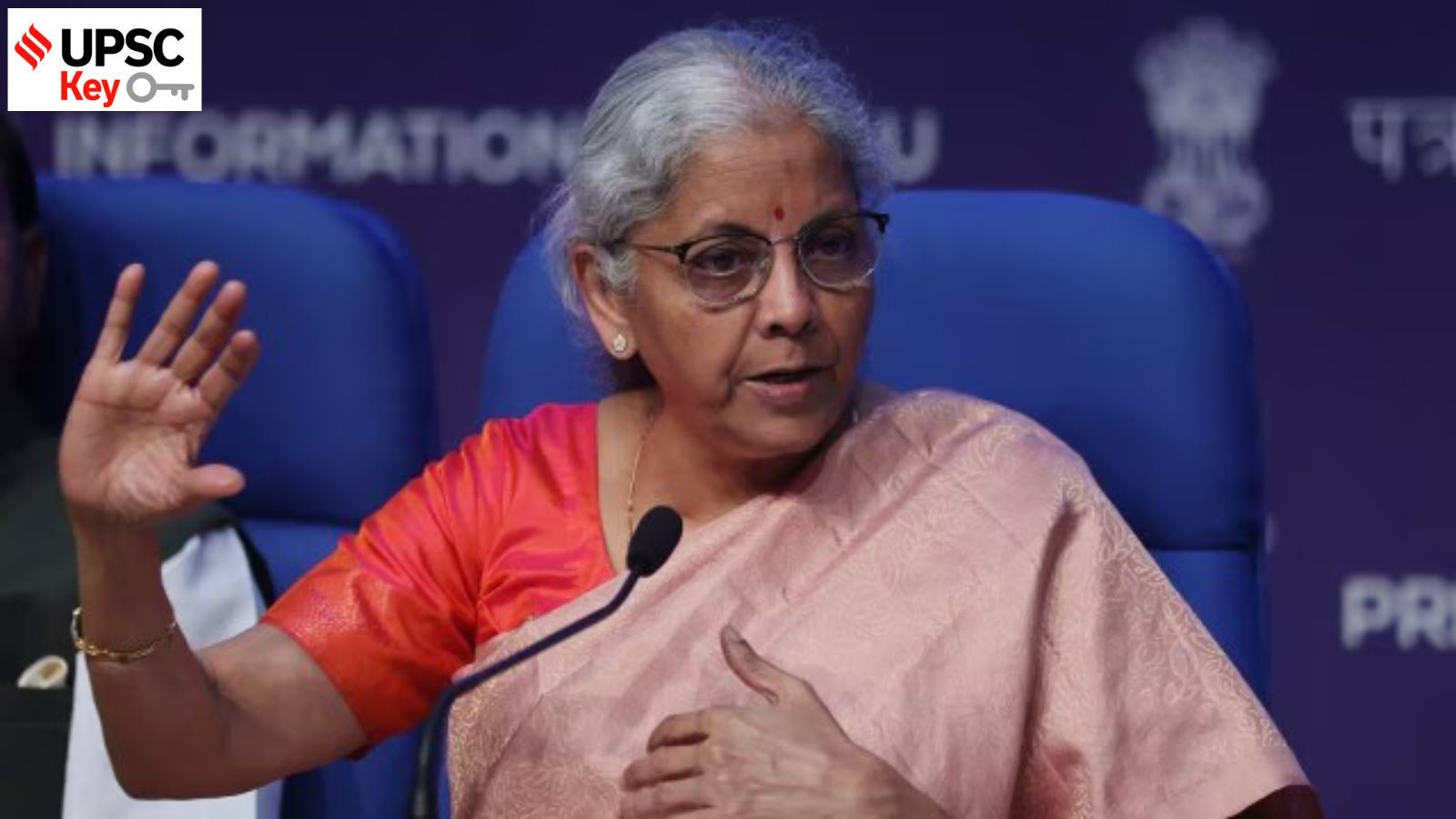 Once passed by Parliament, the new income tax law will likely come into effect on April 1, 2026. Know more in our UPSC Key. (Express Photo by Tashi Tobgyal)
Important topics and their relevance in UPSC CSE exam for March 9, 2025. If you missed the March 8, 2025, UPSC CSE exam key from the Indian Express, read it here.
Syllabus:
Preliminary Examination: Current events of national and international importance.
Main Examination: General Studies-II, III: Effect of policies and politics of developed and developing countries on India’s interests, Effects of liberalisation on the economy.
What’s the ongoing story: US President Donald Trump’s latest salvo that India has “agreed” to “cut their tariffs way down” did not elicit any immediate response from Delhi Saturday. Officials indicated it’s one bait that the Indian establishment is not going to bite, especially when the ground is being prepared for negotiations on a bilateral trade pact.
Key Points to Ponder:
• What are tariffs and why are they imposed?
• How are tariffs retaliated?
• How India’s trade strategy in future will adapt in response to these recent tariff impose developments?
• What strategies should India employ to navigate potential trade negotiations with the US?
• What can be the implications of protectionist trade policies, such as tariffs, on emerging economies like India.
• What are the highlights of the recent Modi-Trump meeting and what are the benefits and challenges associated with it?
Key Takeaways:
• Delhi offered no immediate response and officials pointed to the statement Friday by Randhir Jaiswal, spokesperson for the Ministry of External Affairs, who said “Commerce Minister Piyush Goyal was in the US and met his counterparts and the two governments were in the process of advancing discussions on a multi-sector bilateral trade pact.” Goyal was said to have returned from the US on Saturday.
• There are five broad takeaways from how Delhi views the latest Trump salvo.
• First, it was during Prime Minister Narendra Modi’s meeting with President Trump at the White House on February 13 that Delhi and Washington agreed to negotiate the first tranche of a mutually beneficial multi-sector Bilateral Trade Agreement (BTA) by fall this year — in the next seven-eight months.
• Second, the Indian side conveyed the seriousness and urgency to the Trump administration on February 13, saying it would send the lead negotiators once the US side had its Trade Representative in place.
• Third, the Indian side views this as a good start to the negotiations since both sides have a common understanding of the proposed deal.
• Fourth, given the broad scope of the deal outlined by both sides, the negotiations will be long and tortuous. This would mean several rounds of discussions between the negotiators at the technical and political levels.
• Fifth, until the negotiations take place, the Indian side will work with the Trump administration’s negotiators so that the reciprocal tariffs are not imposed. This is the expectation from Delhi’s side, officials said.
• Trump just delayed the imposition of tariffs on Canada and Mexico by a month, and Delhi will be looking at a similar situation — until the deal is finalised.
Do You Know:
• In the Indian assessment, a bilateral trade pact will deepen two-way trade across the goods and services sector, increase market access, reduce tariff and non-tariff barriers, and deepen supply chain integration. Negotiators will look to finalise the deal by autumn this year.
• The US is one of the largest trading partners of India with overall bilateral trade in goods and services of $190 billion for the calendar year 2023. India’s goods trade surplus with the US has been rising, particularly after the Covid-19 pandemic, doubling from $17.30 billion in 2019-20 to $35.33 billion in 2023-24, alongside a notable shift in the export basket. Meanwhile, India’s imports from the US over the past five years have grown at a slower pace compared to its exports.
• Tariffs are taxes or duties imposed by a government on imported goods and services. Their objective is to make foreign products more expensive compared to domestically produced goods, thereby encouraging consumers to prefer local products. Tariffs also act as a protective measure for domestic industries against foreign competition. Additionally, they serve as a source of revenue for the government.
Other Important Articles Covering the same topic:
📍UPSC Issue at a Glance | PM Modi’s US Visit: 4 Key Questions You Must Know for Prelims and Mains
📍UPSC Issue at a Glance | Tariff war: 4 Key Questions You Must Know for Prelims and Mains
UPSC Prelims Practice Question Covering similar theme:
(1) Consider the following statements:
1. Tariffs are taxes or duties imposed by a government on imported goods and services.
2. The objective of tariffs is to make foreign products more expensive compared to domestically produced goods.
Which of the statements given above is/are not correct?
(a) 1 only
(b) 2 only
(c) Both 1 and 2
(d) Neither 1 nor 2
UPSC Previous Year Mains Question Covering similar theme:
What are the key areas of reform if the WTO has to survive in the present context of ‘Trade War’, especially keeping in mind the interest of India? (UPSC CSE 2018)
Syllabus:
Preliminary Examination: Indian Polity and Governance- Constitution and Rights Issues
Mains Examination: General Studies-II: Government Policies & Interventions, Transparency & Accountability.
What’s the ongoing story: The District Consumer Disputes Redressal Commission, Jaipur II, has issued notices to Bollywood actors Shah Rukh Khan, Ajay Devgn and Tiger Shroff as well as Vimal Pan Masala manufacturers, J B Industries, over an alleged misleading advertisement for the pan masala.
Key Points to Ponder:
• What is the Consumer Protection Act, 2019?
• What are the key provisions of the Consumer Protection Act, 2019?
• How does the Consumer Protection Act of 2019 define ‘misleading advertisement’ ?
• What are the Consumer Protection Rules, 2021?
• What are the six essential consumer rights?
• What is the role and jurisdiction of the District Consumer Disputes Redressal Commission in addressing consumer grievances?
• How do misleading advertisements impact public health and consumer rights in India?
• Analyse the ethical and legal responsibilities of celebrities endorsing consumer products, particularly those that may pose health risks.
• Know about the Central Consumer Protection Authority (CCPA).
Key Takeaways:
• The commission issued notices following a complaint by Jaipur based advocate, Yogendra Singh Badiyal. He claimed that the actors indulge in misleading publicity about the mixing of saffron in Vimal “whereas the truth is that the price of saffron in the market is Rs 4 lakh per kg and gutkha costs only Rs 5. So let alone mixing saffron, even its fragrance cannot be added” to the said product.
• He has filed the complaint under two sections of the Consumer Protection Act, 2019: section 35 (a complaint, in relation to any goods sold or delivered or agreed to be sold or delivered or any service provided or agreed to be provided) and section 89, which states that “Any manufacturer or service provider who causes a false or misleading advertisement to be made which is prejudicial to the interest of consumers shall be punished with imprisonment for a term which may extend to two years and with fine which may extend to ten lakh rupees.”
• He claimed that the product is injurious to health “is known to the manufacturing company as well. Despite this, on the basis of false and misleading advertisements”, the general public is being invited to purchase the masala in the name of saffron. He said that the general public is facing loss of life and health due to this disinformation, and that it will have “serious consequences in the future.”
Do You Know:
• The Consumer Protection Act, 2019 replaced the Consumer Protection Act, 1986. The Act recognises offences such as providing false information regarding the quality or quantity of a good or service, and misleading advertisements. It also specifies action to be taken if goods and services are found “dangerous, hazardous or unsafe”.
• The Section 2(28) of the Consumer Protection Act, 2019 defines “misleading advertisement” in relation to any product or service which— (i) falsely describes such product or service; or (ii) gives a false guarantee to, or is likely to mislead the consumers as to the nature, substance, quantity or quality of such product or service; or (iii) conveys an implied representation which, if made by the manufacturer or seller or service provider thereof, would constitute an unfair trade practice; or (iv) deliberately conceals important information.
Other Important Articles Covering the same topic:
Previous year UPSC Prelims Question Covering similar theme:
(2) With reference to ‘consumers’ rights/privileges under the provisions of law in India, which of the following statements is/are correct ? (UPSC CSE 2012)
1. Consumers are empowered to take samples for food testing.
2. When a consumer files a complaint in any consumer forum, no fee is required to be paid.
3. In case of death of consumer, his/her legal heir can file a complaint in the consumer forum on his/ her behalf.
Select the correct answer using the codes given below:
(a) 1 only
(b) 2 and 3 only
(c) 1 and 3 only
(d) 1, 2 and 3
Syllabus:
Preliminary Examination: Indian Polity and Governance- Rights Issues
Mains Examination: General Studies-I, II: Salient features of Indian Society, Government policies and interventions for development.
What’s the ongoing story: Days after a song by popular rapper Yo Yo Honey Singh kicked up a row in the state, the Bihar Police have ordered a crackdown on the public broadcast of “vulgar” Bhojpuri songs. The songs, according to an order from March 7, “undermine the safety and dignity of women”.
Key Points to Ponder:
• What are Sections 279 and 79 of the Bharatiya Nyaya Sanhita, 2023, and how do they relate to the ban on vulgar songs?
• What is obscenity?
• How do vulgar songs impact societal values and gender sensitivity?
• What laws govern obscenity in content in India?
• What are the legal and ethical implications of restricting artistic expression in the name of public morality and safety?
• How can we balance censorship of music and artistic expression with freedom of speech and cultural diversity?
• What measures can be taken, apart from legal action, to promote responsible entertainment content in India?
• How effective are legal interventions in addressing obscenity in public spaces?
Key Takeaways:
• The order from Bihar ADGP for Weaker Sections Amit Kumar Jain directs senior officers to conduct special campaigns and file FIRs to eliminate the broadcasting of “vulgar” songs.
• The order states: “You are all instructed to conduct a special campaign to completely eliminate the broadcasting of obscene Bhojpuri songs in your respective areas, identify such cases, and direct all subordinates to register FIRs under Section 296/79 of the Bharatiya Nyaya Sanhita, 2023, and other relevant sections”.
• While Section 279 deals with ‘obscene acts and songs’, Section 79 deals with ‘word, gesture or act intended to insult the modesty of a woman’.
• Saying such songs, “broadcasted freely and without interruption”, have adverse effects, the order asks all Senior Superintendents of Police (SSP), Superintendents of Police (SP), including the railway police, to implement campaigns at all public spaces.
• “The cheap double-meaning Bhojpuri songs contribute to a culture of disrespect towards women, making them feel unsafe or experience shame in some way. Additionally, these songs send inappropriate messages to children, potentially influencing their behaviour negatively,” the ADG stated.
Do You Know:
• The Oxford dictionary defines obscene as ‘offensive or disgusting by accepted standards of morality and decency’.
• Section 294 of the BNS punishes those who sell, import, export, advertise, or profit from obscene material such as books, paintings, and figures and also includes the “display of any content in electronic form”.
Other Important Articles Covering the same topic:
UPSC Prelims Practice Question Covering similar theme:
(3) “Hicklin test” is related to:
(a) Physical fitness of sports professionals
(b) Firing tests, durability tests, accuracy tests, and more for military weapons
(c) Tests applied while sentencing an accused in a criminal case.
(d) None of the above
Syllabus:
Preliminary Examination: Indian Polity and Governance-Constitution, Political System, Panchayati Raj, Public Policy, Rights Issues, etc.
Mains Examination: General Studies-I, II : Population and associated issues. Government policies and interventions for development in various sectors and issues arising out of their design and implementation.
What’s the ongoing story: P Chidambaram writes- “Delimitation is a sword hanging over the states’ necks since the 42nd Amendment to the Constitution of India in 1977. Articles 81 and 82 of the Constitution are in clear language: they incorporate the principle of ‘one citizen, one vote’.”
Key Points to Ponder:
• What is delimitation and how is it done?
• What are the constitutional provisions related to delimitation?
• What is the history of delimitation in India?
• What do you understand by ‘one citizen, one vote’ one value’ principle?
• Is the Delimitation Commission’s decision beyond judicial review?
• What are Southern States concerns regarding delimitation?
Key Takeaways:
• “Article 81 puts a cap on the number of members of the Lok Sabha at not more than 530 chosen from the States and not more than 20 chosen from the Union Territories (UT). The current numbers are 530 for the States and 13 for the UTs.”
• “Sub-article (2)(a) reads: “there shall be allotted to each State a number of seats in the House of the People in such manner that the ratio between that number and the population of the State is, so far as practicable, the same for all States.”
• “The expression “population” means the population ascertained at the last preceding census, provided that until the first census taken after 2026, the population of the States shall be the numbers as per the 1971 census. Article 81 requires that after every census the number of seats allotted to a State shall be re-determined, but the exercise was paused until the census taken after 2026.”
• “There is no doubt that ‘one citizen, one vote’ is a basic principle of democracy but, as the Americans realised in 1776, it is contrary to the principle of federalism. They found a solution that seems to have served them well in the last 250 years. They re-determined from time to time the seats allotted to each of the 50 states in the House of Representatives on the basis of the population of the state, but gave equal representation (2 members) to each state in the Senate. India, like the US, is a democracy and a federation. We discovered the pitfalls of representation by proportion-of-population in 1971 but instead of finding a solution we kicked the can down the road until 2026.”
• “A census after 2026 would mean that delimitation must follow; re-determination of the number of seats allotted to each State will follow; and some States will be rewarded for the rapid growth of population and some States will be punished for attaining a total fertility rate (TFR) of 2.0 or below. The inequity of ‘one citizen, one vote’ will hit you on the head.”
• “If the total number of seats in the Lok Sabha is frozen at 530+13 and delimitation and re-determination are done as per Articles 81 and 82, the Southern states (Andhra Pradesh, Karnataka, Kerala, Tamil Nadu and Telangana) will lose badly. Their total number is estimated to come down from 129 to 103. Any manner of applying the principle of proportion-of-population to determine the number of seats in the Lok Sabha for states will ‘punish’ the states that have done well in reducing the fertility rate and stabilising their population — which was a national goal for over 50 years and still is.”
• “In terms of the voice of the state in the Lok Sabha, the low TFR states will be the losers and the high TFR states will be the gainers. The membership of the Rajya Sabha is already skewed in favour of the more populous States. If the central government sticks to the letter of Articles 81 and 82 of the Constitution and the Southern states stick to their opposition to re-determination based on population, it will be a case of an irresistible force facing an immovable object.”
Do You Know:
• In Independent India’s history, delimitation has taken place four times – 1952, 1963, 1973, and 2002.
• The Constitution has provided for an independent Delimitation Commission every decade to reapportion seats among states. The Commission is appointed by the President of India and comprises a retired judge of the Supreme Court or a high court, the Chief Election Commissioner, and the State Election Commissioner.
• Once published, the Commission’s orders are final and, as per the Delimitation Commission Act 1952 and Article 329A of the Constitution, has the “full force of law and shall not be called into question in any court”.
• The Supreme Court in its judgement in July 2024 held that the constitutional courts can review the orders of the delimitation commission and can also grant appropriate remedy if an order is manifestly arbitrary and irreconcilable to constitutional values.
Other Important Articles Covering the same topic:
Previous year UPSC Prelims Question Covering similar theme:
(4) How many Delimitation Commissions have been constituted by the Government of India till December 2023? (UPSC CSE 2024)
(a) One
(b) Two
(c) Three
(d) Four
(5) With reference to the Delimitation Commission consider the following statements:
1. The orders of the Delimitation Commission cannot be challenged in a Court of Law.
2. When the orders of the Delimitation Commission are laid before the Lok Sabha or State Legislative Assembly, they cannot effect any modification in the orders.
Which of the statements given above is/are correct?
(a) 1 only
(b) 2 only
(c) Both 1 and 2
(d) Neither 1 nor 2
Previous Year UPSC Mains Question Covering similar theme:
What changes has the Union Government recently introduced in the domain of Centre-State Relations? Suggest measures to be adopted to build the trust between the Centre and the States for strengthening federalism. (UPSC CSE 2024)
Syllabus:
Preliminary Examination: Current events of national and international importance
Mains Examination: General Studies II: Bilateral, regional and global groupings and agreements involving India and/or affecting India’s interests.
What’s the ongoing story: Foreign ministers from Muslim nations on Saturday rejected Trump’s calls to empty the Gaza Strip of its Palestinian population and backed a plan for an administrative committee to govern the territory to allow reconstruction to go ahead.
Key Points to Ponder:
• Know about the history and geography of the Gaza Strip.
• What is the historical background of the Israel-Palestine conflict?
• What are the socio-economic impacts of prolonged hostilities in Gaza on the civilian population?
• What is the proposed plan for the reconstruction of Gaza, and which countries are supporting it?
• What are the implications of European countries supporting the Arab initiative for Gaza’s reconstruction?
• What is the impact of the Gaza conflict on regional stability in the Middle East? How does it influence international relations?
• What is the significance of West Asia for India?
• What is the Organization of Islamic Cooperation (OIC)?
• Read about Hamas.
• Map work: Locations in news related to the Israel-Hamas conflict
Key Takeaways:
• Meanwhile, Hamas reported “positive signals” in talks with Egyptian and Qatari mediators on starting negotiations on the delayed second phase of its ceasefire deal with Israel.
• The foreign ministers gathered in Saudi Arabia for a special session of the Organization of Islamic Cooperation to address the situation in Gaza. The gathering supported a plan to rebuild Gaza put forward by Egypt and backed by Arab states. The OIC has 57 nations with largely Muslim populations.
• Without mentioning Trump, the ministers’ statement said they rejected “plans aimed at displacing the Palestinian people.”
• Since Sunday, Israel has barred all food, fuel, medicine and other supplies from entering Gaza for its more than 2 million people, demanding Hamas accept the revised deal. Hamas has said the cutoff will affect the remaining hostages as well. The foreign ministers of France, Germany, Italy and Britain said in a joint statement they welcome the Arab initiative for a Gaza reconstruction plan, calling it “a realistic path.”
Do You Know:
• During a joint press briefing with Israeli Prime Minister Benjamin Netanyahu, Donald Trump said that the US will “take over the Gaza Strip” and turn it into “the Riviera of the Middle East”, for “world people” to live in. He said that he saw the United States taking “a long-term ownership position” in Gaza. Saudi Arabia and Turkey have rejected the idea of the USA taking over Gaza and displacing Palestinians. Hamas, which controls Gaza, said Trump’s proposal was a “recipe for creating chaos and tension in the region.” Netanyahu, however, backed Trump, saying, “After the jaws drop, people scratch their heads and they say, ‘You know, he’s right’.”
• Gaza is a strip of land, just 365 sq km in size, wedged between the Mediterranean Sea to the west, Israel to the north and east, and Egypt to the south. It is 41 km long and 12 km wide at its widest point.
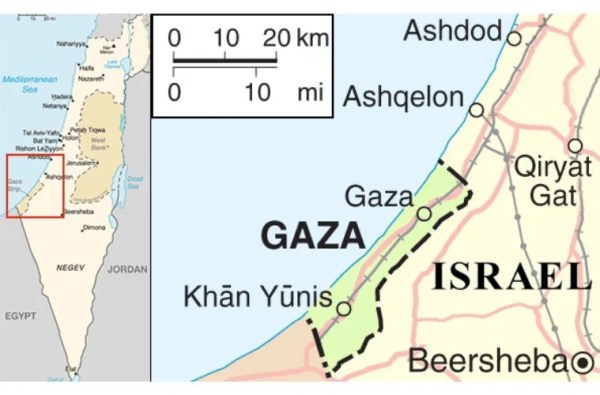 A map of the Gaza Strip. (Wikimedia Commons)
• It has been under military occupation since 1967, and even though Israel maintains that it pulled out in 2005, the United Nations, the European Union and other international organisations still consider Gaza as occupied territory. There are three functional border crossings between Gaza and the outside world – Karem Abu Salem Crossing and Erez Crossing controlled by Israel, and Rafah Crossing controlled by Egypt.
Other Important Articles Covering the same topic:
📍Egypt’s Gaza reconstruction plan endorsed by Arab League, rejected by Israel: What to know
📍There is a crisis of leadership in the Middle East
📍What is the Egyptian alternative to Trump’s Gaza plan?
📍Express View on Trump & Gaza: Protect the ceasefire
Previous year UPSC Prelims Question Covering similar theme:
(6) The term “two-state solution” is sometimes mentioned in the news in the context of the affairs of (UPSC CSE 2018)
(a) China
(b) Israel
(c) Iraq
(d) Yemen
Syllabus:
Preliminary Examination: Economic and Social Development
Main Examination: General Studies III: Indian Economy and issues relating to planning, mobilization, of resources, growth, development and employment.
What’s the ongoing story: The new Income-tax Bill proposes to give powers to tax officers to access social media and other digital accounts including online investment, trading and banking accounts, as well as email servers. The new I-T bill has defined “virtual digital space” in the powers to call for information by income tax authorities during surveys, searches and seizures.
Key Points to Ponder:
• What is ‘virtual digital space’ according to the new Income Tax Bill?
• What is the significance of including ‘virtual digital space’ in tax investigations?
• What new powers are granted to tax officers under Section 247 of the proposed Income Tax Bill?
• How does Section 247 of the new Income Tax Bill compare to Section 132 of the existing Income Tax Act of 1961?
• What are the potential benefits and concerns regarding tax authorities’ access to virtual digital spaces during searches and seizures?
• Analyze the debate between privacy and enforcement in the context of the new tax law.
• What could be the long-term implications of the Income Tax Bill of 2025 on digital economy regulation, tax compliance and financial transparency in India?
Key Takeaways:
• It defines a virtual digital space as “any digital realm that allows users to interact, communicate and perform activities” through computer technology.
• Sources said the new provision under Section 247 of the I-T Bill to override the access code of a virtual digital space is “only the reiteration of the already existing provision in a simpler language”. “No additional power has been given to the tax authorities,” a source said.
• Similar powers for searches and seizures are currently there under Section 132 of the existing I-T Act, 1961, wherein authorities can inspect and seize books of accounts and other documents in the form of electronic records. However, the new bill specifically outlines virtual digital spaces.
• As per Section 132 of the I-T Act, tax authorities can enter and search “any building, place, vessel, vehicle or aircraft” where persons are suspected to have kept books of account, other documents, money, bullion, jewellery or other valuable articles to evade tax. Authorities have the powers to break open doors, locks, safes, other repositories, and seize any such suspected books of account, other documents, money, bullion, jewellery or other valuable articles.
• Now, the new bill — tabled in the Lok Sabha last month — explicitly includes “virtual digital space” under the ambit of such searches and seizures as it attempts to define books of accounts and other valuable items in physical or electronic form. This also allows tax authorities to override the access code to any said computer system, or virtual digital space, where the access code thereof is not available.
Do You Know:
• The Income-tax Bill, 2025, which was introduced in Lok Sabha last month, intends to simplify India’s six-decade-old structure of direct taxation by streamlining provisions, removing obsolete references, and creating a crisper and simpler legal framework. The proposed bill will be reviewed by the Select Committee of Parliament. Once passed by Parliament, the new law will likely come into effect on April 1, 2026.
Other Important Articles Covering the same topic:
📍What’s new in the Income Tax Bill, 2025
📍New Income-Tax Bill: Simplified, shorter, new concept of ‘tax year’
Previous year UPSC Prelims/Mains Question Covering similar theme:
(7) With reference to India’s decision to levy an equalization tax of 6% on online advertisement services offered by non-resident entities, which of the following statements is/are correct? (UPSC CSE 2018)
1. It is introduced as a part of the Income Tax Act.
2. Non-resident entities that offer advertisement services in India can claim a tax credit in their home country under the “Double Taxation Avoidance Agreements”.
Select the correct answer using the code given below:
(a) 1 only
(b) 2 only
(c) Both 1 and 2
(d) Neither 1 nor 2
| ALSO READ | |
| China imposes reciprocal tariff on Canada | China has announced new tariffs on over $2.6 billion worth of Canadian agricultural and food products, responding to trade measures introduced by Canada in October. The tariffs, which will take effect on 20 March, mark a new chapter in ongoing trade tensions, largely influenced by US policies. |
| Two days of clashes, revenge attacks in Syria kill over 600 | More than 1,000 people have died in two days of violence in Syria, according to a war monitoring group, as reported by Associated Press (AP). Clashes between government forces and supporters of former President Bashar Assad, followed by revenge killings, have led to one of the deadliest incidents in the country’s 14-year conflict.Revenge attacks escalated on Friday, with Sunni Muslim gunmen, loyal to the government, targeting Alawites, Assad’s minority sect. The violence is a major challenge for Hayat Tahrir al-Sham, the group that helped overthrow Assad. |
| PRELIMS ANSWER KEY |
| 1. (d) 2. (c) 3. (d) 4. (d) 5. (b) 6. (b) 7. (d) |
🚨Union Budget 2025 special: Click Here to read the February 2025 issue of the UPSC Essentials monthly magazine. Share your views and suggestions in the comment box or at manas.srivastava@indianexpress.com🚨
Subscribe to our UPSC newsletter. Stay updated with the latest UPSC articles by joining our Telegram channel – Indian Express UPSC Hub, and follow us on Instagram and X.

Read UPSC Magazine