22 min read

© IE Online Media Services Pvt Ltd



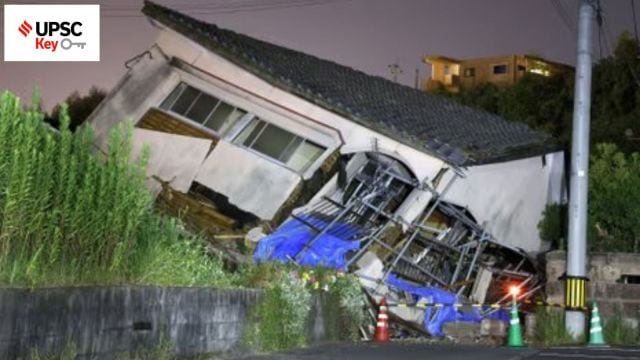 A collapsed house is seen following an earthquake in Osaki town, Kagoshima prefecture, southwestern Japan, August 8, 2024, in this photo taken by Kyodo. Know more in our UPSC Key. (Reuters)
🚨 Attention: UPSC Key is now all 7 Days a Week!🚨
Important topics and their relevance in UPSC CSE exam for August 12, 2024. If you missed the August 11th, 2024 UPSC CSE exam key from the Indian Express, read it here.
🚨 The Indian Express UPSC Essentials brings to you the July edition of its monthly magazine. Click Here to read. Share your views and suggestions in the comment box or at manas.srivastava@indianexpress.com🚨
UPSC Syllabus:
Preliminary Examination: Current events of national and international importance, World Geography
Mains Examination: GS-I: Important Geophysical phenomena such as earthquakes, Tsunami, Volcanic activity, cyclones.
What’s the ongoing story- After a 7.1-magnitude earthquake shook southern Japan on Thursday (August 8), the country’s meteorological agency issued its first-ever “megaquake advisory”.
Prerequisites:
— Read about the earthquakes.
— What is a megaquake?
— What is the Nankai Trough?
— How are earthquakes measured?
Key takeaways:
— The warning said the likelihood of strong shaking and large tsunamis is higher than normal on the Nankai Trough, a subduction zone (a region where tectonic plates collide with each other, and the heavier one slides under another) along Japan’s southwest Pacific coast.
— The Nankai Trough is an underwater subduction zone (nearly 900 km long) where the Eurasian Plate collides with the Philippine Sea Plate, pushing the latter under the former and into the Earth’s mantle. This accumulates tectonic stress which can cause a megaquake — an earthquake with a magnitude larger than 8.
— The trough has produced large earthquakes roughly every 100 to 150 years, according to the 2023 study, ‘High probability of successive occurrence of Nankai megathrust earthquakes’, published in the journal Nature. These tremors usually come in pairs, with the second often rupturing in the subsequent two years — the most recent “twin” earthquakes took place in 1944 and 1946.
— An accurate prediction of an earthquake needs a precursory signal from within the earth, indicating a big quake is on the way. The signal must also occur only before large earthquakes so that it does not indicate every small movement within the earth’s surface. Currently, there is no equipment to find such precursors.
For Your Information:
— The surface of the Earth is divided into 7 major plates and several minor ones. They move a few centimetres a year, riding on semi-molten layers of rock underneath the crust. As the plates move, they pull apart or collide, unleashing the powerful movements known as earthquakes.
Points to Ponder:
— How movements of sections of the Earth’s crust release the energy that we experience as earthquakes?
— What are the most earthquake-prone zones of the world?
(Thought process: Read about the circum-Pacific seismic belt, Alpide earthquake belt (mid Continental belt), and submerged mid-Atlantic Ridge.)
— What are the effects of earthquakes?
— What are the earthquake zones in India, and what measures have been taken by the government concerning the natural disaster?
Post Read Question:
(1) Consider the following: (UPSC CSE 2013)
1. Electromagnetic radiation
2. Geothermal energy
3. Gravitational force
4. Plate movements
5. Rotation of the earth
6. Revolution of the earth
Which of the above are responsible for bringing dynamic changes on the surface of the earth?
(a) 1, 2, 3 and 4 only
(b) 1, 3, 5 and 6 only
(c) 2, 4, 5 and 6 only
(d) 1, 2, 3, 4, 5 and 6
Other Important Articles Covering the same topic:
Explained: Understanding the earthquake
UPSC Syllabus:
Preliminary Examination: Current events of national importance and economic development
Mains Examination: GS-II, GS-III: Government policies and interventions, Economic development
What’s the ongoing story- The Union Cabinet on Friday approved the Clean Plant Programme (CPP), aimed at increasing the yield and productivity of horticulture crops in India.
Prerequisites:
— What is the Clean Plant Programme (CPP)?
— Read about the Mission for Integrated Development of Horticulture (MIDH).
— Organisation to look for: Asian Development Bank
Key takeaways:
— First announced in Union Finance Minister Nirmala Sitharaman’s interim Budget speech in February 2023, the CPP is also targeted at enhancing the quality of fruit crops across the nation.
— The Ministry of Agriculture has sought an allocation of Rs 1,765 crore for the programme. One half of this will be sourced from the budget of the Mission for Integrated Development of Horticulture (MIDH), while the other half will be in the form of a loan from the Asian Development Bank (ADB).
— The programme has three main components geared towards helping farmers obtain virus-free, high-quality planting material (plants used for vegetative propagation) in order to increase crop yields and improve income opportunities. These are:
1. Development of nine Clean Plant Centers (CPCs) which will provide disease diagnostics and therapeutics, create mother plants to be sent to nurseries.
2. Enhancement of infrastructure, including the development of large-scale nurseries to facilitate the efficient multiplication of clean planting material.
3. Creation of regulatory and certification process to ensure thorough accountability and traceability in the production and sale of planting material.
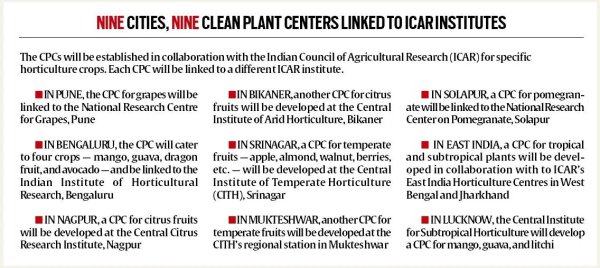
— At present, the process of importing plants is very cumbersome, with imported plants having to be kept in quarantine for two years. The CPCs will cut this period down to six months, and thus make it easier for farmers to access disease free and genuine planting material for horticultural crops in India.
For Your Information:
— India is the second largest producer of fruits and vegetables in the world after China. From 2013-14 to 2023-24, the area under horticulture crops has risen from 24 million hectares to 28.63 million hectares, and production has increased from 277.4 million metric tonnes (mt) to 352 million mt. India is also a major importer and exporter of fresh fruits.
Points to Ponder:
— What is the status of horticulture farming in India?
— What are the challenges faced by the horticulture sector?
— What are the government initiatives to improve horticulture?
Post Read Question:
Prelims
(2) With reference to the Clean Plant Programme, consider the following statements:
1. The programme has been launched under the Mission for Integrated Development of Horticulture (MIDH)
2. The initiative will ensure superior produce with enhanced taste, appearance and nutritional value.
3. It will provide access to virus-free and high-quality planting materials.
How many of the statements given above are correct?
(a) Only one
(b) Only two
(c) All three
(d) None
Mains
Assess the role of National Horticulture Mission (NHM) in boosting the production, productivity and income of horticulture farms. How far has it succeeded in increasing the income of farmers? (UPSC CSE 2018)
Other Important Articles Covering the same topic:
Govt approves Rs 1,766-crore ‘Clean Plant Programme’ to boost horticulture sector
UPSC Syllabus:
Preliminary Examination: Current events of national and international importance
Mains Examination: GS-II, GS-III: Government policies and interventions and Health
What’s the ongoing story- The Drug Controller General of India on August 7 formalised the pathway by which certain categories of new drugs can get marketing and manufacturing approval in the country without conducting local clinical trials.
Prerequisites:
— Read about the New Drugs and Clinical Trial Rules (2019).
— Know about the Drug Controller General of India and other major bodies regulating drugs and pharmaceuticals in India.
Key takeaways:
— Medicines for rare diseases, new cellular or gene therapies, drugs needed in a pandemic, and medicines specifically needed by the armed forces will be exempt from local trials if they have been approved by the US, the UK, Japan, Australia, Canada, or the European Union regulators. Drugs that have a therapeutic edge over existing treatments for a condition can also apply for this waiver.
— Waiving local clinical trials reduces huge cost burdens on companies. This is because trials are expensive- exactly how expensive depends on the kind of side effects that a medicine may cause, the number of sites and trial participants needed, and the duration of the trial, including patient follow-up.
— Waiving local trials will also help Indian pharma companies that have secured manufacturing licenses from international corporations. At present, even after obtaining manufacturing licenses, local clinical trials are a must for a product to enter the Indian market.
— The step will likely hasten entry of drugs for the treatment of rare diseases afflicting very few people, where trials take longer to recruit participants. Similarly, the availability of new cancer therapies, whose clinical trials require long follow-ups, may also be expedited.
— The exemption was included in the 2019 New Drugs and Clinical Trial Rules but had not been utilised until now because the drug regulator had not specified which countries’ approvals could be used to waive local trials. Wednesday’s notification clears the way for that.
Points to Ponder:
— What are the issues and challenges associated with the drug regulation in India?
— What measures have been taken by the government for efficient drug regulation?
— What are the challenges faced by the pharmaceutical sector in India?
Post Read Question:
(3) With reference to the India’s pharmaceutical exports, consider the following statements:
1. The pharmaceutical exports from India have decreased in 2023-24 as compared to 2022-23.
2. South Africa is the leading market for pharmaceutical exports from India.
Which of the statement(s) given above is/are correct?
(a) 1 only
(b) 2 only
(c) Both 1 and 2
(d) Neither 1 nor 2
Other Important Articles Covering the same topic:
Government waives clinical trial requirement for several drugs approved in select countries
UPSC Syllabus:
Preliminary Examination: Current events of national importance and economic development
Mains Examination: GS-II, GS-III: Indian economy, Statutory Bodies.
What’s the ongoing story- Securities and Exchange Board of India (Sebi) Chairperson Madhabi Puri Buch and her husband, Dhaval Buch, on Sunday said that their investment in the offshore funds, mentioned by Hindenburg Research in its latest allegations, were made in 2015 when they both were ‘private citizens’ living in Singapore.
Prerequisites:
— Read about the SEBI.
— What is the role of SEBI in regulating stock exchanges in India?
— What do you understand by the term “Conflict of interest”?
Key takeaways:
— A series of revelations, based on whistleblower papers, made by the US-based firm raise questions for SEBI, and turn the spotlight, specifically, on the regulator’s disclosure norms. The outright denial by all parties is hardly an answer.
— Hindenburg has alleged that Buch and her husband “had hidden stakes in the exact same obscure offshore Bermuda and Mauritius funds, found in the same complex nested structure, used by Vinod Adani”. During her tenure as a whole-time member of SEBI, it says, Buch was in communication with the managers of the offshore fund, and wrote to India Infoline to redeem the units in the fund.
— In her defence, Buch has said that “all disclosures as required have already been furnished to SEBI”. The SEBI code for board members asks that they disclose their interests which may conflict with their duties, along with transactions of family members.
— In light of the latest controversy, it must be asked that any connection between the regulator and the regulated must be publicly disclosed.
— When the market regulator is under a cloud, all stakeholders, from SEBI to the government, need to act urgently to clear it, fully protecting its institutional autonomy. A short-seller may play fast and loose — the Indian market, the world’s fourth largest by market cap, needs to ring-fence its regulator with a stronger firewall — and a higher bar.
For Your Information:
From Economy Page “All disclosures and recusals have been diligently followed: Madhabi, husband”
— On Saturday, US-based Hindenburg Research, in a post on X (formerly Twitter) alleged that Madhabi and her husband had stakes in obscure offshore funds used in the Adani money siphoning scandal. The short-seller alleged that the couple invested in Global Dynamic Opportunities Fund (GDOF), in which Vinod Adani, brother of Gautam Adani, had invested.
Points to Ponder:
— What are the powers and functions of SEBI?
— What are the issues and challenges associated with the SEBI?
— What measures should be taken to ensure transparency and efficiency in the functioning of the SEBI?
Post Read Question:
(4) Consider the following statements with regard to the Securities and Exchange Board of India (SEBI)
1. It was established as a statutory body in 1992.
2. The basic functions of the SEBI are to protect the interests of investors in securities and to promote the development of and regulate the securities market.
Which of the statements given above is/are correct?
(a) 1 only
(b) 2 only
(c) Both 1 and 2
(d) Neither 1 nor 2
Other Important Articles Covering the same topic:
As Sebi chief Madhabi Buch digs heels in, key query: Did she disclose fund linked to Adani?
UPSC Syllabus:
Preliminary Examination: Current events of national and international importance
Mains Examination: GS-II: India and its neighbourhood- relations.
What’s the ongoing story- Vivek Katju writes– “In less than three years, Indian foreign and security interests have suffered severe setbacks in three countries in India’s immediate neighbourhood.”
Prerequisites:
— What is the India’s Neighbourhood First policy?
— Read about the India’s Sagar vision?
— Map work: Neighbouring countries of India and bordering states
Key takeaways:
— “On August 5, Prime Minister Sheikh Hasina, the mainstay of India’s Bangladesh policy, had to resign at short notice amidst widespread and violent protests and flee to this country.”
— “On November 17, 2023, Mohamed Muizzu was sworn in as President of Maldives…He is committed to diminishing India’s role in the island country while enhancing China’s presence…And, on August 15, 2021, Afghanistan’s President Ashraf Ghani, in whom India had invested so much diplomatic capital, had to fly out of the country even as the Taliban took over.”
— “Were these grave reverses the consequence of misjudgements of those in charge of the country’s foreign and security policies or do the reasons lie in the structures of policy making in these critical areas.”
— “It is essential that the political and security classes introspect on these issues, avoiding political point scoring. The nation is facing such significant security challenges that it cannot afford the luxury of politics as usual on these matters.”
— “The government, apart from the judgement and instincts of its top leadership, has to rely on the professional advice given by the various ministries, organisations and agencies which handle India’s external interests. It has to be ensured that they work harmoniously. A brief consideration if this is so would not be out of place in view of the adverse impact to India’s interests in the cited cases of regime change.”
— “In 1968, India created its external intelligence service with the mandate to ensure that it develops the skills to explore and bring forth the subterranean which impacts India’s interests. It has a special role to play in the neighbourhood. Diplomats and officers of the external intelligence, MEA, other concerned ministries and the external intelligence agency have different but complementary roles and methods to safeguard and promote national interest. They have to avoid the temptation to tread into the others’ mandate.”
Points to Ponder:
— What is the history of India-Bangladesh relations?
— What are the areas of cooperation and conflict between India and Bangladesh?
— How have India-Afghanistan relations evolved over the years?
— What is the status of India-Maldives bilateral relations?
Post Read Question:
What is meant by Gujral doctrine? Does it have any relevance today? Discuss. (UPSC CSE 2013)
UPSC Syllabus:
Preliminary Examination: Current events of national and international importance
Mains Examination: GS-II: India and its neighbourhood- relations, bilateral, regional and global groupings and agreements involving India and/or affecting India’s interests.
What’s the ongoing story- The Maldives is a key partner for India in the Indian Ocean region and the two nations aspire to turn their cooperation into a modern partnership, External Affairs Minister S Jaishankar said on Sunday.
Prerequisites:
— How have India and Maldives bilateral relations evolved over time?
— What is EXIM bank?
— Map work: Location of Maldives, Atolls in news in Maldives, Lakshadweep’s Minicoy Island, Indian Ocean region.
Key takeaways:
— Jaishankar’s remarks came as he along with his Maldivian counterpart Moosa Zameer attended the handing over ceremony of Addu Reclamation and Shore Protection Project and inauguration of the 4-lane Detour Link road project facilitated by the Government of India under the Line of Credit of EXIM Bank.
— “The Maldives for us is a key partner in the Indian Ocean region. It is very much at the heart of our Neighbourhood First policy. And it is therefore very natural that the cooperation between our two countries has moved beyond the traditional role. And today really aspires to be a modern partnership,” Jaishankar said.
— India has partnered with the government of Maldives on the Addu Reclamation and Shore Protection project to find a sustainable way to develop it as a regional hub, he said.
For Your Information:
— The Maldives is an essential ally for India, helping to protect its maritime borders and monitor the wider Indian Ocean region, where China is waging war. The archipelago is located about 300 nautical miles (560 km) off the west coast of India and about 70 nautical miles (130 km) from Minicoy Island in Lakshadweep.
From the World Page: “Maldives Opp welcomes India policy recalibration”
— The Maldivian Democratic Party has welcomed President Mohamed Muizzu-led government’s “sudden recalibration” of its India policy and said Male has always been confident that India will always be the first responder any time the Maldives “dials an international 911”.
Points to Ponder:
— What are the areas of cooperation between India and the Maldives?
(Thought Process: Mention the essentials that India supplies to the Maldives, India’s support in the Maldives’ education system, the economic dependence of the Maldives on India—tourism—and India’s significant role during disasters.)
— What are the emerging challenges to India-Maldives relations?
— What steps can be taken by the government of India to strengthen bilateral relations with the Maldives?
— What is the significance of the Maldives for India?
Post Read Question:
Discuss the political developments in Maldives in the last two years. Should they be of any cause of concern to India? (UPSC CSE 2013)
Other Important Articles Covering the same topic:
Jaishankar meets Muizzu, says New Delhi attaches top priority to ties with Maldives
UPSC Syllabus:
Preliminary Examination: Environment and General Science
Mains Examination: GS-II, GS-III: Government policies and interventions, Environment, Agriculture, Economic Development
What’s the ongoing story- Prime Minister Narendra Modi on Sunday released 109 high-yielding, climate-resilient and biofortified varieties of crops at an event at the India Agricultural Research Institute in New Delhi.
Prerequisites:
— What is biofortification?
— Read about the climate-smart agriculture?
— What are climatically-vulnerable regions?
Key takeaways:
— “The 109 varieties of 61 crops released by the Prime Minister included 34 field crops and 27 horticultural crops. Among the field crops, seeds of various cereals including millets, forage crops, oilseeds, pulses, sugarcane, cotton, fibre and other potential crops were released. Among the horticultural crops, different varieties of fruits, vegetable crops, plantation crops, tuber crops, spices, flowers and medicinal crops were released,” The Prime Minister’s Office said in a statement.
— The PM also discussed the importance of millets, and about the benefits of “natural farming and the increasing faith of common people towards organic farming”.
For Your Information:
— Scientists at the Indian Council of Agricultural Research (ICAR) have been developing biofortified crops in India with a view to eradicating malnutrition amongst the poor sections of the society.
Points to Ponder:
— What are the benefits of climate-resilient and biofortified varieties of crops?
— How extreme weather events triggered by global warming are affecting agricultural production?
— Are biofortified crops developed through genetic modification (GM)?
— What are the issues and challenges associated with the biofortified crops?
Post Read Question:
Prelims
(5) Other than resistance to pests, what are the prospects for which genetically engineered plants have been created? (UPSC CSE 2012)
1. To enable them to withstand drought
2. To increase the nutritive value of the produce
3. To enable them to grow and do photosynthesis in spaceships and space stations
4. To increase their shelf life
Select the correct answer using the codes given below:
(a) 1 and 2 only
(b) 3 and 4 only
(c) 1, 2 and 4 only
(d) 1, 2, 3 and 4
Mains
Explain various types of revolutions, took place in Agriculture after Independence in India. How have these revolutions helped in poverty alleviation and food security in India? (2017)
Other Important Articles Covering the same topic:
For ‘climate smart’ agriculture
UPSC Syllabus:
Preliminary Examination: Current events of national and international importance
Mains Examination: GS-II: Effect of policies and politics of developed and developing countries on India’s interests.
What’s the ongoing story- President Volodymyr Zelenskiy said Ukraine had launched an incursion into Russian territory to “restore justice” and pressure Moscow’s forces, in his first acknowledgement of Kyiv’s surprise offensive into the western Kursk region.
Prerequisites:
— Read about the ongoing Ukraine-Russia war and the Bucha massacre.
— History of India-Russia bilateral relations.
— Map work: Places in news related to Ukraine and Russia.
Key takeaways:
— Moscow’s forces on Sunday were in their sixth day of intense battle against Kyiv’s largest incursion into Russian territory since the start of the war, which left southwestern parts of Russia vulnerable before reinforcement started arriving.
— Russian authorities rushed to evacuate residents and imposed a sweeping security regime in three border regions on Saturday, after the attack which military analysts say caught the Kremlin off-guard. Belarus, a staunch ally of Moscow, also sent more troops to its border with Ukraine, accusing Kyiv of violating its air space.
For Your Information:
— More than 76,000 people have been evacuated from areas bordering Ukraine in Russia’s Kursk region, the local emergency ministry was quoted by the Tass news agency as saying on Saturday, following Ukraine’s incursion into the region this week.
Points to Ponder:
— What is India’s stand on the Ukraine-Russia war?
— What are the areas of cooperation between India and Russia?
— What is the strategic significance of Russia for India?
— What has India gained or lost as a consequence of the ongoing Ukraine- Russia war, in terms of the impact on its economy, and its global diplomatic standing?
Post Read Question:
(6) Consider the following pairs:
(Place in news) (Location)
How many of the pairs given above are correctly matched?
(a) Only one
(b) Only two
(c) All three
(d) None
Other Important Articles Covering the same topic:
An Expert Explains: Russia-Ukraine war, two years on
| ALSO IN NEWS | |
| Will maintain smooth India, China ties, says Bangladesh interim government | Bangladesh’s newly-installed interim government on Sunday said it would maintain a “balanced” foreign policy, asserting that Dhaka intends to maintain “smooth and positive” ties with all, induding India and China. |
| Revalidate all decisions by contractual staff: DPIIT directs patent office | The Department for Promotion of Industry and Internal Trade (DPIIT) has asked the patent office to terminate its Memorandum Of Understanding with Quality Council of India (QCI) and form a committee consisting of 5 to 10 officials from Office of the Controller General of Patents, Designs and TradeMarks (CGPDTM) to re-validate all decisions taken by contractual staff, a government official told The Indian Express on Sunday. To know more read: Lakhs of patent orders by ‘outsourced’ staff null and void, says Law Ministry |
| ANSWER KEY |
| 1. (d) 2. (c) 3. (d) 4. (c) 5. (c) 6. (a) |
Subscribe to our UPSC newsletter and stay updated with the news cues from the past week.
Stay updated with the latest UPSC articles by joining our Telegram channel – Indian Express UPSC Hub, and follow us on Instagramand X.
https://www.youtube.com/watch?v=NLF5t533dYo?si=Mk58ZrQTa__DXVpp


Read UPSC Magazine