In less than three years, Indian foreign and security interests have suffered severe setbacks in three countries in India’s immediate neighbourhood. On August 5, Prime Minister Sheikh Hasina, the mainstay of India’s Bangladesh policy, had to resign at short notice amidst widespread and violent protests and flee to this country. On November 17, 2023, Mohamed Muizzu was sworn in as President of Maldives after winning the presidential election. He is committed to diminishing India’s role in the island country while enhancing China’s presence. His predecessor, Ibrahim Solih, had the opposite approach. And, on August 15, 2021, Afghanistan’s President Ashraf Ghani, in whom India had invested so much diplomatic capital, had to fly out of the country even as the Taliban took over. Were these grave reverses the consequence of misjudgements of those in charge of the country’s foreign and security policies or do the reasons lie in the structures of policy making in these critical areas?
It is essential that the political and security classes introspect on these issues, avoiding political point scoring. The nation is facing such significant security challenges that it cannot afford the luxury of politics as usual on these matters. Indeed, it was encouraging that the government called an all-party meeting on August 6 to brief the Opposition on the developments in Bangladesh and the Opposition leaders have responded, as yet, by not raising the temperature on the government’s handling of Bangladesh. This government-Opposition dialogue should continue in the coming weeks and months and extend also to a consideration of policy-making structures — ultimately, the government, apart from the judgement and instincts of its top leadership, has to rely on the professional advice given by the various ministries, organisations and agencies which handle India’s external interests. It has to be ensured that they work harmoniously. A brief consideration if this is so would not be out of place in view of the adverse impact to India’s interests in the cited cases of regime change.

The Ministry of External Affairs (MEA) is in charge of managing the foreign policy of the country. It is manned by the Indian Foreign Service (IFS) whose mandate is to look after India’s external interests. In the neighbouring countries, India’s embassies are helmed by diplomats who are carefully chosen for their competence and understanding of regional and global affairs. They have insights not only into the thinking, inclinations and compulsions of the political leaders of their countries of posting, but of the country’s social, economic and political trends. The top management of MEA has similar capabilities to appropriately advise the country’s political leadership.
In 1968, India created its external intelligence service with the mandate to ensure that it develops the skills to explore and bring forth the subterranean which impacts India’s interests. It has a special role to play in the neighbourhood. Diplomats and officers of the external intelligence, MEA, other concerned ministries and the external intelligence agency have different but complementary roles and methods to safeguard and promote national interest. They have to avoid the temptation to tread into the others’ mandate. In this context, it needs to be examined how far the original idea regarding the constitution of the external service has been adhered to.
In a paper published in 2019 in the Journal of Defence Studies of the Manohar Parrikar Institute for Defence Studies and Analyses, P S Raghavan, a distinguished diplomat who, after his retirement, chaired the National Security Advisory Board, examined the additions made to India’s National Security Structure after its nuclear tests of 1998. As India became a nuclear weapons state and in the quarter century since, naturally, new security structures had to be put in place to meet new and growing challenges. These emanated from changing global power equations, technological changes in the cyber and space fields — to mention only two. They had a direct bearing on the country’s defence and internal and external security. In addition, concerns in the neighbourhood have only increased with China’s rise and its continuing hostility towards India.
The formation of new structures began in 1999 with the creation of the National Security Council chaired by the Prime Minister, a Strategic Policy Group, and, most significantly, the creation of the post of National Security Advisor (NSA). A National Security Council Secretariat (NSCS) was established to service these new structures.
Within a relatively short period it became clear, as Raghavan notes, “the NSA was to assist the Prime Minister on foreign policy, defence, atomic energy and space issues (besides internal and external security)”. Raghavan also writes “the quickest and most effective means to reach a foreign government in times of crises is through the NSA”. Along with the importance of the NSA, the NSCS has also proportionately grown. After 2018, it consists of four officials of Deputy NSA rank dealing with different areas of foreign and security issues. Following this year’s elections, an officer of Additional NSA status has been added. There is, therefore, an elaborate security structure now, in addition, to the line ministries and the intelligence agencies. The ultimate purpose of the NSA and NSCS is to coordinate strategic and security related work but, as Raghavan writes, “turf” issues arise.
The overriding question in considering the foreign policy failures in Afghanistan, Maldives and Bangladesh is why should the Indian system have been taken by surprise by the swiftness of the final changes, even if it had an inkling that all was not well in these countries in the context of Indian interests. These surprises occurred despite the large structures that are now in place. Are “turf” issues responsible and, if so, how high do they reach? Or were there a series of misjudgements and, if so, by whom?
The writer is a former diplomat

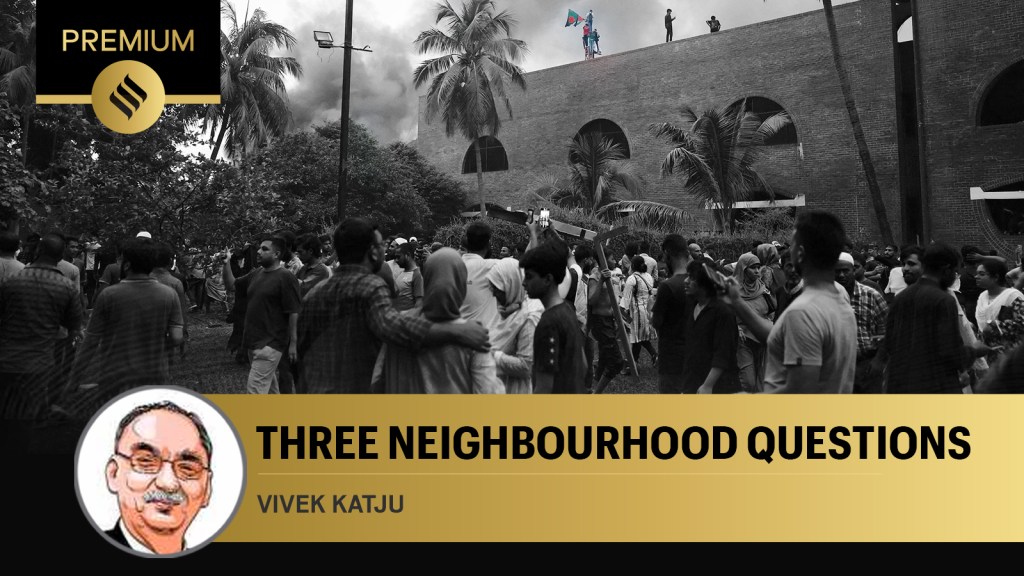 Smoke rising from Ganabhaban, the PM’s residence, which was stormed by public shortly after Hasina’s resignation. (Reuters)


 Share


