21 min read


© IE Online Media Services Pvt Ltd



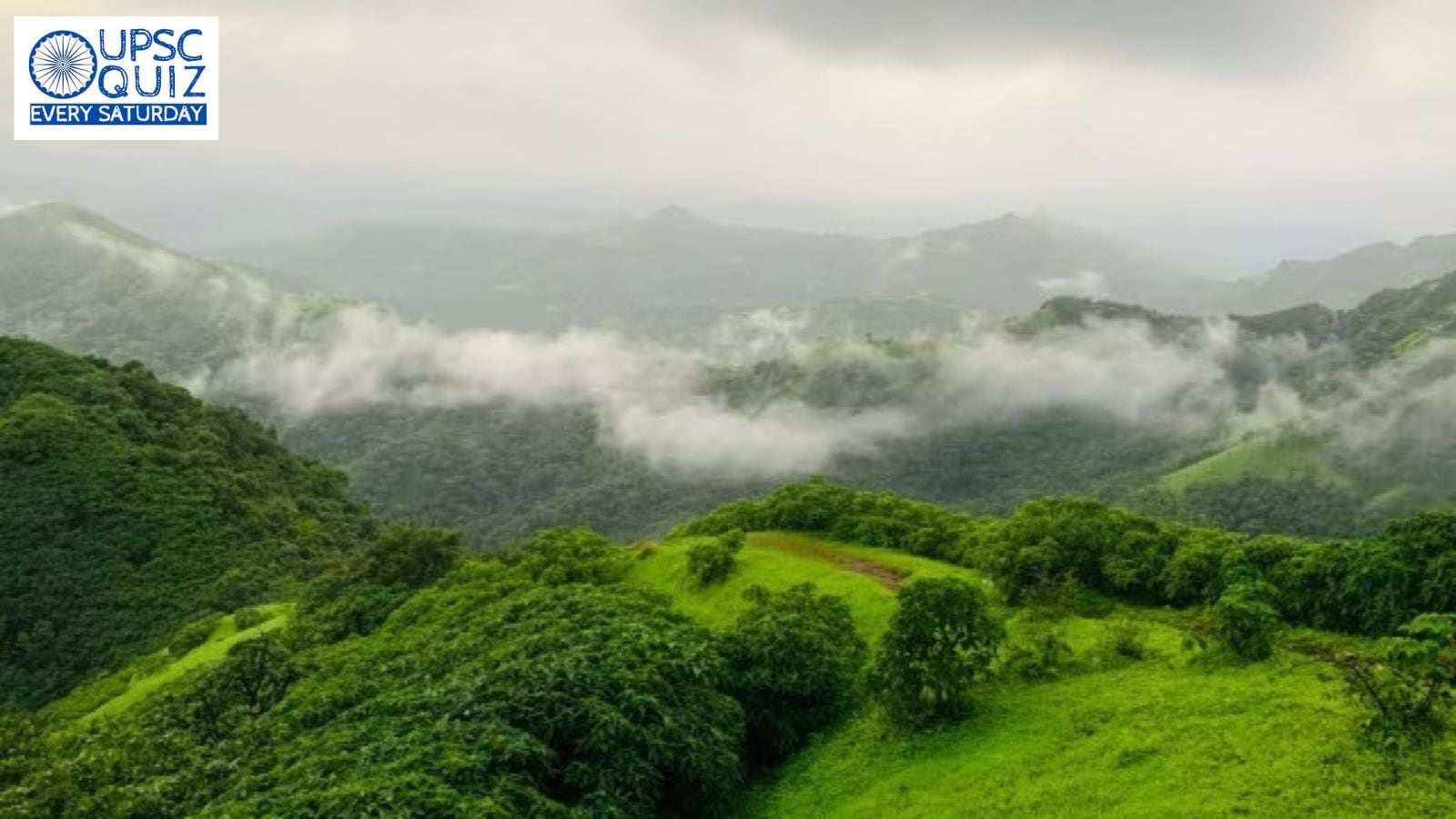 The Western Ghats are one of the world’s most important biodiversity hotspots. Find a question on Western Ghats in today's quiz. (Representational image via Canva)
UPSC Weekly Quiz is a current affairs-based quiz on relevant topics from the past week, curated for the aspirants of competitive examinations. Attempt the weekly quiz every Saturday and find answers to the MCQs with explanations at the end of the article.
With reference to the Digital Health Incentive Scheme (DHIS), consider the following statements:
1. The scheme was launched by the National Health Authority (NHA) to promote digital health transactions.
2. It was launched in 2018.
3. The scheme is applicable to only public hospitals.
4. The central government has given one year extension to DHIS and now it will remain in effect till June 30, 2025.
How many of the statements given above are correct?
(a) Only one
(b) Only two
(c) Only three
(d) All four
With reference to the Unlawful Activities (Prevention) Act (UAPA), consider the following statements:
1. The UAPA grants the state more powers than it has in ordinary criminal law – from relaxing timelines for the state to file chargesheets and its stringent conditions for bail.
2. Section 13 of the UAPA deals with punishment for unlawful activities for advocating, abetting or inciting any unlawful activity and is punishable with imprisonment up to seven years.
3. Unlawful activity under the UAPA is defined to include an act which causes “disaffection against India” among others.
How many of the statements given above are correct?
(a) Only one
(b) Only two
(c) All three
(d) None
The Kavli Prizes are awarded in:
1. Astrophysics
2. Nanoscience
3. Neuroscience
4. Biochemistry
5. Outer Space
Select the correct answer using the codes given below:
(a) 1 and 2 only
(b) 1, 2 and 3 only
(c) 1, 2, 3 and 4 only
(d) 1, 2, 3, 4 and 5
The term “Donanemab” was in news. It is associated with:
(a) Therapy for Alzheimer’s disease
(b) Volcano erupted in Iceland
(c) Atoll in Maldives
(d) Drug for bird flu
The A.K Rajan Committee was in news recently. The committee is related to:
(a) Strengthen the Capital Goods Sector
(b) Preventing stubble burning
(c) Loan Restructuring
(d) Study the impact of the NEET-based admission process
The Centre has proposed eco-sensitive areas (ESA) to protect the Western Ghats. The Western Ghats passes through how many states?
(a) Three states
(b) Four states
(c) Five states
(d) Six states
With reference to the Agnipath scheme, consider the following statements:
1. The scheme aims to recruit personnel who are not commissioned officers — to the Indian Armed Forces.
2. The maximum age to join as an Agniveer is 21 years.
3. The scheme was introduced in the year 2021.
How many of the statements given above are correct?
(a) Only one
(b) Only two
(c) All three
(d) None
Lachung was recently in news due to road blockages caused by heavy rainfall and landslides. It is located in:
(a) Arunachal Pradesh
(b) Sikkim
(c) Assam
(d) West Bengal
With reference to the SpaceX’s Starship rocket, consider the following statements:
1. Starship is a single-stage heavy lift-off vehicle designed to carry crew or cargo to Earth orbit.
2. The Super Heavy booster consists of 33 Raptor engines which use a 3.6:1 ratio of liquid oxygen and liquid methane.
3. The Starship rocket system is designed to be entirely, and rapidly reusable.
How many of the statements given above are correct?
(a) Only one
(b) Only two
(c) All three
(d) None
With reference to the speaker of the Lok Sabha, consider the following statements:
1. The Speaker is elected by the special majority (two-third) of the parliament.
2. The term of the speaker ends with the dissolution of the House.
3. A motion of no-confidence cannot be moved against the Speaker.
4. Qualifications for becoming a Speaker is mentioned in the Constitution of India.
How many of the statements given above are correct?
(a) Only one
(b) Only two
(c) Only three
(d) All four
With reference to Bayesian Convolutional Neural Network (BCNN), recently seen in news, consider the following statements:
1. It uses the latest technologies such as Artificial Intelligence (AI), deep learning, and machine learning (ML) to improve forecasts related to the ENSO phases.
2. World Meteorological Organisation has developed this product to predict the emergence of El Niño and La Niña conditions up to 15 months in advance.
3. It is a statistical model of forecasting weather, which generates forecasts based on various information sets received from different countries and regions.
How many of the statements given above are correct?
(a) Only one
(b) Only two
(c) All three
(d) None
Consider the following statements:
Statement 1: Heatwaves have not been included as a notified disaster in the Disaster Management Act.
Statement 2: Heatwaves were a common occurrence during summer, and not really an unusual weather event.
Which one of the following is correct in respect of the above statements?
a) Both Statement-I and Statement-II are correct and Statement-II is the correct explanation for Statement-I
b) Both Statement-I and Statement-II are correct and Statement-II is not the correct explanation for Statement-1
c) Statement-I is correct but Statement-II is incorrect
d) Statement-I is incorrect but Statement-II is correct
Recently seen in news, ‘Tharsis’ refers to:
(a) Volcanic plateau
(b) Solar flare
(c) Abbysal hill
(d) Meteor
Consider the following statements and answer the question below:
1. Agricultural production and livestock rearing were the two key human-driven sources of nitrous oxide.
2. The Global Carbon Project analyses the impact of human activity on greenhouse gas emissions and earth systems and quantifies emissions of carbon dioxide, nitrogen dioxide and nitrous oxide—three major planet-warming gases—to inform public policy and international action.
3. High levels of nitrous oxide in the atmosphere can deplete the ozone layer and compound effects of climate change.
How many statements given above are correct?
(a) Only one
(b) Only two
(c) All three
(d) None
With reference to G7 consider the following statements:
1. The G7 originated from a 1973 meeting of finance ministers and central bank governors in France which was convened in response to major economic challenges of at time including collapse of the Bretton Woods system.
2. Russia’s inclusion in 1998 expanded the group to the G8, but its membership was suspended in 2014.
3. India has been invited as an outreach country to the G7 Summit 2024.
How many of the statements given above are correct?
(a) Only one
(b) Only two
(c) All three
(d) None
FYI:
— The central government has extended the Digital Health Incentive Scheme (DHIS) for a year, with the goal of digitising patients’ health information and linking them to the Ayushman Bharat Digital Health Account (ABHA ID). Hence, statement 1 is correct.
— The plan, which was introduced on January 1, 2023, will now be in effect until June 30, 2025. Hence, statement 2 is not correct and statement 4 is correct.
— The Centre has also requested information from states and union territories regarding the use of funds received through the scheme.
— The initiative applies to public and private hospitals, as well as digital solution companies (DSCs) that create digital health records. Under the plan, government and private hospitals, clinics, nursing homes, diagnostic labs, and pharmacies get paid Rs 20 for each extra record digitised above the monthly threshold of 100 transactions. Hence, statement 3 is not correct.
— Under it, each facility or digital solution firm can receive incentives of up to Rs 4 crore.
— The scheme was launched by the National Health Authority (NHA) to promote digital health transactions and to provide a boost to the healthcare providers for adopting digital health.
— This extension would serve to further galvanise health facilities in embracing the digital prerequisites essential for their operations.
Therefore, option (b) is the correct answer.
FYI:
— The imposition of stringent UAPA charges, 14 years after a FIR was first filed against author-activist Arundhati Roy and Dr Sheikh Showkat Hussain, a former professor at the Central University of Kashmir, for allegedly “delivering provocative speeches in public,” allows the state to circumvent the statute of limitation.
— However, under Section 468 of the Code of Criminal Procedure, courts are barred from taking cognizance of offences which are brought after an undue delay or after the lapse of the period of limitation.
— Section 13 of the UAPA deals with punishment for unlawful activities for advocating, abetting or inciting any unlawful activity and is punishable with imprisonment up to seven years. Hence, statement 2 is correct.
— The UAPA also grants the state more powers than it has in ordinary criminal law – from relaxing timelines for the state to file chargesheets and its stringent conditions for bail. Hence, statement 1 is correct.
— The definition of “unlawful activity” includes phrases used in the sedition provision.
— Unlawful activity under the UAPA is defined to include an act which causes “disaffection against India” among others. IPC Section 124A also criminalises an act to “excite disaffection towards the Government established by law in India.” Hence, statement 3 is correct.
Therefore, option (c) is the correct answer.
FYI:
— The winners of the 2024 Kavli Prize (not to be confused with the Kavli Medal) were announced. Eight winners were awarded for their contributions to astrophysics, neuroscience, and nanoscience.
— The Kavli Prize is awarded in honour of Norwegian-American businessman and philanthropist Fred Kavli (1927-2013).
— The Kavli Prizes are given in three categories: astrophysics, nanoscience, and neuroscience—the largest, tiniest, and most complicated.
— The prize consists of a $1 million cash prize (per field), a scroll, and a 7 cm diameter medal. The award ceremony is more showy than the Nobel Prize ceremony, with invitees walking down a red carpet.
— The prize is awarded in collaboration with the Norwegian Academy of Science and Letters and the Norwegian Ministry of Education and Research, as well as the Kavli Foundation in the United States.
Therefore, option (b) is the correct answer.
FYI:
— Donanemab, a new Alzheimer’s disease treatment created by Eli Lilly, has gotten unanimous endorsement from independent experts advising the United States Food and Drug Administration (USFDA), putting it one step closer to clinical trials.
— The potential risks of donanemab, when used as directed on the label, are offset by the established benefits on clinical endpoints in people with Alzheimer’s disease (AD), according to an FDA advisory committee briefing document.
— The medicine is exclusively intended for people in the early stages of Alzheimer’s disease, who have mild cognitive impairment or mild dementia. The medicine causes a significant clinically meaningful slowing of the disease, which means that a person taking it can maintain their functions for a longer period of time.
Therefore, option (a) is the correct answer.
FYI:
— Tamil Nadu Chief Minister M K Stalin said that his government was the first to recognise the risks associated with NEET and “undertook a large-scale campaign against it” in the midst of the controversy over the NEET-UG results, which were announced on June 4.
— A committee has been established by the Education Ministry and the National Testing Agency (NTA), which administers the NEET-UG, to examine the outcomes of students who received grace marks.
— Tamil Nadu formed a High-Level Committee, led by Justice A K Rajan, to investigate the impact of the NEET-based admission procedure. The Committee’s report, which was based on comprehensive data analysis and input from students, parents, and the general public, was published and sent to various state governments to highlight NEET’s anti-poor and anti-social justice tendencies.
— NEET is an all-India competitive examination for admission to medical, dentistry, and AYUSH programmes in government and private universities throughout India.
— The Rajan Committee discovered that after NEET was implemented in 2017-18, fewer students from rural areas, those learning in Tamil, those from low-income households, and those from Tamil Nadu state board schools were admitted to the state’s medical colleges.
Therefore, option (d) is the correct answer.
FYI:
— Karnataka, Maharashtra and Goa, three of the six states where the Centre has proposed eco-sensitive areas (ESA) to protect the Western Ghats, have sought a reduction in the extent of these ESAs to allow development works.
— In negotiations with an expert panel formed by the Centre to produce a draft notification, the states highlighted the need for rationalisation of these ESAs, which cover 56,825 square kilometres in the Ghats.
— Despite a June deadline, the expert committee plans to present its findings to the Environment Ministry by September. While considering the concerns of the states, the panel will adhere to ecological principles and take a consistent approach.
— The Western Ghat runs through Gujarat, Maharashtra, Goa, Karnataka, Kerala, and Tamil Nadu.
— During the discussions, sources claimed, Karnataka, where an area of 20,668 sq km was suggested as ESA, maintained its resistance to the K Kasturirangan panel report, which served as the foundation for the original plan, claiming that people’s livelihoods would suffer.
— The Kasturirangan panel categorised 37% of the Ghats as ecologically vulnerable and suggested that some activities be prohibited or regulated.
— Goa, on the other hand, demanded that the state’s 1,461 sq km of ESAs be reduced by roughly 370 sq km.
Therefore, option (d) is the correct answer.
FYI:
— Since its announcement in June 2022, the Bharatiya Janata Party-led government’s ambitious Agnipath project has met opposition from both political parties and veterans of the Armed Forces. Hence, statement 3 is not correct.
— Agnipath was designed to recruit personnel below officer ranks — soldiers, airmen, and sailors who are not commissioned officers — for the Indian Armed Forces over a four-year period. Hence, statement 1 is correct.
— At the end of this period, up to 25% of these recruits, known as ‘Agniveers’, may join the services on a permanent commission (for another 15 years), subject to merit and organisational criteria.
— Aspirants aged 17.5 to 23 are eligible to apply, and the recruitment standards are the same as they were before Agnipath. Hence, statement 2 is not correct.
— Currently, all sailors, airmen, and soldiers, with the exception of the medical branch’s technical cadre, are recruited to the services under the plan, which has also opened the way for women to join the IAF and the Navy.
Therefore, option (a) is the correct answer.
FYI:
— Landslides and torrential rain killed at least six people in the Himalayan state, causing property damage and disrupting road connectivity, power, food supplies, and mobile networks in various locations.
— According to the ground report, around 1,200 domestic and 15 foreign tourists (Thailand: 2, Nepal: 3, Bangladesh: 10) are stranded in Lachung, Mangan district, due to road bottlenecks caused by severe rain and landslides.
Therefore, option (b) is the correct answer.
FYI:
— SpaceX’s Starship rocket, owned by Elon Musk, completed its first totally successful test flight last week, with both its booster and spaceship splashing down gently following an hour-long sub-orbital journey.
— Starships’ booster (known as Super Heavy) separated from the top part (or the Starship spacecraft) to make a soft landing in the Gulf of Mexico. However, the spacecraft went halfway around the earth before making a controlled splashdown in the Indian Ocean.
— Starship is a two-stage heavy lift-off vehicle designed to carry crew or/and cargo to Earth orbit, the Moon, Mars, and beyond. Hence, statement 1 is not correct.
— The rocket system is over 120 metres tall, making it the tallest rocket ever launched – larger than the Saturn V (111 metres), which flew Neil Armstrong to the moon. For reference, the Qutab Minar stands 72.5 metres tall.
— The Super Heavy booster consists of 33 Raptor engines capable of producing 74 meganewtons of thrust. The Space Launch System (SLS), NASA’s largest currently functioning rocket, generates 39 meganewtons off the pad.
— These Raptor engines use a 3.6:1 ratio of liquid oxygen (the oxidiser, a chemical which reacts with the fuel to cause combustion) and liquid methane (the fuel). Hence, statement 2 is correct.
— According to SpaceX, once the project is completed, the Super Heavy will be totally reusable and capable of reentering Earth’s atmosphere after landing at the launch site. The Starship spacecraft, which features six Raptor engines and four landing fins, is also totally reusable. Hence, statement 3 is correct.
Therefore, option (b) is the correct answer.
FYI:
— As the 18th Lok Sabha prepares to convene, the TDP and JD(U), the BJP’s primary allies in the National Democratic Alliance (NDA), are rumoured to be competing for the position of Speaker. After a pro tem or interim Speaker delivers the oath to new members, the Speaker is chosen as the House’s Presiding Officer.
— The Speaker plays an important role in parliamentary democracy. According to Article 93 of the Indian Constitution, the Speaker and Deputy Speaker must be elected “as soon as may be” after the House’s start.
— The Speaker is elected by a simple majority of the House. The term concludes with the dissolution of the House, unless the Speaker resigns or is removed from office before then. Hence, statement 1 is not correct and statement 2 is correct.
— Article 94 of the Constitution allows for the filing of a resolution of no-confidence against the Speaker with 14 days’ notice. Separately, the Speaker, like any other member of the House, might be disqualified. Hence, statement 3 is not correct.
— There are no formal criteria for becoming Speaker, therefore any member can be considered. However, the Speaker’s position is separate from that of other House members. Hence, statement 4 is not correct.
Therefore, option (a) is the correct answer.
FYI:
— Hyderabad-based Indian National Centre for Ocean Information Services (INCOIS) has developed a new product to predict the emergence of El Niño and La Niña conditions — they are different phases of El Niño Southern Oscillation (ENSO) — up to 15 months in advance. Hence, statement 2 is not correct.
— Known as Bayesian Convolutional Neural Network (BCNN), the new product uses the latest technologies such as Artificial Intelligence (AI), deep learning, and machine learning (ML) to improve forecasts related to the ENSO phases. Hence, statement 1 is correct.
— There are largely two kinds of weather models used for forecasting. One is the statistical model, which generates forecasts based on various information sets received from different countries and regions. The other is the dynamic model, which involves a 3D mathematical simulation of the atmosphere done using High Performance Computers (HPC). The dynamic model is much more accurate than the statistical model.
— The BCNN, however, is a combination of the dynamic model with AI. This helps it forecast the emergence of El Niño and La Niña conditions with a 15-month lead time — unlike other models which can give a prediction up to six to nine months in advance. Hence, statement 3 is not correct.
Therefore, option (a) is the correct answer.
FYI:
— Currently, there are 12 categories of disasters which are notified under this Act. These are cyclones, drought, earthquake, fire, flood, tsunami, hailstorm, landslide, avalanche, cloudburst, pest attack, and frost and cold waves.
Why heatwaves were not included as notified disasters?
— Though heatwaves are not a new phenomenon in India, and heat-related illnesses and deaths have been common in large parts of northern, eastern and central India, these were not viewed as a disaster when the Act came into being in 2005. It was because heatwaves were a common occurrence during summer, and not really an unusual weather event.
Therefore, option (a) is the correct answer.
FYI:
— Tharsis is a vast volcanic plateau centered near the equator in the western hemisphere of Mars. The region is home to the largest volcanoes in the Solar System.
— Three recently discovered craters on the surface of Mars have been named for renowned cosmic ray physicist late Devendra Lal and the towns of Mursan and Hilsa in northern India.
Therefore, option (a) is the correct answer.
FYI:
— Emissions of planet-warming nitrous oxide gas rose by 40 per cent between 1980 and 2020, a study by the Global Carbon Project said on Wednesday. China (16.7 per cent), India (10.9 per cent), US (5.7 per cent), Brazil (5.3 per cent) and Russia (4.6 per cent) were the top five emitters of the gas more potent than carbon dioxide and methane.
— High levels of nitrous oxide in the atmosphere can deplete the ozone layer and compound effects of climate change, the study said. On the earth, excess nitrogen contributes to soil, water and air pollution. Hence, statement 3 is correct.
— Agricultural production and livestock rearing were the two key human-driven sources of nitrous oxide. In the last decade agricultural production, chiefly owing to the use of nitrogen fertilisers and animal manure, contributed to 74 per cent of the total anthropogenic nitrous oxide emissions, according to the study. Hence, statement 1 is correct.
— The Global Carbon Project analyses the impact of human activity on greenhouse gas emissions and earth systems and quantifies emissions of carbon dioxide, methane and nitrous oxide—three major planet-warming gases—to inform public policy and international action. Hence, statement 2 is not correct.
Therefore, option (b) is the correct answer.
FYI:
— The G7 originated from a 1973 meeting of finance ministers and central bank governors in Paris, France. This meeting was convened in response to major economic challenges of at time – an oil crisis, rising inflation and collapse of the Bretton Woods system. Under this, the value of the US dollar was fixed against gold. Hence, statement 1 is correct.
— Since 1977, representatives of the European Economic Community, now the European Union, have also participated. Russia’s inclusion in 1998 expanded the group to the G8, but its membership was suspended in 2014 following its annexation of Crimea. Hence, statement 2 is correct.
— The Group of Seven (G7) countries will meet for the Leaders’ Summit in Italy’s Apulia region between June 13 and 15, with the Mediterranean nation assuming the group’s presidency earlier this year.
— It comes at a crucial time for the forum, as members Italy, Canada, France, Germany, Japan, the United Kingdom, the United States, and the European Union navigate complex global challenges. Prime Minister Narendra Modi will also attend the summit, with India having been invited as an Outreach Country. It will mark his first foreign visit in his third term as PM. Hence, statement 3 is correct.
Therefore, option (c) is the correct answer.
Subscribe to our UPSC newsletter and stay updated with the news cues from the past week.

Read UPSC Magazine