11 min read
500+
Princely States
States Department: Sardar Vallabhbhai Patel (Head) & V.P. Menon (Secretary)
Strategy: "Coax, Cajole and Convince" under Lord Mountbatten's guidance



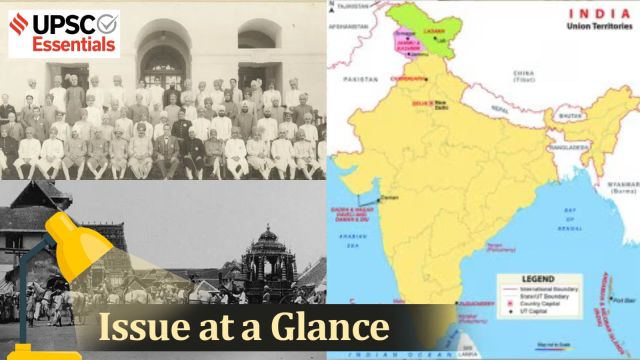 The princely states were given autonomy over their territories, but the British acquired for themselves the right to appoint ministers and get military support as and when required. (Wikimedia Commons)
UPSC Issue at a Glance is an initiative by UPSC Essentials aimed at streamlining your UPSC Current Affairs preparation for the prelims and mains examinations by focusing on issues making headlines. This week, we cover the history of state formation in India from a broader perspective. Let’s get started.
The month of November holds a special place in the political history of independent India. 2025 marks the 25th anniversary of the formation of Chhattisgarh, Uttarakhand, and Jharkhand—three states that were established in November 2000. This month also commemorates the anniversaries of the formation of other states, including Andhra Pradesh, Karnataka, Kerala, Punjab, Madhya Pradesh and Haryana. The history of state creation in India reflects the nation’s evolving federal structure, shaped by regional aspirations, administrative needs, and identity-based demands.
As Chhattisgarh, Uttarakhand, and Jharkhand celebrate a quarter of a century since their establishment, let’s reflect on how India’s states have evolved—from the princely states of the British era to the complex processes of reorganisation and creation of new ones.
(Relevance: UPSC Syllabus General Studies-I, II: Post-independence consolidation and reorganisation within the country, Constitution of India —historical underpinnings, evolution, features, amendments, significant provisions and basic structure. )
What will you learn from this article? |
|
At the time of Independence, only 60 per cent of modern-day India was under British occupation. The remaining 40 per cent belonged to the 565 Princely states. The structuring of the provinces in British India took place throughout the 19th century as the British expanded their territories. For instance, the coastal Presidencies of Madras and Bombay acquired their final shape in 1801 and 1827, respectively. The Central Provinces were formed only in 1861.
By the early 20th century, nationalism began to influence territorial changes in provinces. With the ongoing reform movement in Bengal, sentiments of nationalism and desire for freedom also arose. To curtail any further development of these sentiments, in 1905, Bengal was divided into two parts — East Bengal and Assam and the rest of Bengal, which included the western part of Bengal and modern-day Bihar, Orissa and Chota Nagpur Plateau.
Lord Curzon, the then Governor-General of India, cited reasons emerging out of peculiar linguistic and racial conditions of the province. Although the Partition of Bengal was annulled later, Assam was constituted in 1912 and a separate province of Bihar and Orissa was also formed. Notably, under British rule the formation of states was grounded in imperial interests rather than any welfare or pleas of the masses. The state boundaries were drawn either on
administrative convenience or simply coincided with the territories annexed by the British government or the territories ruled by the princely powers.
In 1947, Independent India commenced its long journey to overcome the legacies of colonial rule, such as centuries of economic stagnation, weak political institutions, undemocratic governance, fragmented polities, widespread illiteracy, westernised education, social inequalities, and pervasive poverty.
In addition, the partition of British India and the communal tensions that accompanied decolonisation further compounded the challenges of nation-building, as well as fulfilling promises made during the freedom struggle.
The first and foremost task for the leaders of independent India was to consolidate and strengthen the nation’s unity by recognising the regional, linguistic, cultural, and social diversity of its vast population and by preparing the country for social transformation, economic development, and political unity. In this context, unifying a fragmented polity with more than five hundred large and small princely states after the partition of British India was yet another test of the statesmanship of leaders of independent India.
Many of the large princely states wanted to remain independent, claiming that their paramountcy couldn’t be transferred to independent India or Pakistan. This sentiment was further encouraged by British Prime Minister Clement Atlee, as he granted them the freedom to become independent states. Sardar Vallabhbhai Patel and V P Menon were tasked with integrating these hundreds of princely states into the Indian Union.
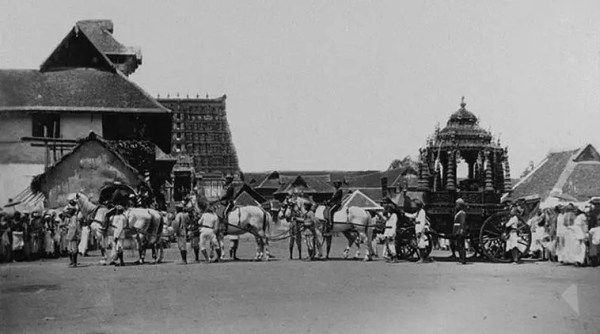 The princely states, both pampered and exploited by the British, maintained a position of semi-autonomy under the colonisers and were the toughest challenge facing free India. (Wikimedia Commons)
Patel warned Menon, “the situation held dangerous potentialities and that if we did not handle it promptly and effectively, our hard-earned freedom might disappear through the States’ door.” Patel also offered the rulers of princely states privy purses and other privileges in exchange for their accession to the Union.
Political strategies and diplomacy of Patel and Menon persuaded all except Hyderabad, Junagadh, and Jammu and Kashmir to accede to the Indian Union by August 14, 1947. Subsequently, Junagadh joined the Indian Union through a plebiscite, Hyderabad was integrated after military action, and Jammu and Kashmir acceded to India through an Instrument of Accession.
In the early years after Independence, the territorial boundaries of the states remained consistent with British India. The administrative structure of the provinces was also similar.
Under the British, there existed three forms of provincial governments — the rule of a governor and Executive council, administration by a Lieutenant Governor, and those administered by a Chief Commissioner. A distinction was also made between the territories that were administered directly by the central government and the provinces that had their administrative structures. Territories that were administered by the Chief Commissioner fell directly under the rule of the central government.
In the Constitution of Independent India, this division was reflected as Part A, B, and C. Part A states consisted of the erstwhile Governor states such as Bombay, and Madras. Part B, which had an elected legislature, included states like Mysore and Saurashtra. Part C states like Delhi and Himachal Pradesh were controlled by the Chief Commissioner. Later, Part D states were introduced as territories that were administered by the central government, with no provision for a local legislature. The Andaman and Nicobar Islands alone were included under this category.
The political turmoil surrounding the process of integration compelled the leaders of free India to set aside the formation of linguistic states, which was promised during the national freedom movement. However, Potti Sriramalu’s martyrdom after a 58-day hunger strike demanding a separate state for Telugu-speaking people triggered mass protests, and eventually forced Nehru to announce the formation of Andhra Pradesh in 1952 and it officially came into existence on October 1, 1953.
Later, Nehru appointed a States Reorganisation Commission (SRC) to make recommendations to resolve the linguistic problem in India. Comprising Justice Fazil Ali, KM Panikkar and HN Kunzru, the Commission travelled across 104 towns and cities between 1954 and 1955, interviewed more than 9,000 people, and received as many as 152,250 written submissions.
The Commission submitted its report in September, 1955, recommending the reorganisation of India’s administrative units to form 14 states on linguistic lines and six centrally administered territories. This reorganisation helped avert the fear of disintegration and preserve national unity.
One of the most important concerns in the early years was that demands for separate states would endanger the unity of the country. It was felt that linguistic states may foster separatism and create pressures on the newly founded nation. But the leadership, under popular pressure, finally made a choice in favour of linguistic states. It was hoped that if we accept the regional and linguistic claims of all regions, the threat of division and separatism would be reduced. Besides, the accommodation of regional demands and the formation of linguistic states were also seen as more democratic. Over time, several new states were created to further reflect regional identities and administrative efficiency. This naturally raises an important question: How is a new state formed in India?
| State | Year of Formation | Details |
|---|---|---|
| Andhra Pradesh | 1953 | Formed as the first linguistic state for Telugu-speaking people (from Madras State). |
| Tamil Nadu | 1956 | Renamed from Madras State; reorganized under the States Reorganisation Act. |
| Karnataka | 1956 | Formed as Mysore State (renamed Karnataka in 1973) under the States Reorganisation Act. |
| Kerala | 1956 | Formed by merging Travancore-Cochin and Malabar districts (from Madras). |
| Maharashtra | 1960 | Formed along with Gujarat from the bilingual Bombay State. |
| Gujarat | 1960 | Formed along with Maharashtra from Bombay State. |
| Nagaland | 1963 | Created as a separate state from Assam. |
| Haryana | 1966 | Carved out of Punjab; Chandigarh made Union Territory and joint capital. |
| Punjab | 1966 (reorganized) | Trifurcation led to Punjab, Haryana, and Himachal Pradesh. |
| Himachal Pradesh | 1971 | Became a full-fledged state (earlier Union Territory). |
| Manipur | 1972 | Became a state along with Tripura and Meghalaya. |
| Tripura | 1972 | Upgraded from Union Territory to state. |
| Meghalaya | 1972 | Created from Assam’s autonomous hill regions. |
| Sikkim | 1975 | Became the 22nd state of India (earlier a protectorate). |
| Mizoram | 1987 | Upgraded from Union Territory to state. |
| Arunachal Pradesh | 1987 | Upgraded from Union Territory to state. |
| Goa | 1987 | Separated from Daman and Diu; became the 25th state. |
| Chhattisgarh | 2000 | Carved out of Madhya Pradesh. |
| Uttarakhand | 2000 | Carved out of Uttar Pradesh (earlier named Uttaranchal; renamed in 2007). |
| Jharkhand | 2000 | Carved out of Bihar. |
| Telangana | 2014 | Carved out of Andhra Pradesh as the 29th state. |
Article 3 of the Indian Constitution empowers Parliament to form new states and alter existing states by a simple majority and without the need for the concurrence of the state concerned.
Once the government has decided to form a new state and a cabinet decision has been taken, the President is requested to make a reference to the legislature or legislatures of the state(s) involved for their views.
A bill needs to be drafted with details on geography, financial status, capital, high court, and division of various elements: assets, infrastructure, human resources, river waters between the old and new states. Once the views are sent,the bill is introduced. Once it is passed by both houses of Parliament and gets the President’s assent,the new state comes into being.
Prelims
(1) Which was the Capital of Andhra State when it was made a separate State in the year 1953? (UPSC CSE 2008)
(a) Guntur
(b) Kurnool
(c) Nellore
(d) Warangal
(2) With reference to the States Reorganisation Commission (SRC), consider the following statements:
1. It was appointed to make recommendations to resolve the linguistic problem in India.
2. The Commission comprised Tej Bahadur Sapru, KM Panikkar, and Vivian Bose.
3. The commission recommended reorganisation of India’s administrative units to form 24 states on linguistic lines and eight centrally administered territories.
Which of the statements given above is/are correct?
(a) 1 only
(b) 1 and 2 only
(c) 1 and 3 only
(d) 2 only
Mains
1. Has the formation of linguistic states strengthened the cause of Indian unity? (UPSC CSE 2016)
2. Discuss the major challenges faced by India in the immediate aftermath of independence in achieving political consolidation and national unity.
|
Prelims Answer Key |
|
(Sources: How the idea of Indian Union Territories was conceived and executed, How India achieved political consolidation and national unity after independence, Express explains: How a state is formed)
Subscribe to our UPSC newsletter. Stay updated with the latest UPSC articles by joining our Telegram channel – Indian Express UPSC Hub, and follow us on Instagram and X.
🚨 Click Here to read the UPSC Essentials magazine for October 2025. Share your views and suggestions in the comment box or at manas.srivastava@indianexpress.com🚨


Read UPSC Magazine