What is the issue?
Over the last decade, Delhi winters have developed a pattern as predictable as the turning of the calendar. The air becomes filled with particulate matter, temporary measures are implemented, and then, as the season changes, things roll on and the issue is relegated. In this context, it becomes essential to understand the issue from a broader perspective.
(Relevance: UPSC Syllabus Mains Examination: General Studies-II, III: Government policies and interventions, Conservation, environmental pollution and degradation, environmental impact assessment.
The issue of air pollution is significant for the UPSC CSE, as environmental pollution is explicitly mentioned in General Studies Paper III syllabus. The UPSC has previously asked questions related to air quality. Additionally, this topic is relevant for essay writing and current affairs, making it important for candidates preparing for their personality tests.)
Question 1: What is air pollution and what are its sources?
Air pollution is the contamination of the environment, whether indoors or outdoors, by any agent—chemical, physical, or biological—that alters the natural characteristics of the atmosphere. According to the World Health Organization (WHO), almost all of the global population (99%) breathe air that exceeds WHO guideline limits and contains high levels of pollutants.
Sources of Air Pollution
Household combustion devices, motor vehicles, industrial facilities and forest fires are common sources of air pollution.- WHO
From consistent vehicle emissions to pollutants from construction and factories, various sources of air pollution have significantly worsened the air quality throughout the country.
Story continues below this ad
Vehicular pollution is the significant contributor to air pollution. According to the Decision Support System of the Indian Institute of Tropical Meteorology (IITM), transport is the biggest contributor to PM2.5 emissions in Delhi, its share going up to 20% or more in winter.
According to the Commission for Air Quality Management (CAQM), as many as 93% of the 2.88 crore vehicles on the road in Delhi-NCR are light motor vehicles (LMVs; essentially cars) and two-wheelers. More than a third – around 37% – of this fleet comprises Bharat Stage (BS) III or even older vehicles, which have a significantly higher emissions potential.
India's Annual Average PM2.5 Concentration (2023)
54.4 µg/m³
3rd Most Polluted Country Globally | Up from 53.3 µg/m³ in 2022
🚗
Vehicle Emissions
NO₂ + PM2.5
Respiratory diseases, asthma
🏭
Thermal Power Plants
SO₂ from fossil fuels
Cardiovascular harm
🔥
Stubble Burning
PM + CO + SO₂ + NOₓ
Emergency AQI levels
⚙️
Industrial Facilities
NO₂ steady emissions
Chronic exposure
🏗️
Construction Activities
Particulate Matter
Compounds crisis
Indian Express InfoGenIE
Thermal power plants and factories also emit a steady stream of pollutants, compounding the problem. Furthermore, stubble burning is a major contributor to air pollution in northern India, particularly in states like Punjab and Haryana, as it significantly deteriorates air quality, often pushing it to emergency levels during the post-harvest season. The smoke produced from burning agricultural residue releases high levels of particulate matter, carbon monoxide, sulfur dioxide, and nitrogen oxides.
| Pollutants |
Source |
Impact |
| Nitrogen dioxide (NO2) |
Burning of fuel, with sources including emissions from vehicles and power plants. |
Short-term exposure to high levels of NO2 can aggravate respiratory diseases. Long-term exposure may also contribute to the development of asthma and could increase susceptibility to respiratory infections. |
| Ozone (O3) |
Surface ozone pollutant is formed by the reaction of atmospheric pollutants in the presence of sunlight. |
Increase in risk of hospital admissions for Chronic Obstructive Pulmonary Diseases (COPD) and the number of cardiovascular and respiratory deaths |
| Sulfur dioxide (SO2) |
Burning of fossil fuels by power plants and other industrial facilities. Additional sources are industrial processes and natural sources such as volcanoes. |
Harmful to the cardiovascular system and can lead to the development of respiratory illnesses. SO2 can also react with other compounds to form particulate matter. |
| Ammonia (NH3) |
Increase in fertilizer use coupled with large contributions from livestock waste have resulted in the world’s highest concentrations of atmospheric ammonia |
Excess ammonia is harmful to plants and reduces air and water quality |
| Lead (Pb) |
It is a naturally occurring toxic metal found in the Earth’s crust exposed through mining, smelting, manufacturing and even recycling activities |
Children who survive severe lead poisoning may be left with permanent intellectual disability and behavioural disorders. |
| Carbon Monoxide (CO) |
It is given off when fuel containing carbon, such as wood, coal and petrol, is burned |
If CO levels are high enough, a person may become unconscious and die. Long-term exposure has been linked with an increased risk of heart disease. |
Question 2: Why do northern cities have worse air quality levels?
Compared to western and southern cities — such as Chennai, Chandigarh, Visakhapatnam, Mumbai, and Bengaluru — northern cities — like Delhi, Lucknow, and Varanasi — experience worse air quality levels, especially during winters, due to the region’s geography.
Story continues below this ad
The issue is that these northern cities are landlocked, as the Indo-Gangetic Plain is surrounded by the Himalayas. Due to this, pollutants get trapped and are not able to disperse. Moreover, “within cities, dense urban structures create additional “surface roughness,” a frictional effect that further slows wind speeds and limits dispersion,” notes the analysis Air Quality Assessment of Major Indian Cities (2015–2025) by Climate Trends.
While during the summer monsoon, rain and strong westerly winds help disperse pollutants, in winter, the situation becomes worse. Delhi is particularly affected during this time because it is situated in the middle of a vast, flat basin bound by the Himalayas to the north.
“During winters (December-February), the air in the planetary boundary layer (the lowest part of the atmosphere) is thinner as the cooler air near the Earth’s surface is denser. The cooler air is trapped under the warm air above, forming a kind of atmospheric ‘lid’. This phenomenon is called winter inversion. Since the vertical mixing of air happens only within this layer, the pollutants released lack enough space to disperse in the atmosphere,” the analysis said.
Question 3: What are the impacts of air pollution?
Each year, indoor and outdoor air pollution is responsible for nearly seven million deaths around the globe.- WHO
Air pollution, from urban smog to household smoke, affects various sectors differently. It poses a threat not only to health and the environment but also to the economy.
Story continues below this ad
| What is smog? |
| Smog is a type of air pollution that creates a hazy or foggy atmosphere, reducing visibility and affecting air quality. Originally used in the early 1900s to describe a blend of smoke and fog, the term “smog” referred to pollution from coal-burning, especially common in industrial areas. |
📍Impact on Environment: Ground air pollution significantly impacts terrestrial ecosystems, leading to various respiratory and pulmonary disorders in both animals and humans.
— In marine ecosystems, the consequences include lake acidification, eutrophication, and the accumulation of mercury in aquatic food sources. These processes can indirectly harm the health of living beings.
— Additionally, the concentration of greenhouse gases in the atmosphere has long-term environmental implications, including global warming and climate change.
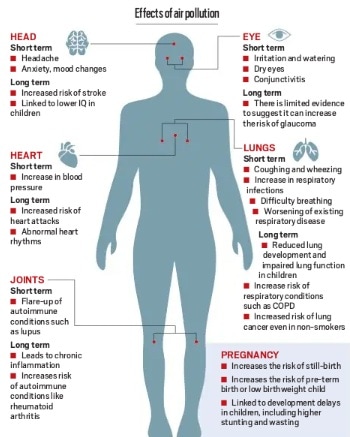
📍Impact on Health: Air pollution is one of the leading environmental threats to human health. At least 1.67 million deaths in 2019 — making up nearly 17.8 per cent of all deaths in the country that year — were attributable to air pollution, according to a study published in Lancet Planetary Health in 2021.
Story continues below this ad
— Exposure to air pollutants can lead to various health issues, including lung disease, asthma, stroke and cancer.
— Severe air pollution also has significant consequences for children, especially those aged one to five years. During this stage, their lungs and immune systems are still developing, making them particularly vulnerable to the harmful effects of airborne pollutants like particulate matter (PM2.5 and PM10), nitrogen oxides, sulfur dioxide, and volatile organic compounds (VOCs).
— Additionally, it can affect the cognitive development in children, exacerbate existing conditions like diabetes and contribute to mental health problems.
— Health experts say older adults are among the most vulnerable to severe air pollution. Lung function naturally declines with age, and scientific studies show that exposure to polluted air causes greater harm in elderly populations.
Story continues below this ad
📍Impact on Economy: Studies have shown that air pollution also affects the economy of the country. The costs of poor air quality manifest in distinct ways, such as, lower labor productivity, lower consumer footfall, lower asset productivity, welfare losses, premature mortality, increased health expenses.
A World Bank report estimated that the cost of the health damage caused by air pollution amounts to $8.1 trillion a year, equivalent to 6.1% of global GDP.
Anil Sasi writes- “Air pollution has a direct, and a particularly debilitating impact on GDP growth and per-capita income levels by way of reduced worker output, lower consumer footfall in consumption-led services, hampered asset productivity, and a surge in health expenses and welfare allocations, especially in the productive age groups….Even in indoor jobs such as those in call centres, air pollution takes a toll on productivity.
Also, poor air quality impeded the performance of otherwise highly productive employees as much as it did of less productive workers.”
Question 4: What initiatives have been taken by the government to combat air pollution?
Comprehensive initiatives have been implemented by the government to address air pollution, ranging from legislation to monitoring.
Story continues below this ad
📍Air (Prevention and Control of Pollution) Act, 1981: This act outlines the mechanisms and authorities responsible for addressing the issue of air pollution, and the government implements actions for air quality regulation and pollution abatement under various provisions of it.
📍National Air Quality Monitoring Programme: The Central Pollution Control Board (CPCB) is executing a nationwide program for monitoring ambient air quality known as the National Air Quality Monitoring Programme (NAMP).
📍National Clean Air Programme (NCAP): The initiative was launched by the Ministry of Environment, Forest and Climate Change (MoEFCC) in January 2019 with the goal of improving air quality in 131 cities across 24 states.
— It aims to reduce PM10 concentrations by 20-30% compared to the baseline levels recorded in 2017 by the year 2024. The target has since been revised to achieve a reduction of up to 40% in PM10 levels or to meet the national standard of 60 µg/m³ by the year 2025-26.
Story continues below this ad
Government Initiatives Fighting Air Pollution
6
Major Programs | From Legal Framework to Ground Action
1981
Air (Prevention and Control of Pollution) Act
Legal framework for air quality regulation and pollution abatement with mechanisms and authorities
Foundation Law
CPCB
National Air Quality Monitoring Programme
Nationwide ambient air quality tracking by CPCB
Continuous Monitoring
2019
National Clean Air Programme
131 cities across 24 states with 40% PM10 reduction target by 2025-26
Flagship Program
2017
Graded Response Action Plan
Implemented by CAQM to prevent PM levels exceeding moderate AQI
Emergency Protocol
2014
AQI System
6 color-coded categories from Good (0-50) to Severe (401-500) for public awareness
Public Health Tool
2017-18
Other Measures
Pet coke ban, farm machinery subsidies, thermal plant emission standards
Multi-Sector Action
Indian Express InfoGenIE
📍Air Quality Index (AQI): The colour-coded AQI index was launched in India in 2014, and it helps the public and the government understand the condition of the air and what subsequent measures are to be taken to combat the situation, based on its severity.
— The pollutants measured include PM 10, PM 2.5, Nitrogen Dioxide, Ozone, Carbon, etc. There are six categories of AQI, namely
(i) ‘Good’ (0-50),
(ii) ‘Satisfactory’ (51-100),
(iii)‘Moderately polluted’ (101-200),
(iv) ‘Poor’ (201-300),
(v) ‘Very Poor’ (301-400),
(vi) ‘Severe’ (401-500).
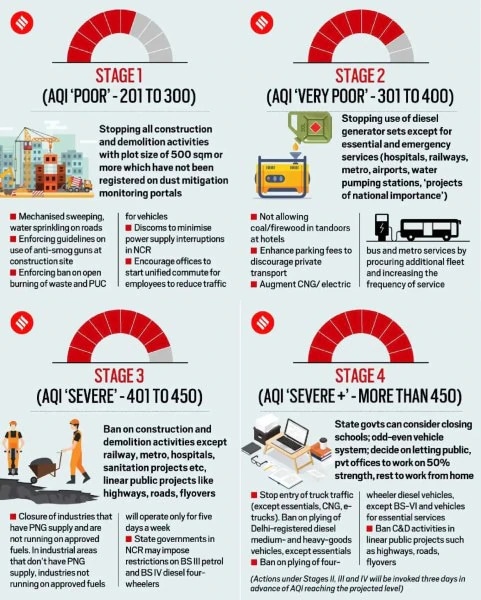
📍Graded Response Action Plan (GRAP): The GRAP was first notified in January 2017 by the MoEFCC. This was based on a plan that was submitted by the CPCB in November 2016.
— According to the notification, the task of implementing the GRAP fell on the now-dissolved Environment Pollution (Prevention and Control) Authority for the NCR. From 2021 onwards, the GRAP is being implemented by the Commission for Air Quality Management (CAQM).
— GRAP outlines the necessary actions to address particulate matter (PM) emissions from various sources and aims to prevent PM10 and PM2.5 levels from exceeding the ‘moderate’ category of the national AQI.
📍Other Measures: The CPCB has established guidelines to promote the establishment of paddy straw-based pelletization and torrefaction plants, which may help address supply chain issues.
— In 2018, the Ministry of Agriculture and Farmers’ Welfare launched a scheme to provide subsidies for the purchase of crop residue management machinery and the establishment of Custom Hiring Centres (CHCs) in the National Capital Territory (NCT) of Delhi, as well as the states of Punjab, Haryana, and Uttar Pradesh.
— Notifications regarding SO2 and NOx emission standards have been issued for thermal power plants.
Question 5: What steps should be taken to reduce air pollution?
Despite government efforts to control air pollution, poor air quality persists. In this context, we should consider additional steps that can be taken.
1. Stop municipal solid waste (MSW) burning: MSW is essentially everyday items we use and then throw away. They include product packaging, furniture, clothing, bottles, food scraps, newspapers, appliances, and batteries.
2. Promote the use of electric, BS-VI vehicles: As vehicular emissions are among the key contributors to air pollution, we should promote the use of electric and BS-VI vehicles. Improvement of public transport is also necessary.
3. De-SOx-ing and De-NOx-ing systems at power plants: The large power plants and refineries in Delhi emit pollutants like sulphur dioxide (SO2) and nitrogen oxides (NOx). In a bid to limit them, these plants and refineries need to install De-SOx-ing and De-NOx-ing systems that remove SO2 and NOx respectively.
4. Construction materials at construction and demolition sites must be covered: Measures like vertically covering the construction area, covering raw materials, use of water spray and windbreaker to ensure raw materials such as sand don’t fly away, storing waste inside premises, and covering construction materials during on-road movement can improve air quality by 50%, according to the report.
5. LPG to all: Each household must avoid using wood, crop residue, cow dung, and coal for cooking. Everyone should get access to Liquefied Petroleum Gas (LPG), which would bring down levels of PM 2.5, PM 10, and nitrogen oxides (NOx).
6. Petrol pumps should install vapour recovery systems: Petrol contains volatile organic compounds (VOCs) that dissipate into the atmosphere during the unloading of petrol to storage tanks or refuelling of vehicles. These petrol vapours contribute to the formation of smog and pose a potential health risk to the public. Vapour recovery systems help to collect VOCs released during unloading and refuelling and curtail the emissions.
Post Read Questions
Prelims
(1) Artificial way of causing rainfall to reduce air pollution makes use of (UPSC CSE 2025)
(a) silver iodide and potassium iodide
(b) silver nitrate and potassium iodide
(c) silver iodide and potassium nitrate
(d) silver nitrate and potassium chloride
(2) In the cities of our country, which among the following atmospheric gases are normally considered in calculating the value of Air Quality Index? (UPSC CSE 2016)
1. Carbon dioxide
2. Carbon monoxide
3. Nitrogen dioxide
4. Sulfur dioxide
5. Methane
Select the correct answer using the code given below:
(a) 1, 2 and 3 only
(b) 2, 3 and 4 only
(c) 1, 4 and 5 only
(d) 1, 2, 3, 4 and 5
(3) With reference to the National Clean Air Programme (NCAP), consider the following statements:
1. India launched National Clean Air Programme (NCAP) in 2019.
2. The Centre has set a new target of 40 percent reduction in particulate matter concentration in cities covered under the National Clean Air Programme (NCAP) by 2026.
3. The acceptable annual standard for PM2.5 is 80 micrograms per cubic metre.
How many of the statements given above are correct?
(a) Only one
(b) Only two
(c) All three
(d) None
(4) With reference to the Smog, consider the following statements:
1. It is a type of air pollution that creates a hazy or foggy atmosphere.
2. It forms when pollutants react chemically in the presence of sunlight.
3. Volatile organic compounds are not a part of the smog.
4. Stubble burning is cited as a major contributor to smog in northern India.
Which of the statements given above are correct?
(a) 1, 2 and 3 only
(b) 1 and 2 only
(c) 1, 3 and 4 only
(d) 1, 2 and 4 only
Mains
Describe the key points of the revised Global Air Quality Guidelines (AQGs) recently released by the World Health Organisation (WHO). How are these different from its last update in 2005? What changes in India’s National Clean Air Programme are required to achieve revised standards? (UPSC CSE 2021)
| PRELIMS ANSWER KEY |
| 1. (a) 2. (b) 3. (b) 4. (d) |
(Sources: Articles from the Indian Express– Why northern cities are more polluted than southern and western cities in India (Explained), How Delhi’s pollution is breaking the elderly by Ankita Upadhyay (News), What is the impact of air pollution on economic growth? By Anil Sasi (Explained), Knowledge Nugget | GRAP III and other measures to tackle Air Pollution: A must-know for UPSC aspirants)
Subscribe to our UPSC newsletter. Stay updated with the latest UPSC articles by joining our Telegram channel – Indian Express UPSC Hub, and follow us on Instagram and X.
🚨 Click Here to read the UPSC Essentials magazine for December 2025. Share your views and suggestions in the comment box or at manas.srivastava@indianexpress.com🚨


 16 min read