29 min read


© IE Online Media Services Pvt Ltd



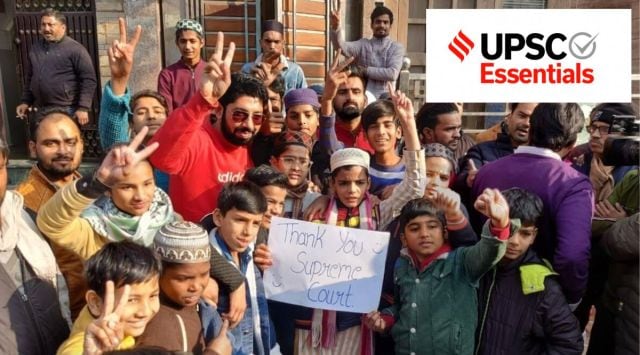 People rejoicing the Supreme Court's verdict staying the order of the Uttarakhand HC evicting people living on land claimed by the railways in Haldwani. (Express)
(The UPSC Essentials Indian Express is now on Telegram. Click here to join our channel and stay updated with the latest updates.
Subscribe to The Indian Express UPSC Key and prepare for the Civil Services and other competitive examinations with cues on how to read and understand content from the most authoritative news source in India.
Note: Catch the UPSC Weekly Quiz every Saturday evening and brush up on your current affairs knowledge.)
The Indian Express’ UPSC weekly news express covers some of the important and burning topics of current affairs news from this week to help you prepare for UPSC-CSE. Try out the MCQs and check your answers provided towards the end of the article.
Syllabus:
Preliminary Examination: Current events of national and international importance.
Mains Examination:
• General Studies II: Structure, organization and functioning of the Executive and the Judiciary—Ministries and Departments of the Government; pressure groups and formal/informal associations and their role in the Polity.
• General Studies III: Inclusive growth and issues arising from it.
Why in news?
— On Monday, (January 2) the Supreme Court upheld the government’s decision to demonetise currency notes of Rs 500 and Rs 1,000 by a 4:1 majority. Rather than the effect of the decision, the court was to consider whether the recommendation for the policy came from the government or the RBI.
— “From the record, it appears that there was a consultative process between central govt and RBI for over 6 months before the decision was taken,” the top court observed in a majority judgement written by Justice B R Gavai.
— In a surprise announcement on the evening of November 8, 2016, Prime Minister Narendra Modi said in a televised address to the nation that the two banknotes will be “just worthless piece of paper” with immediate effect, and went on to introduce new notes of Rs 2,000 and Rs 500 for public circulation.
— While many termed it as a “bold” move, the Opposition, over the years, has criticised the government.
KEY TAKEAWAYS
What were the six issues and the majority view?
1. Whether the power available to the Central Government under sub-section (2) of Section 26 of the RBI Act can be restricted to mean that it can be exercised only for “one” or “some” series of bank notes and not “all” series in view of the word “any” appearing before the word “series” in the said sub-section, specifically so, when on earlier two occasions, the demonetisation exercise was done through the plenary legislation?
Majority view: Section 26(2) of the RBI Act states that “on recommendation of the Central Board (of the RBI) the Central Government may, by notification in the Gazette of India, declare that, with effect from such date as may be specified in the notification, any series of bank notes of any denomination shall cease to be legal tender.”
The petitioners argued that the word “any” would have to be given a restricted meaning to mean “some” and not “all” legal tender of a given denomination. Senior Advocate P Chidambaram argued that RBI has power only to recommend “a particular series” of notes, but to demonetise “all series” of a particular denomination, it was considered necessary to do so by way of a separate enactment of Parliament.
The majority view disagreed, and held that the term has to be given a purposive interpretation and that any other meaning would lead to absurdity. Citing an example, the court said: “If there are 20 series of a particular denomination, and if the argument of the petitioners is to be accepted, the Central Government would be empowered to demonetise 19 series of a particular denomination, leaving one series of the said denomination to continue to be a legal tender, which would lead to a chaotic situation.”
2. In the event it is held that the power under sub-section (2) of Section 26 of the RBI Act is construed to mean that it can be exercised in respect of “all” series of bank notes, whether the power vested with the Central Government under the said sub-section would amount to conferring excessive delegation and as such, liable to be struck down?
Majority view: On the issue of whether the RBI Act delegates excessive power to make law to the Centre, and is therefore unconstitutional, the majority view disagreed with the petitioners. “Insofar as the decision to be taken by the Central Government under sub-section (2) of Section 26 of the RBI Act is concerned, it is to be taken on the recommendation of the Central Board. We, therefore, find that there is an inbuilt safeguard in sub-section (2) of Section 26 of the RBI Act inasmuch as the Central Government is required to take a decision on the recommendation of the RBI,” the court said. It also said that the delegation of power is in any case to the central government, which is answerable to Parliament.
3. As to whether the impugned Notification dated 8th November 2016 is liable to be struck down on the ground that the decision making process is flawed in law?
Majority view: The majority view relied on the government’s argument that merely because the process was initiated by the Centre, it could not be struck down. The ruling notes that the minutes of the RBI Central Board meeting that recommended demonetisation on November 8, 2016 itself stated that the RBI and the Centre had discussed the idea for over six months before it was notified.
On the merits and soundness of the decision, the majority stated that the court cannot determine the effectiveness of economic policy. However, it agreed with the Centre’s contention that the decision had to be made in secrecy and in haste for it to be effective.
4. As to whether the impugned notification dated 8th November 2016 is liable to be struck down applying the test of proportionality?
Majority view: The majority decision applies a four-pronged test of proportionality to the constitutionality of the decision. The four ingredients of the test to be satisfied are: i) legitimate purpose (ii) rational connection with the purpose (iii) necessity (iv) whether the action taken is proportional or balanced.
The majority verdict states that curbing fake currency, black money and terror funding are legitimate interests of the state and have a rational nexus with demonetisation. For the third aspect, the court has to determine if the decision was necessary, and that there were no alternative measures that could have achieved a similar purpose with a lesser degree of harm for citizens.
Here, the court said that it is “exclusively within the domain of the experts”, that is the RBI, to answer this question.
On the fourth aspect, the court said “what alternate measure could have been undertaken with a lesser degree of limitation is very difficult to define”.
5. As to whether the period provided for exchange of notes vide the impugned notification dated 8th November 2016 can be said to be unreasonable?
Majority view: The court cited an earlier instance of demonetisation in 1978 where a three-day period was provided for exchanging the demonetised notes. This was upheld by a Constitution Bench of the court. Relying on this decision, the majority view said, “we fail to understand as to how the said period of 52 days could be construed to be unreasonable, unjust and violative of the petitioners’ fundamental rights.”
6. As to whether the RBI has independent power under sub-section (2) of Section 4 of the 2017 Act in isolation of provisions of Section 3 and Section 4(1) thereof to accept the demonetised notes beyond the period specified in notifications issued under sub- section (1) of Section 4?
Majority view: The Specified Bank Notes (Cessation of Liabilities) Act, 2017 prohibits and penalises holding, transferring, or receiving demonetised currency. However, some earlier notifications allowed a grace period for certain individuals, like those who were abroad when demonetisation was notified, to exchange their old currency.
The petitioners argued that RBI had no independent powers to allow that when the 2017 Act had been passed by Parliament. The majority view stated that the earlier notifications have to be read as part of the 2017 law, giving it a “contextual and harmonious construction”.
(Source: Two views on six issues: What the Supreme Court’s demonetisation verdict says by Apurva Vishwanath)
Point to ponder: Supreme Court upholds demonetisation. What was the challenge about?
1. MCQ:
With reference to the recent Supreme Court’s demonetisation verdict, consider the following statements:
1. Supreme Court upheld the government’s decision to demonetise currency notes of Rs 500 and Rs 1,000 by a 4:1 majority.
2. Supreme Court was to consider the effect of the decision and whether the recommendation for the policy came from the government or the RBI.
Which of the above statements are correct?
a) Only 1
b) Only 2
c) Both 1 and 2
d) Neither 1 nor 2
Syllabus:
Preliminary Examination: History of India
Mains Examination: General Studies I: Indian culture will cover the salient aspects of Art Forms, literature and Architecture from ancient to modern times.
Why in news?
— Fifty of India’s 3,693 centrally protected monuments have gone missing, the Ministry of Culture has told Parliament. The submissions were made by the ministry on December 8 to the Parliamentary Standing Committee on Transport, Tourism and Culture as part of a report titled ‘Issues relating to Untraceable Monuments and Protection of Monuments in India’.
KEY TAKEAWAYS
What are centrally protected monuments?
— The Ancient Monuments and Archaeological Sites and Remains Act (AMASR Act) regulates the preservation of monuments and archaeological sites of national importance. The Archaeological Survey of India (ASI), which is under the aegis of the Union Ministry of Culture, functions under this Act. The Act protects monuments and sites that are more than 100 years old, including temples, cemeteries, inscriptions, tombs, forts, palaces, step-wells, rock-cut caves, and even objects like cannons and mile pillars that may be of historical significance.
— According to the provisions of AMASR Act, ASI officials are supposed to regularly inspect the monuments to assess their condition. Apart from various conservation and preservation operations, ASI officials can also file police complaints, issue show cause notices for the removal of encroachments, and communicate to the local administration the need for demolition of encroachments.
So how can a monument go “missing”?
— The ASI was founded in 1861 by Alexander Cunningham, when he realised the need for a permanent body to oversee archaeological excavations and conservation. But while the body remained largely dysfunctional in the 19th century owing to fund crunch, in the decades preceding Independence, it became very active. A bulk of the protected monuments were taken under the ASI’s wings during the 1920s and 30s, up till the 50s, officials told The Indian Express.
— But in the decades after independence, the focus of successive governments was on health, education and infrastructure, rather than protecting heritage, officials said. Even within the scope of heritage, the aim was to uncover more monuments and sites, instead of conservation. So in due course, ASI officials said, many monuments and sites were lost to activities like urbanisation, construction of dams and reservoirs, and even encroachments.
— As per the ASI submission in Parliament, 14 monuments have been lost to rapid urbanisation, 12 are submerged by reservoirs/dams, while 24 are untraceable, which brings the number of missing monuments to 50.
“Even now, we are grappling with an acute manpower shortage to physically man all the big and small monuments which may fall under a particular region,” an ASI official said.
— The agency told the Parliamentary committee that security guards were posted at only 248 of the 3,693 monuments. “The committee notes with dismay that out of the total requirement of 7,000 personnel for the protection of monuments, the government could provide only 2,578 security personnel at 248 locations due to budgetary constraints,” the report said.
Is this the first time monuments have been reported missing?
— While ASI officials said a comprehensive physical survey of all monuments has never been conducted after Independence, in 2013, a Comptroller and Auditor General (CAG) report said that at least 92 centrally protected monuments across the country had gone missing.
— The CAG report said that the ASI did not have reliable information on the exact number of monuments under its protection. It recommended that periodic inspection of each protected monument be carried out by a suitably ranked officer. The Culture ministry accepted the proposal, but there was hardly any movement.
Which monuments are missing?
— The report notes that “out of the 92 monuments declared as missing by the CAG, 42 have been identified due to efforts made by the ASI.” Of the remaining 50, 26 have been accounted for, as mentioned earlier, while 24 are untraceable. The Ministry said, “Such monuments which could not be traced on ground for a considerable time because of multiple factors, despite the strenuous efforts of ASI through its field offices, were referred as Untraceable monuments.”
— These include 11 in Uttar Pradesh, two each in Delhi and Haryana, and in states like Assam, West Bengal, Arunachal Pradesh and Uttarakhand. Official sources told The Indian Express, “Many such cases pertain to inscriptions, batteries and tablets, which don’t have a fixed address. They could have been moved or damaged and it may be difficult to locate them.”
— The Parliamentary panel said it was perturbed to find that the Barakhamba Cemetery in the very heart of Delhi was among the untraceable monuments. “If even monuments in the Capital cannot be maintained properly, it does not bode well for monuments in remote places in the country,” it said. Officials told the Express that the particular cemetery may have been lost to the “redevelopment of the New Delhi Railway Station”.
— Other missing monuments include the Guns of Emperor Sher Shah, Tinsukia (Assam); the Ruins of Copper Temple, Paya, Lohit (Arunachal Pradesh); Kos Minar, Mujesar, Faridabad (Haryana); Kutumbari Temple, Dwarahat, Almora (Uttarakhand); Rock Inscription, Satna (Madhya Pradesh); Old European Tomb, Pune (Maharashtra); 12th Century Temple, Baran (Rajasthan); and Telia Nala Buddhist ruins, Varanasi (Uttar Pradesh).
Could there be more missing monuments?
— The CAG audit included a joint physical inspection, along with the ASI, of merely 1,655 monuments out of the 3,678 on the protected list at the time. The 24 monuments reported to be untraceable are from this sample of 1,655 monuments.
“The Committee is perturbed to note that having found out that at least 24 monuments are untraceable out of the sample of monuments studied, no further surveys were conducted for the remaining monuments, even nearly a decade after the original study,” the panel said.
So does India now have fewer protected monuments?
— The ASI submitted that even as the monuments lost to urbanisation or dams can be deemed gone, it will make one last attempt to locate the 24 untraceable monuments. If any of those can be traced, the missing monuments list will be pruned.
— However, deleting the lost/untraceable monuments from the protected list may not be that simple. The deletion requires denotification of the said monument under Section 35 of the AMASR Act, which happens to be a long-drawn process.
— Section 35 has the provision to issue notifications only for such Centrally Protected Monuments (CPMs) which, according to the central government, have ceased to be of national importance. The situation of a missing monument cannot be automatically equated with the loss of its historical importance, the committee said.
— It recommended that the untraceable monuments may not be removed from the list, because once that is done, there would be no imperative to find them. Since the missing monuments cannot continue to be on the protected list either, the Committee recommended that the list of Untraceable Monuments may be maintained as such and if necessary, the AMASR Act be amended to include this terminology.
(Source: 50 ASI-protected monuments disappear: How did they go ‘missing’, what happens next by Divya A)
Point to ponder: “ASI’s record in protecting monuments is nothing to write home about. Corporates can, and should, contribute to conservation.” Do you agree?
2. MCQ:
With reference to the Archaeological Survey of India (ASI), consider the following statement:
1. ASI was founded in 1861 by James Princep.
2. It was founded by a statute passed into law by Lord Canning.
Which of the following statements are correct?
a) Only 1
b) Only 2
c) Both 1 and 2
d) Neither 1 nor 2
Syllabus:
Preliminary Examination: Economic and Social Development-Sustainable Development, Poverty, Inclusion, Demographics, Social Sector Initiatives, etc.
Mains Examination: General Studies III: Indian Economy and issues relating to planning, mobilization, of resources, growth, development and employment.
Why in news?
— The Indian rupee depreciated by around 10 per cent against the US dollar in 2022 on account of sharp appreciation of the greenback, as the US Federal Reserve tightened its interest rate to check inflation amid the uncertainties surrounding the Russia-Ukraine conflict.
KEY TAKEAWAYS
How did the rupee perform in 2022?
— The rupee was the worst-performing Asian currency in 2022, witnessing a fall of around 10 per cent against the greenback. This decline was mainly on account of appreciation in the US currency on safe haven appeal amid fears of recession and inflation across many parts of the world and Russia-Ukraine war.
— During the year, the rupee fell to a lifetime low of 83.2 against the dollar. Compared to rupee, depreciation of other Asian currencies was to a lesser extent. During the year, Chinese Yuan, Philippine Peso and Indonesian Rupiah fell around 9 per cent. South Korean Won and Malaysian Ringgit declined by nearly 7 per cent and 6 per cent, respectively.
— However, the Reserve Bank of India (RBI) heavily intervened in the forex market to defend rupee. Since the beginning of 2022, the country’s foreign exchange reserves have fallen by $70 billion. It stood at $562.81 billion as of December 23, 2022, the latest RBI data showed.
“Reserves have witnessed a bit of erosion but the central bank is now starting to again build up its reserves and that would act as a buffer in times of uncertainty,” said Navneet Damani, senior vice president (currency and commodity) Motilal Oswal Financial Services (MOFSL).
What was the reason for capital outflows?
— The US Fed aggressively raised interest rates by 425 basis point (bps) in 2022 in its fight against inflation. This led to a higher interest rate differential between the US and India, and investors pulled out money from the domestic market and started investing in the US market to take advantage of higher rates.
— In 2022, foreign portfolio investors (FPIs) pulled out Rs 1.34 lakh crore from the Indian markets – the highest-ever yearly net outflow. They withdrew Rs 1.21 lakh crore from the stock markets and Rs 16,682 crore from the debt market in 2022, putting pressure on the rupee. Russian invasion of Ukraine accentuated the FPI withdrawals with the global economic slowdown making inflows tougher, analysts said.
What is the outlook on rupee for 2023?
— According to forex analysts, although the outlook on the rupee remains weak in the near future, the depreciation in local currency may not continue for a longer period as India remains the fastest-growing economy.
“The terminal interest rate for the US Fed is anybody’s guess, but it cannot be the case that their monetary policy will be tightened endlessly. When the (US Fed) tightening is over, the tide will surely turn,” Reserve Bank of India Governor Shaktikanata Das said during the December monetary policy announcement.
(Source: Why the Indian rupee fell 10% against the US dollar in 2022 by Hitesh Vyas)
Point to ponder: With Fed hiking rates, dollar strengthening and current account deficit deteriorating, RBI should allow currency to adjust. Do you agree?
3. MCQ:
Which one of the following is not the most likely measure the Government/RBI takes to stop the slide of Indian rupee?
(a) Curbing imports of non-essential goods and promoting exports
(b) Encouraging Indian borrowers to issue rupee-denominated Masala Bonds
(c) Easing conditions relating to external commercial borrowing
(d) Following an expansionary monetary policy
Syllabus:
Preliminary Examination: Economic and Social Development-Sustainable Development, Poverty, Inclusion, Demographics, Social Sector Initiatives, etc.
Mains Examination:
• General Studies I: Urbanization, their problems and their remedies.
• General Studies II: Issues relating to development and management of Social Sector/Services relating to Health, Education, Human Resources.
Why in news?
— The Supreme Court Thursday stayed the Uttarakhand High Court decision to evict over 4,000 families from land claimed by the Railways in Haldwani, saying they could not be moved within a week and without rehabilitation plans.
KEY TAKEAWAYS
Khadija Khan writes:
What was the HC decision?
— On December 20 last year, the Uttarakhand High Court directed the Railways to evict those living in Haldwani’s Gafoor Basti, land adjoining the Haldwani railway station. The decision by Justices Sharad Kumar Sharma and Justice Ramesh Chandra Khulbe came in a public interest litigation (PIL) filed in 2013. The petitioner had moved court against illegal mining in the area after a bridge collapse, but the HC expanded the scope of the petition.
— While the residents claimed ownership of the land through lease and sale deeds, the HC declared that the land belongs to the Railways and directed “to use the forces to any extent determining upon need, to evict forthwith the unauthorised occupants after giving them a week’s time to vacate the premises…”
What is the land dispute?
— The land dispute essentially revolves around a 1907 government record, based on which Gafoor Basti residents claim ownership. The document, they claim, declared the area as “nazul land” or government land used for non-agricultural but public purposes. Some residents claimed in the HC that their ancestors had purchased plots from the Custodian Department of Government of India, which was entrusted with properties of those who left India after partition.
— However, the High Court held that the 1907 document was a mere ‘Office Memorandum’ and therefore invalid for the purposes of determining the classification of land. This would essentially mean that every transaction, sale, lease that flows from the document is now deemed invalid.
— The court instead relied on a 1959 notification of the vesting of land with the Railways.
— The Court had first ordered Railways to remove encroachment in the area in 2016. The state had sought a review of that ruling, but that was dismissed in 2017. Subsequently, the Supreme Court, hearing an appeal against the HC decisions, directed affected parties to file their objections before the High Court immediately.
— Dismissing the claim by residents that the 1907 record established the area as nazul land, the HC said the document is only “an official communication, it will not have a statutory force”.
What is the claim by the residents?
— Several affected residents have claimed that they have been in possession of the land for over 50 years. However, the Court said that “merely being in uninterrupted possession for last 50 years will not in itself mature their legal rights to continue with possession” since the 1907 document itself does not classify the land as nazul land.
— A resident, Rehmat Khan, argued that the assessment committee of the municipality through its Resolution No. 18 dated April 18, 1976 had accepted the transfer of the land, made in his favour by the sale deed in 1966. The Court dismissed this argument expressing doubts on the sale deed itself.
— On giving the residents a fair hearing, the High Court said that apart from “advertisements in newspapers inviting objections to the proceedings,” the news articles on the proceedings themselves will be treated as adequate notice.
How did the HC decide in favour of Railways?
— The HC records that “a railway line was laid down by a Company in the year 1884, and it was later on transferred to Government of India in 1943.”
“This fact has already been dealt by this Court, that in view of the notification of vesting of land with the Railways, as issued way back in 1959, it has also been a case of one of the interveners, that the railway lines in Haldwani stood established as back as on 1834, and at point of time, it was being operated by a private Railway Agency, and it was later on subsequently to the enforcement of the Railways Act, the management, control and establishment of the Railways of the North Eastern Region was vested with the Government of India,” the court stated.
— During the proceedings, the Railways also submitted to the court a report stating that 4,365 occupants of the state and Railways land were found to be ‘unauthorised’ and eviction process was immediately required to be initiated against them.
(Source: Haldwani case: How did the Uttarakhand High Court arrive at its ruling? by Khadija Khan )
Point to ponder: Why India needs an urbanisation policy?
4. MCQ:
The 11th World Urban Forum was held at:
a) Belgium
b) Norway
c) Germany
d) Poland
Syllabus:
Preliminary Examination: Economic and Social Development-Sustainable Development, Poverty, Inclusion, Demographics, Social Sector Initiatives, etc.
Mains Examination: General Studies III: Major crops-cropping patterns in various parts of the country, – different types of irrigation and irrigation systems storage, transport and marketing of agricultural produce and issues and related constraints; e-technology in the aid of farmers.
Why in news?
— As 2022 drew to a close, the government announced that it would provide free foodgrains to eligible beneficiaries under the National Food Security Act (NFSA), 2013, for all of the new year.
— The Union Cabinet’s December 24 decision came amid a debate over freebies to voters in the country.
KEY TAKEAWAYS
— The Pradhan Mantri Garib Kalyan Anna Yojana (PM-GKAY) — launched in April 2020 as a pandemic relief measure under which 5 kg of free foodgrains were provided to NFSA beneficiaries in addition to their monthly entitlement (35 kg to a Antyodaya household and 5kg per person in a Priority Household) of subsidised foodgrains under at Act — has been discontinued.
Food security law
— The NFSA, which was enacted by the UPA-2 government and came into effect on July 5, 2013, entitles 67 per cent of households — 50 per cent urban and 75 per cent rural — in India to subsidised grains under the Targeted Public Distribution System (TPDS). About 81.35 crore people around the country are covered under the NFSA.
— The subsidised prices are specified in Schedule-1 of the Act which the government can change by executive order. In fact, the government issued a notification on December 30, 2022 to provide free foodgrains under the NFSA from January 1. The quantity of grains to which a beneficiary is entitled is also laid down, and cannot be changed without Parliament’s approval.
— As of now, NFSA beneficiaries pay Rs 3, Rs 2, and Re 1 per kilogram of rice, wheat, and nutri-cereals (millets) respectively. These prices were initially fixed for three years. Thereafter, the grains were to be supplied “at such price, as may be fixed by the Central Government, from time to time, not exceeding,(i) the minimum support price for wheat and coarse grains; and (ii) the derived minimum support price for rice, as the case may be”.
— While the three years ended on July 5, 2016, prices have remained constant despite the steady rise in the Economic Cost of the foodgrains, and the government’s growing food subsidy bill.
Rising financial burden
— The Economic Cost has four main components — Pooled Cost of Grain, Procurement Incidentals, Acquisition Cost, and Distribution Cost — which have increased over the years.
— The government’s food subsidy bill too has increased apace. The government has said that the cost of distributing free foodgrains under the NFSA would be around Rs 2 lakh crore.
PM-GKAY and NFSA
— On September 28 last year, ahead of Assembly elections in Gujarat and Himachal Pradesh, the government had announced the seventh phase of PM-GKAY, extending the Covid-19 relief measure until the end of December. According to official data, the government had spent about Rs 3.45 lakh crore up to the sixth phase of PM-GKAY, and expected the total cost at the end of the seventh phase to reach Rs 3.91 lakh crore.
— The total foodgrains allocation under the scheme stood at 1,121 lakh metric tonnes (LMT). The discontinuation of PM-GKAY after December 31, 2022 is significant in view of the depletion of the country’s foodgrain stocks in recent months. While the rice stock position is comfortable, wheat stocks are just above the buffer stock requirement.
— The government’s expenditure on the PM-GKAY was about Rs 15,000 crore per month.
How much is enough?
— Announcing the Cabinet decision on December 24, Food Minister Piyush Goyal said that additional quantity is not required. This was different from the thinking in the government when the PM-GKAY was launched.
— During the time of PM-GKAY, a person from a Priority Household (PHH) received 10 kg of foodgrains (5 kg each under NFSA and PM-GKAY) per month. This was a little less than the average monthly cereal consumption of 11.23 kg in rural areas and a little more than the 9.32 kg consumed in urban areas during 2011-12, the latest available figures under the NSSO’s household consumption survey.
— As per the latest allocation order for December 2022, 13.67 LMT of wheat and 31.72 LMT of rice is required for distribution per month under NFSA. The monthly requirement for PM-GKAY was about 40 LMT. (7 LMT wheat and 33 LMT rice)
Free grains economics
— The December 24 decision will put an additional financial burden of Rs 13,900 crore on the exchequer, and the total food security bill for the 2023 calendar year will be around Rs 2 lakh crore.
— However, it will bring some savings to NFSA beneficiaries. For Antyodaya Anna Yojana (AAY) families, who are entitled to 35 kg of foodgrains per month, the government has allocated 99.75 LMT (71.07 LMT rice and 28.68 LMT wheat) for the financial year 2022-23.
— This means AAY families will save about a total of Rs 2,705 crore for the entire year. However, if AAY families need to buy extra quantities of foodgrains (equal to what they were receiving under the PM-GKAY) from the open market, they will have to pay more.
— Similarly, for PHHs, the government has allocated 423.86 LMT foodgrains (272.8 LMT rice, 144.76 LMT wheat, and 6.3 LMT nutri-cereals), enabling them to together save about Rs 11,142 crore in the year. Like the AAY families, the PHHs will also be required to shell out more to buy additional food grains at the market rate.
(Source: Govt announces free foodgrains in 2023, but what’s the economics and politics underlying the promise?by Harikishan Sharma )
Point to ponder: What is the economics underlying the promise of free food grains?
5. MCQ:
With reference to the PM Garib Kalyan Anna Yojana (PM-GKAY), consider the following statements:
1. It was started during difficult time of COVID-19 crisis.
2. Its nodal ministry is Ministry of Finance.
Which of the statements given above is/are correct?
(a) Only 1
(b) Only 2
(c) Both 1 and 2
(d) Neither 1 nor 2
Share your views, answers and suggestions in the comment box or at manas.srivastava@indianexpress.com

Read UPSC Magazine