13 min read

Journalism of Courage



 Going into the Asian Athletics Championships, Tintu had the best performance in the continent in the early part of the season. (Source: Express File)
Tintu Luka emerges through the sheet of a steady downpour pattering down on the track at the Wuhan Sports Center in China, sprinting furiously. In the background are the fading figures of home girl Zhao Jing, Sri Lanka’s Nimali Liyanarachchi and M Gomathi, the other Indian in the 800 metres final of the Asian Athletics Championships.
As she pounds towards the finish-line, Tintu’s eyes are transfixed on the giant screen at a distance. She is looking for a confirmation that nobody is sneaking up on her and stealing her thunder on the rain-soaked track.
At this moment coach PT Usha notices Tintu’s head falling backwards. This involuntary change in alignment of her head forces her chin to jut out and disturbs her rhythm as the neck, torso, back and legs make her adopt a far-from-ideal running form. The sideways oscillating of the head is a warning sign that Tintu is tiring or relapsing into the running style she regresses into when under pressure from competitors in the final stages of the race. The sight makes Usha wince.
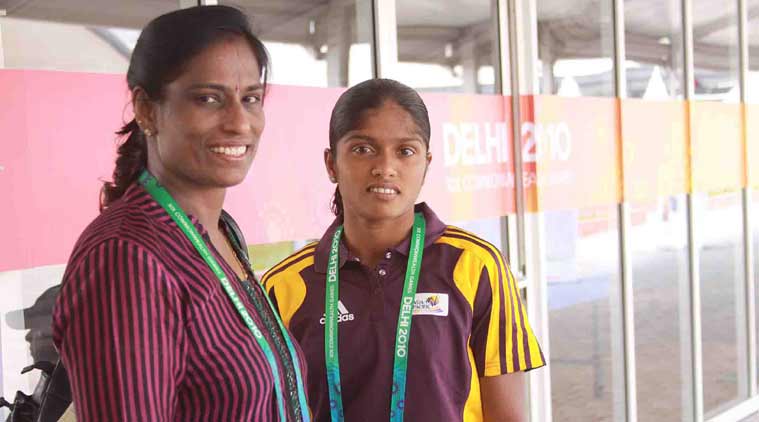 PT Usha has coached Tintu since 2002. Usha says: When I first spotted Tintu, she weighed 26 kilograms and was 146 centimetres tall. (Source: Express File)
Far too often, and never more heart-breakingly than at the Commonwealth Games in New Delhi, Tintu has lost steam going into the final curve of this two-lap race. The bobbing-oscillating head is a giveaway of the imminent meltdown around the start of the final corner.
Drenched in the warm rain — not the cold chilly downpour Indian athletes have encountered in Europe and then struggled to stop their bodies from stiffening up — Tintu crossed the finish-line first in Wuhan earlier this month to win her maiden gold at an international meet.
2:01.53 was Tintu’s official timing, currently the forty-ninth best in the world. But this list of top performances typically sees newer entries at the top ahead of a major international meet by when athletes tend to peak. This year it is the World Championships in Beijing, to be held towards the latter part of August, which is the showcase event where competition from the Kenyans, the Americans and the Russians will be many notches higher than what Tintu faced at Wuhan.
Going into the Asian Athletics Championships, Tintu had the best performance in the continent in the early part of the season. The absence of defending champion, China’s Wang Chunyu, and Incheon Asian Games gold medallist Margarita Mukasheva of Kazakhstan at Wuhan would have eased Tintu’s anxiety on the eve of the race.
Wuhan is being seen as a seminal moment in the 26-year-old’s career — a high for the coach and the athlete. But with Tintu not getting any younger nor faster — her personal best of 1:59.17 was set in Split four years ago – the pertinent question is whether she has plateaued and is doing herself no favours by putting faith in a race strategy which is all too predictable.
On the sidelines of the Commonwealth Games in Glasgow, Britain’s former middle distance great Sebastian Coe told the president of the Athletics Federation of India Adille Sumariwala that Tintu is a class athlete but needs to be given the best possible guidance, facilities and coaching. At Wuhan, where Coe was present, he had not changed his opinion regarding Tintu.
Coach Usha has been grappling with trying to find the right rhythm in the two lap race for Tintu.
Usha admits that Tintu needs to fine-tune certain aspects of her race but believes she is getting closer to cracking the code with regard to her star ward in this strategic race.
“Even in Wuhan, on way to winning her first gold, Tintu’s head was tilting from side to side in the last 70 metres. But I would say she has improved in this aspect. Earlier, her head would start shaking during the last 150 metres. She also needs to get much stronger in the last 300 metres of the race because this is where she tends to lose steam. She is a strong starter but by finding the right balance when it comes to her first lap and the second lap, Tintu can find the extra gear in the final stretch,” Usha says.
Being a strong front-runner she pushes hard in the first lap — between 57 and 58 seconds when in peak form. This leaves the tiring Indian vulnerable to a late surge from competitors who have enough in the tank to cancel out the advantage Tintu gains till the 600 metre mark. Pushed to the limit, she tends to drop her hands, which results in her losing stability and in-turn the head falls back and her legs lose traction.
She ends up losing a vital second or two.
Her races at the CWG 2010, the Guangzhou Games and the Incheon Asiad follow this pattern. She has tried to change her race strategy in the past, a case in point being in the previous edition of the Asian Athletics Championships in Pune.
Two years ago Tintu briefly dumped her strategy of going all out in the first lap but still in the final stretch she could not produce the kick required and had to settle for bronze. At the Inter State Championships in Lucknow last year, Tintu kept a lid on her tendency to produce a burst of speed at the start but it backfired as unheralded Sushma Devi stole a march on her in the final phase. When she runs with the leading pack, Tintu gets boxed-in (London Olympics semifinals) between stronger and more experienced athletes.
Tintu’s meltdown in the home stretch has happened so often that it can be termed a recurring nightmare, for fans and the athlete and her coach. Mukasheva had surged past a tiring Tintu with the race entering its final stages twice – at Guangzhou and four years later at Incheon. Being outwitted in the same manner in two continental meets four years apart, after leading both races till the last 150 metre, should make the alarm bells ring.
At the end of the race at the Incheon Games, Usha in a candid admission to this paper said: “I will be very happy if she goes and trains abroad. Any kind of international exposure will be good for her.”
A deep bond
Yet, it won’t be easy for the bird to leave the nest, the Usha School of Athletics in Kinalur, her home since she was first spotted by Usha during a selection trial in 2002. Back then, Usha recalls, Tintu was a malnourished 13-year-old who weighed 26 kilograms and measured 146 centimetres in height. Since then the bond between the two has only grown stronger with Usha fulfilling multiple roles.
She can be demanding and uncompromising as the hard taskmaster-coach, patient as a mentor, the understanding elder sister and the doting mother. Usha has been all this and more to the girl who had the most ‘awkward running style’ the former sprint queen has ever seen.
Usha’s influence over Tintu is similar to what OM Nambiar held over Usha herself. A nine year-old Usha came under the wings of Nambiar and for over two decades they were inseparable. Nambiar shaped Usha’s glittering career successfully because he knew Usha’s pulse – when to chide her, how to motivate her and when to put an arm around her drooping shoulders.
This emotional bond and the reluctance to move out of a comfort zone are widely believed to be the reasons why Usha never ventured outside the cocooned world Nambiar had created for her.
A majority of Indian athletes even to this day remain wary of looking beyond their revered coaches but there are some who have gained by travelling for training stints under a new coach with their long-time coach in tow.
Long jumper Anju Bobby George is one such example. In the early 2000s she went to train under world record-holder Mike Powell. Anju’s husband-cum-coach Robert Bobby George accompanied her.
“What I picked up by training with Powell was the importance of energy distribution during the run-up before take-off. In India, coaches sit with a stopwatch and measure how fast a jumper approaches the take-off board. But a more even distribution of speed and energy is what is ideal for a long jumper.
Powell helped me improve my runway technique. Having Bobby alongside me helped immensely because as a coach he too could take a calculated call if Powell’s inputs would suit me. Bobby and I had a short stint with Powell but we took away some positives which helped me,” said Anju who won a World Athletics Championships bronze in 2003.
Anju believes that at 26, Tintu still has another four or five years during which she can remain at her peak. “Tintu is an athlete of whom we expect a lot. She has produced decent timings but in terms of winning medals at major meets she has not fulfilled her potential. There is no harm in Tintu looking at a training-cum-competition stint abroad. I believe she could have looked at this option earlier too but it is still not too late. But for an athlete like Tintu who is used to the training methods of her long-time coach, it is important that Usha goes along with her,” Anju adds.
However, the key to success remains having an open mind and having the ability to grasp the change in techniques of top athletes around the world. “I used to closely watch American jumper Dwight Phillips competing. Over a four year period I noticed changes he brought to his technique. Bobby and I would discuss it and also see if it worked for me. If you want to learn and progress both the coach and the athlete need to be sharp and be up-to-date with what the latest methods and training techniques are around the world,” Anju believes.
Usha and Tintu can take a leaf out of the book of other Indian athletes too.
Discus thrower Krishna Poonia, a sixth-place finisher at the London Games is coached by her husband Vijendra but has turned to American Mac Wilkins – the 1976 Montreal Olympics gold medal winner – ahead of big competitions when she shifts her base to Portland.
Tintu is well-entrenched in the the Usha School of Athletics, which has an incomplete synthetic track (paucity of funds), a gymnasium and hostel blocks. Nutritionists and doctors are on call, while trainees are also exposed to yoga and meditation. It is Tintu’s second home and asking her to shift base even for a couple of months will be akin to taking a fish out of water.
Shive Gowda, discus thrower Vikas Gowda’s father, is of the opinion that Tintu can benefit if she is prepared to travel and stay abroad with a long-term goal in mind. Shive a former decathlete and a Team India national coach at the Seoul Olympics moved to Frederick, Maryland, in 1989 when Vikas was just six. He believes a well-planned move to a foreign training base, where Tintu and Usha are exposed to fresh inputs is the way forward.
“Look at Tintu running these days and you know she is pushing herself to the limit in every race just to stay in contention for a medal. She looks like she has nothing more to give. She is simply exhausted and lacks a Plan B. The 800 metres is won or lost in the final stretch with an explosion of speed but Tintu is unable to sustain herself for the entire length of the race.
Her muscle groups have matured now so it will be difficult for her to make any major changes but if she and Usha are prepared to look at new ideas when it comes to diet, recovery, technique and training philosophies then they must be prepared to train with the best possible coach at least for a year. It is a gamble but it is worth taking if Tintu wants to be a contender at the world level. Else she will remain a frog in the well or like a plant in a pot,” Gowda says.
The gold at Wuhan is a turning point in Tintu’s career, Usha believes.
“Her first international gold has given her lots of confidence and you will see her run faster times more often now. Not winning gold was a mental barrier which she has overcome now. She has learnt to pace her race better, she has tried not to over-speed or over-stride and mentally I would say she is much stronger in the final 300 metres. When it comes to Tintu everybody needs to be patient. She is India’s most consistent athlete,” Usha says.
Everyone wrote off Tintu even before she was given a chance to prove herself, Usha recalls.
“I remember how other coaches used to snigger at Tintu’s running style and physique in the early days. But I had faith in my training methods and in Tintu and she has delivered. People can criticise all they want but let us not forget she is a two time Asiad medal winner. Tintu has not reached where she is now overnight… it has taken years of dedication and training. We have seen highs and lows and I believe the future will remain bright for Tintu,” she stresses.
Tintu’s future could dazzle even brighter if she could leave the nest and fly into the sun. There’s still a year to go before hitting the sun and sand of Rio.