Long before the ICC announced the schedule for the 2023 World Cup, Ahmedabad was seen with suspicion. When the news broke that the world’s biggest stadium, the Narendra Modi Stadium, was likely to host cricket’s biggest draw, the battle between two neighbours with a past, Pakistan upped their ante.

The Pakistan government took its time to clear their cricket team’s tour across the border. They set up a high-level committee that was headed by Pakistan’s foreign minister Bilawal Bhutto Zardari and had 11 ministers to compile a report based on which Pakistan PM Shehbaz Sharif, also the PCB patron-in-chief, was to take the final call.
On Sunday evening, the Pakistan government gave the green signal but added a rider. “Pakistan, however, has deep concerns about the security of its cricket team.
We are conveying these concerns to the International Cricket Council and the Indian authorities. We expect that the full safety and security of the Pakistan Cricket Team will be ensured during its visit to India,” the Pakistan government spokesperson said in a press release.
With Pakistan’s participation getting the final stamp of approval, the ball is now in India’s court. And with Ahmedabad set to host India’s game with Pakistan, and also the final, all eyes will be on the close- to-one-lakh capacity stadium that in the past has hosted an event featuring the POTUS and Indian PM Modi.
Over the past few years, since Jay Shah rose to prominence in the BCCI, the Modi stadium has witnessed several important India games, along with a couple of IPL finals. However, the India vs Pakistan World Cup game is no MI vs Titans clash or even an India vs Australia Test.
Story continues below this ad
Chances are Ahmedabad will see fans in Pakistan green waving their country’s flags from the stands. This scenario provides the biggest test for organisers, security agencies, hotel staff and, of course, the local fans. This October, Ahmedabad needs to be at its best behaviour.
Chequered past
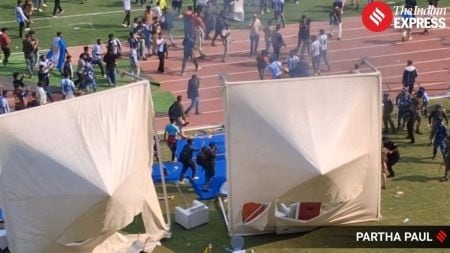
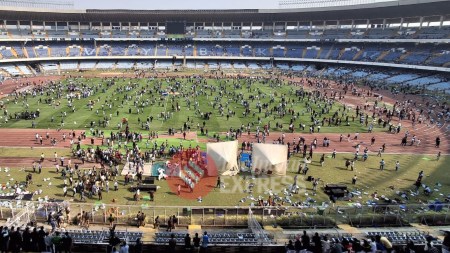
Historically, Indian fans haven’t taken a World Cup loss in a crucial game too kindly. Images of Vinod Kambli in tears and the Eden Gardens in flames, after the surprising 1996 World Cup semi-final, are a reminder of Indian cricket’s embarrassing past.
For most of that March, the country’s collective dream of winning the Cup had grown. That was until Aravinda de Silva started treating Anil Kumble like a club bowler. Ahmedabad can’t afford to be Kolkata, it needs to be Chennai, the city of sports lovers who gave a standing ovation to the Wasim Akram-led team after the 1999 Test that Pakistan won.
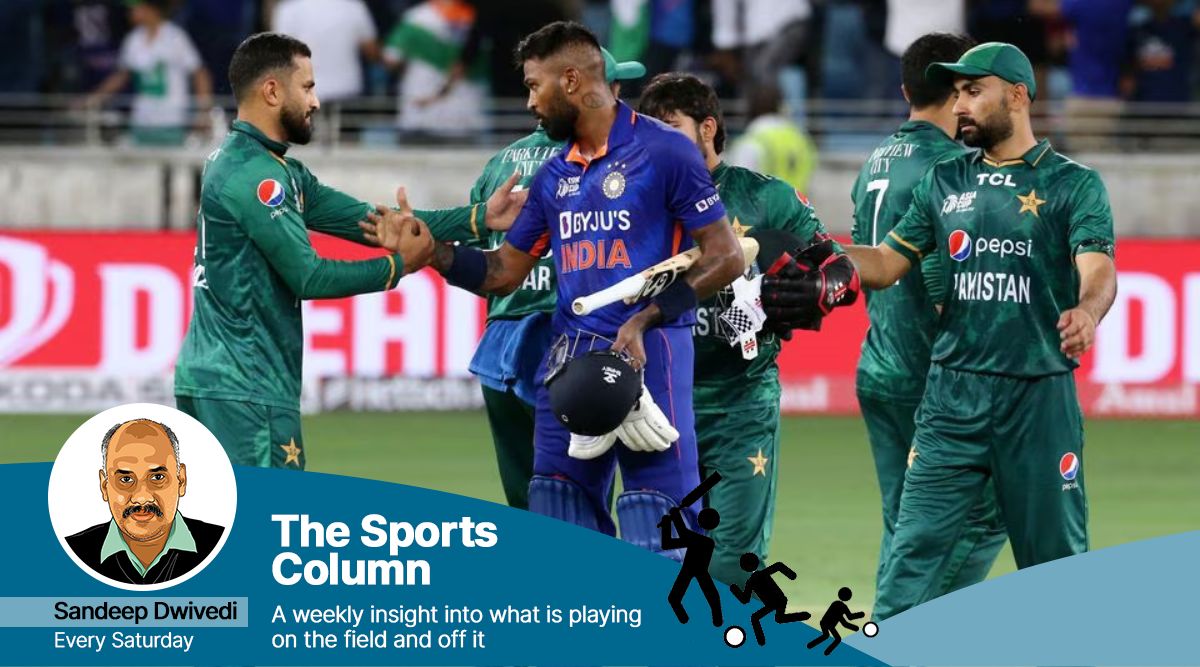
Interestingly, India and Pakistan might have seen a bitter Partition, but the cricket fans of the two nations have coexisted peacefully in the stands. In several intense World Cup games between the arch-rivals, there is rigorous flag-waving, sometimes even finger-wagging, but there is rarely any further transgression. Ahmedabad has a rich legacy to live up to.
Story continues below this ad
In his book ‘My years in BCCI’, Indian cricket’s seasoned administrator Ratnakar Shetty has a chapter on India’s historic 2004 tour to Pakistan. He describes the heart-warming scene after India’s close one-day series win in Lahore.
“The scenes we witnessed after the game were to be seen to be believed. Imagine Indians waving the Tricolour and dancing to the beat of drums being played by Pakistanis, on the streets of Lahore! Unbelievable, but then, that is exactly what happened that night.” Ahmedabad will have a tough act to follow.
“The scenes we witnessed after the game were to be seen to be believed. Imagine Indians waving the tricolour and dancing to the beat of drums being played by Pakistanis, on the streets of Lahore! Unbelievable, but then, that is exactly what happened that night.” Ahmedabad will have a tough act to follow.
Peak of cricket diplomacy
It was a tour that was high on cricket diplomacy with the premiers of both nations asking their cricketers to be ambassadors of peace. Indian PM Atal Bihari Vajpayee would invite the team to his home before they boarded the flight to fly across the border. Vajpayee would give the team a bat with ‘Khel bhi jeeto aur dil bhi’ written on it. And just when the team was leaving, the poet PM would float a request to the naval band to play ‘Hum honge kaamyaab’.
Story continues below this ad
Shetty also gives juicy details of the evening in Pakistan when President Pervez Musharraf hosted the teams for tea. “He was in a jovial mood as he interacted with the players of both sides and cracked jokes, some at the expense of the Pakistani team. He described the lavish spread of food, which was rich in ghee, as ‘weapons of mass destruction’,” wrote Shetty.
Ahmedabad needs to remember that when India meets Pakistan on a cricket field, hostile neighbours talk of peace and even generals take a break from wars and use lethal war instruments to break ice.
But the most endearing snippet in Shetty’s book is the one that sums up the love-hate relationship between the nations with a shared history. It is from Pakistan’s reciprocal tour to India when BCCI president Sharad Pawar invited the Pakistan team to his residence for dinner. Pawar would be thoughtful to add India’s leading industrialist and Mohammad Ali Jinnah’s grandson Nusli Wadia to the guest list.
Shetty writes: “We hosted a dinner for both the teams at Mr Pawar’s official residence in New Delhi. Nusli Wadia, Jinnah’s grandson, was one of the invitees. The Pakistan squad waited till he arrived and each member of the team knelt before him and kissed his hand as a mark of respect.”
Story continues below this ad
These are the reasons that despite wars and failed dialogues, the fragile Indo-Pak hyphen refuses to be snapped. Ahmedabad has a chance to change perceptions.
Schedule, tickets delay
It was during the chaotic months before the 2010 Commonwealth Games that the then Sports Minister MS Gill made the famous statement that till date offers respite to all sports administrators fighting deadlines in the run-up to high-profile events. Tired of answering questions about unfinished stadiums and umpteen organisations snafus, the bureaucrat-turned-parliamentarian made a prophecy that more or less came true.
“Never mind the delays. Like a seemingly disorganised arrangement in an Indian marriage – just like in the movie ‘Monsoon Wedding’ – we will have a grand Games,” Gill had said.
Story continues below this ad
Like the Delhi CWG 2010, India gets ready for another October wedding and not everything is going according to plan.
Cricket’s oldest and biggest rock show, the 50-over World Cup, is less than two months away but fans still wait for the final modified schedule. While coming to terms with flight cancellation losses, they keep their fingers crossed to deal with the suspense over match-day ticket sales.
The game at the centre of this uncertainty is the India-Pakistan league clash that has been slated for October 15, the day Gujarat gets into a 9-day garba frenzy to celebrate Navratri. Unofficially, the reason for the expected date-shift is the potential security stretch but BCCI secretary Jay Shah has insisted that it is because of ‘requests of change’ floated by other boards. Also, Kolkata has reportedly asked for a schedule change as the Pakistan-England fixture allotted to it falls on November 12 during Kali Puja. Whatever be the truth, there are a couple of questions that beg to be answered: Didn’t the schedule makers refer to the panchangam that lists Hindu festivals? Wasn’t the itinerary cleared by all participating nations before the ICC made it public?
Send your feedback to sandydwivedi@gmail.com


 9 min read