8 min read

© The Indian Express Pvt Ltd



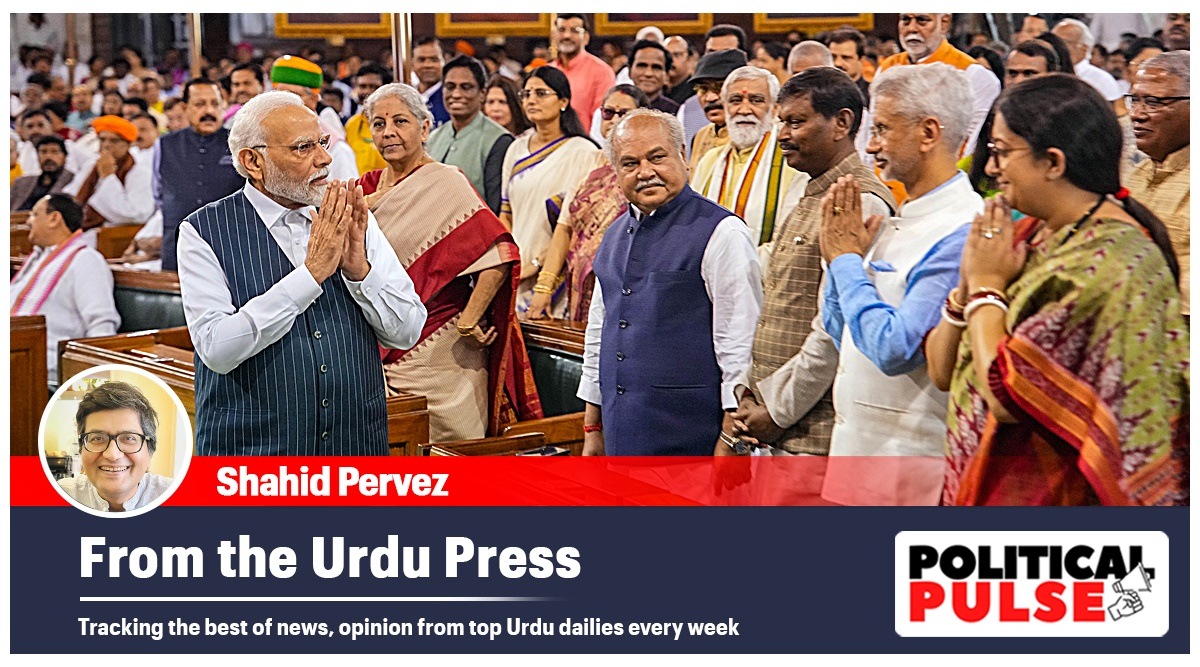 Prime Minister Narendra Modi being greeted by Parliamentarians during an event organised to commemorate the rich legacy of the Parliament of India at the Central Hall of the old Parliament building, in New Delhi, Tuesday, Sept. 19, 2023. (PTI Photo)
 As Parliament House shifts to its new building in the same complex atop Raisinia Hill in the heart of the national capital, Urdu dailies turned their gaze on India’s tryst with democracy, flagging hopes and concerns for its future. They spotlighted the Narendra Modi government’s move for women empowerment during the ongoing special Parliament session by introducing the women’s reservation Bill, which has been hanging fire for nearly three decades.
Highlighting the Opposition INDIA alliance’s decision to boycott the shows of 14 TV anchors across channels, the dailies also joined the fraught debate over the distinction between journalism and hate speech.
Focusing on the last sitting of Parliament in the historic edifice before its move to the adjacent new building as the five-day special session got underway, the multi-edition Roznama Rashtriya Sahara, in its editorial on September 19, points out that Prime Minister Modi led the Lok Sabha in bidding farewell to the old Parliament House while initiating a discussion on the “Parliamentary Journey of 75 years starting from Samvidhan Sabha – Achievements, Experiences, Memories and Learnings”. In his tribute to the old Parliament building, the PM traced the history of its contributions to the progress of the country, which will inspire future generations.
The daily writes that in his speech PM Modi hailed former PMs, from Jawaharlal Nehru to Atal Bihari Vajpayee, for their role and vision in nation-building. Referring to Nehru’s historic “stroke of midnight” speech on the eve of India’s Independence, he said it will keep inspiring everyone.
“Modi mentioned Narasimha Rao’s bold new economic reforms, which is benefitting the country today. He highlighted the Vajpayee government’s Sarva Shiksha Abhiyan, the formation of the Tribal Affairs Ministry and 1998 Pokhran-II nuclear tests,” the editorial states. He recalled Vajpayee’s words that “governments may come and go; parties will be formed or disbanded; but this nation must live on”. PM Modi said the House had also witnessed the “cash for vote” scam during the Manmohan Singh government, the edit notes. He showcased the success of the G20 Summit that India recently hosted under its presidency.
The daily says that PM Modi also related his own story to showcase the robustness of Indian democracy. He recalled the emotional moment when he first entered the Parliament House as the PM. He also said he had never imagined that “a child from a poor family, living on a railway platform” would reach Parliament, attributing it to the strength of Indian democracy and common people’s faith in it, the editorial notes. “This is a tribute to our democracy. And if democracy remains alive, then a child from any poor family could dream about becoming the Prime Minister,” it states. “But it is imperative that we must take all measures to ensure that the roots of our democracy are not damaged and that its key wings, including Press and Judiciary, remain free, fair and independent.”
Commenting on the Opposition alliance INDIA’s move to boycott 14 TV anchors accusing them of conducting “hate-filled” news debates, the Hyderabad-based Siasat, in its editorial on September 15, says that the Opposition parties have been complaining for the past several years that several TV channels and their anchors have turned into government spokespersons rather than discharging their journalistic duty by asking questions to power. “There has been a public perception across the country about such TV faces, barring some exceptions, that they have diminished as journalists and turned into the BJP dispensation’s megaphones, who go all out with blazing intensity and a cynical mindset to target only the Opposition and their leaders,” the daily writes.
“Several quarters believe that these anchors are also undermining communal harmony in the country by polarising people, spreading poison of hatred, and vitiating the atmosphere,” the editorial says. “Some of these media persons have also been engaged in defending the government instead of holding it to account over various rows by deflecting real problems and raking up non-issues. Perhaps this is why the credibility and prestige of media in the country has taken such a severe beating.”
Press is a key pillar of democracy, which has a crucial mandate as an impartial watchdog in public life, the daily notes.
“This seems to have changed in our country now, with media betraying a single-point agenda to gun for the Opposition. It has become a toy in political hands, turning into a pliant ally of the government, instead of remaining an unbiased, questioning institution dedicated to public interest. Not surprisingly, the situation has resulted in a sharp decline in public respect for media persons,” it says.
The 28-member Opposition bloc’s decision to boycott certain TV anchors reflects the point that a large stakeholder of our democracy does not have confidence in a section of TV channels, Siasat says, adding that media should undertake an introspection and apply correctives over the just and fair criticism of its functioning.
Referring to the arrest of Telugu Desam Party (TDP) president and ex-Andhra Pradesh chief minister Chandrababu Naidu by the state police for his alleged involvement in the multi-crore State Skill Development Corporation “scam”, the Siasat daily, in its leader on September 18, says that his arrest has roiled Andhra politics. Naidu had been making an outreach to the people in the run-up to the simultaneous Assembly and Lok Sabha polls, criss-crossing the state to highlight the “failings” of the Jagan Mohan Reddy-led YSRCP government in a bid to build up his party’s campaign, the editorial says. Naidu’s son Nara Lokesh had also been undertaking a march through the state to mobilise public support for the TDP, it says, adding that their campaigns were possibly posing a challenge to the Jagan government.
“The manner in which Naidu was bundled up in the wee hours and put behind bars has caused resentment among the people besides riling the TDP rank and file,” the Hyderabad-based daily says. “The development might prove to be a turning point in Andhra politics, setting the stage for a direct fight between the two arch rivals.”
The editorial points out that the BJP, which had earlier indicated that it may tie up with the TDP, was non-committal while keeping its plan under wraps now. The actor-turned-politician and Jana Sena Party (JSP) chief, Pawan Kalyan, has announced his party’s alliance with the TDP to take on the YSRCP, it notes. “Pawan Kalyan also leans towards the BJP.
In the evolving situation, a TDP-JSP-BJP alliance might be stitched up for the 2024 Assembly and parliamentary polls. While the BJP and JSP would like to capitalise on the situation and join hands with Naidu, the latter is also a seasoned and astute politician, who can play his own game.”
The state is in turmoil due to the prevailing political situation, the edit says. Notwithstanding their possible satisfaction over the Jagan government’s performance, Naidu’s arrest has ruffled the people, it says. “Now, all eyes would be on Naidu. Once he steps out of prison after securing bail, it may lead to fast-paced changes in the state’s political scenario.”