10 min read

Journalism of Courage



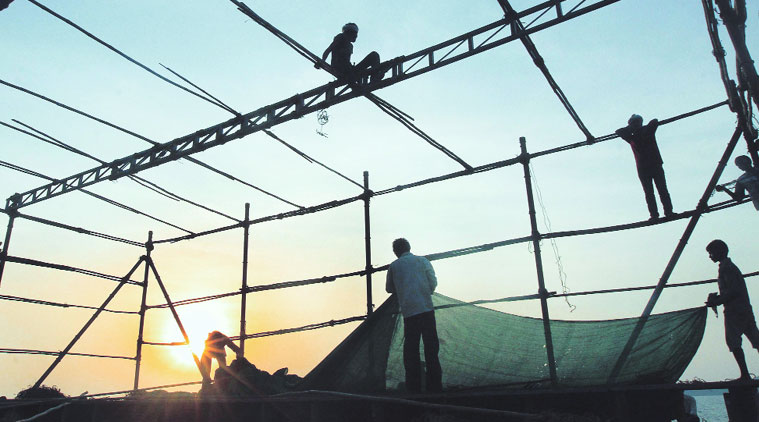 Preparations in full swing at Wankhede Stadium for Friday’s swearing-in ceremony. (Source: Express photo by Pradip Das)
From reviving a stagnant farm sector to ensuring a credible, corruption-free government, the new CM to be sworn in today has several complex tasks ahead.
FINANCES

In their bid to woo voters, the erstwhile Congress-Nationalist Congress Party regime threw fiscal prudence to the wind in the run-up to the Lok Sabha and Assembly polls in Maharashtra.
The state’s revenue deficit for 2014-15, estimated at Rs 4,103 crore, when former finance minister Ajit Pawar presented his additional budget, had climbed to Rs 26,000 crore by July-end, with the Prithviraj Chavan government going on a pre-poll sop spree. It announced a Rs 7,394-crore dole in the form of electricity bill waiver for farmers, besides raising Rs 20,388 crore in supplementary grants immediately after presenting the budget. A senior finance department official said the projected revenue deficit numbers now stood at nearly Rs 30,000 crore.
Bureaucrats also conceded that the state’s total debt was expected to cross over the Rs 3.1 lakh crore in the current year that it was disconcerting. “The debt is rising at over 10 per cent per year with borrowings mainly used to foot non-revenue expenditure,” a senior official said.
As an opposition legislator, Fadnavis had often targeted the Congress-NCP regime for fiscal mismanagement, even demanding tabling of a ‘white paper’ on finances. With the state administration imposing a cut on development spends to manage the dwindling resources, Fadnavis will have to walk the tightrope while chalking out his government’s agenda. Fadnavis had earlier assured that octroi and local body tax would be abolished by the BJP regime, but with the state’s financial managers against such a move, it remains to be seen if he can deliver on that promise.
FARM SECTOR

Stark regional disparities in irrigation and other amenities, unpredictable weather patterns in the past few years and an overall stagnation in agricultural growth have led to Maharashtra’s farm sector emerging as a likely early crisis area for the new government.
The year 2012-13 saw a drop in the yield of several crops, hit partly by the 2012 drought and partly by unseasonal rains. This year’s kharif crop was affected by the hailstorms in large parts of central Maharashtra, with the affected farmers now complaining bitterly of dysfunctional crop insurance schemes and incomplete government dole.
Meanwhile, the more recent drop in prices has the farm sector worried about the Bharatiya Janata Party’s apparently exclusive focus on the middle-class consumer. “There Arvind Kejriwal is complaining about the skyrocketing prices of tomatoes and here farmers are literally throwing tomatoes away in Marathwada and Khandesh,” said Nishikant Bhalerao, the Aurangabad-based editor of Adhunik Kisan. “The policies on food processing have to be looked at urgently — there is near absence of processing facilities in Marathwada for example,” he said. The prices of tomatoes and potatoes have fallen in recent weeks, and while onions usually see an upward spurt after Diwali, that has not yet happened. “It could be some election-time effect,” said Bhalerao.
In addition, 78 per cent of the operational land holdings in the state belong to small and marginal farmers with 2 hectares of land or less, and the occasional hailstorm or the sequential drought pattern are crippling them. Bhalerao said the hailstorms in Marathwada, the low yield on soyabean and cotton farms this year and the unexplained delay in the start of sugarcane crushing in the sugar factories had all resulted in farmers suffering from a severe cash-in-hand problem. He said Paithan in Aurangabad district saw two farmers ending their lives last week.
With the kharif crop affected by the hailstorms and very slow sowing for the rabi season under way, a jumpstart for the farm sector will have to be among the top priorities for the new cabinet.
INDUSTRY

Though in terms of pure statistics Maharashtra’s gross domestic product and the growth in the industrial sector have been looking up as compared to last year’s figures, there are several challenges that remain in the path of accelerating the industrial growth. One of the main issues plaguing industries is availability of land and difficulties in the acquisition process, especially after the new Land Acquisition Act. For instance, the state government had to scale down the Dighi port node of the Delhi Mumbai Industrial Corridor from the original 25,000 hectares due to vociferous protests by local residents against land acquisition.
Power tariff is another cause of concern for industries with the electricity cost being a major factor in manufacturing. The tariff is high mainly as the state power distribution company has to recover an excess of about Rs 6,300 crore from industries to enable it to cross-subsidise other consumers such as those from the agriculture sector and domestic consumers using less than 300 units.
Besides land acquisition, availability of skilled labour and the time taken in securing clearances also hamper the ease of doing business. Improving connectivity and access to ports across the state and linking various industrial areas is also imperative to fuel industrial growth. The state government has not been able to add ports after the Mumbai Port Trust and the Jawaharlal Nehru Port Trust, with Dighi and Jaigarh being private ports. The government had planned projects such as the Chakan airport, modernisation of the Nagpur airport strip and the Navi Mumbai International Airport to boost air connectivity, but the plans have failed to take off so far.
Ajit Gulabchand, CMD of Hindustan Construction Company Ltd, said the new chief minister must get going on the various pending projects. “Speed on these projects will not only create a momentum for change but will also kill corruption and expose redtape. Two, he needs to create employment. The country needs 300 million jobs, more than twice the number of people the USA employs. And if we are to create two America-sized economies, Maharashtra must bear a large burden as a developed state. This is not possible without investments, for which the government must create a suitable climate,” he said.
For a party that ran a high-octane election campaign targeting the Congress-NCP government for its multiple graft cases, the BJP government will have to show action on this count immediately. “No compromises,” MP Kirit Somaiya told The Indian Express when asked if he would follow up the irrigation scam case now that the NCP has offered support to the BJP government. “The government will be following it. It will go to its logical conclusion,” Somaiya said.
Rights activist Medha Patkar pointed out that the laundry list of corruption cases and alleged scams uncovered in recent years, all pointing at either inaction or active collusion of senior Congress-NCP leaders, was a challenging one.
“The new chief minister Fadnavis has proven himself to be a person who studies issues. He has read previous CAG reports,” said Patkar. She said scams exposed earlier must be taken to prosecution and trial stage — the Adarsh and Lavasa scams in which the government already filed cases, for example. “Even when Modi visited Lavasa, he said the country needed more such spaces but without irregularities. In Lavasa there are illegalities,” she said, also citing the irrigation scam, the case of the Hiranandani complex in Powai and the sale of defunct sugar factories to politicians who purchased these at a fraction of their value.
Whether the new government is able to take a strong position on these, especially given that it is a minority government at least in its early days, will be its litmus test.
Apart from these, there are other issues to urgently set right. For example, the general image of the Maharashtra government being too close to builders has to be reversed, something the BJP may find easier said than done. That apart, there is the recent government resolution amending the Right to Information Act, curbs on which have been decried by activists including former chief information commissioner Shailesh Gandhi. Strengthening the Lokayukta is another long-awaited move for the creation of more effective watchdogs.
URBANISATION

Successive governments have not been able to shed the perception that urban development policies, housing schemes and even transportation projects are designed to benefit, not the common man, but the powerful builder lobby. The Adarsh blot served to enhance that image. The state government had rolled out a series of schemes for urbanization, housing, stemming growth of slums and redevelopment. However, the schemes have hardly helped in ridding cities of slums or modernising them.
While this image needs to be corrected urgently, the first challenge is to understand the processes behind rapid urbanisation in the state and to prepare the small towns and Tier II cities for the coming demographic change. Even as the state is nearly 50 per cent urban today, Maharashtra’s small towns are uniformly uninhabitable. Even then, they continue to attract thousands from worse-off hinterlands, rendering these unplanned towns even more decrepit with mushrooming slums.
Big cities such as Mumbai and Pune need to be decongested and their peripheral areas that can be tapped to create urban agglomerations are in the midst of haphazard growth. At several places, the development plans have not been updated and illegal construction is rampant. Despite the rapid transformation of Mumbai’s transport infrastructure, transportation is still a challenge with there being chronic bottlenecks across the city. The other cities have had no transport infrastructure development to speak of.
Housing in these cities is also an escalating concern with property in Mumbai and Pune being largely overvalued with much of the inventory being under construction. Affordable housing in these cities is negligible with prices of homes built by agencies such as Maharashtra Housing and Area Development Authority (MHADA) also increasingly on the rise. Schemes to check slum proliferation in big cities have also failed such as the rental housing and the slum rehabilitation scheme. Even as about 55 lakh people in Mumbai live in slums, the slum rehabilitation scheme has largely been a dud due to shoddy work, lack of quality control and inordinate delays by developers in implementing projects.