3 min read


© The Indian Express Pvt Ltd



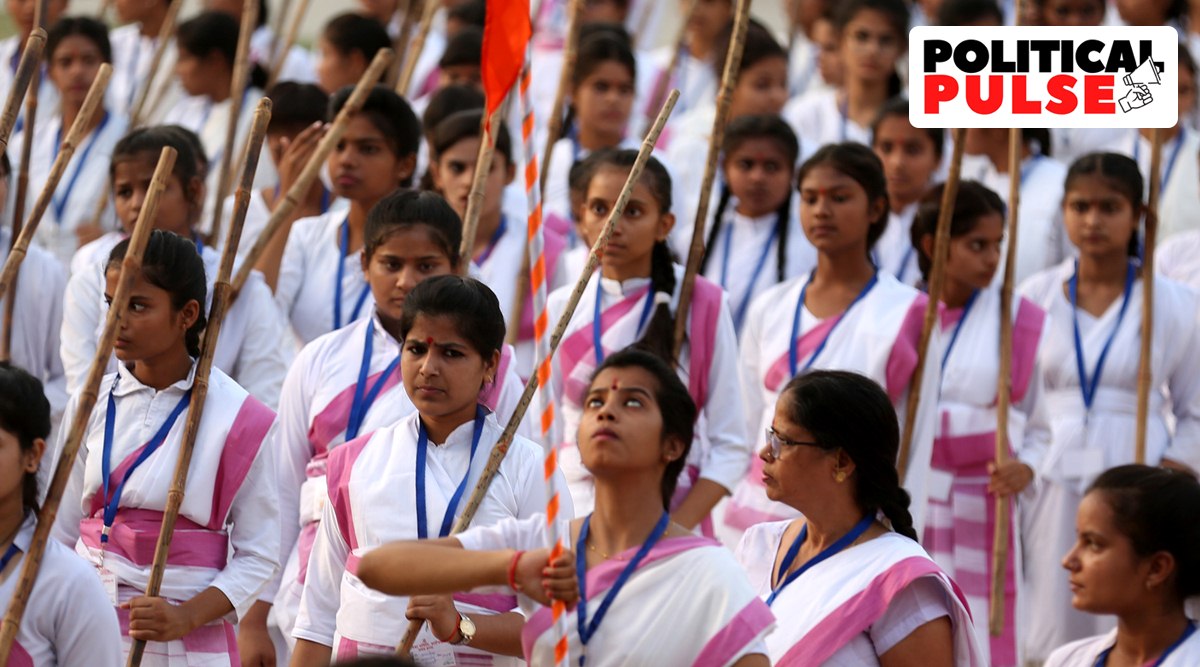 RSS' women wing carries out a march in Lucknow. (Express file photo by Vishal Srivastav)
Even as the BJP has identified women voters as crucial to its electoral growth and targeted its messaging and schemes around them, the RSS has struggled with the question of women in its ranks for decades.
Recently, speaking at a conference in Delhi on agriculture and prosperity organised by the Sangh, RSS sarkaryawah (general secretary) Dattatreya Hosabale lamented at the lack of women participation in the meeting. “This seminar should have had some more women. There are no women speakers either,” he said.
While the RSS formed its women’s wing called the Rashtra Sevika Samiti back in 1936, in Wardha, led by Lakshmibai Kelkar or “Mausiji”, it remains a far cry from the original Sangh. Set up when RSS founder K B Hedgewar was alive, the Samiti has the same organisational structure as that of the Sangh – with shakhas, dedicated whole-timers called “pracharikas”, and annual training camps called Sangh Shiksha Varg. However, the Samiti’s ranks are largely confined to women relatives of RSS office-bearers and swayamsevaks.
The RSS’s annual report for 2021-22, which gives details regarding its women-centric programmes, said 41 of its Sampark Vibhag (outreach wings) in states had women representation. The Sangh’s state units do not strictly follow geological lines but a division formula as per convenience.
The push to attract more women started in earnest in the Sangh around two decades ago. Now, apart from the Rashtra Sevika Samiti, the RSS organises programmes reaching out to women. As part of its ‘Kutumb Prabodhan’ scheme, with convenors in 41 states, “parivar sammelan (family meetings)” are organised in different places of the country. The aim of this scheme is to guide families towards “Indian value systems”.
Besides, the RSS organises “mahila sammelans” in different parts of the country. In December last year, a “Matrishakti (Power of the mother) Kumbh” was held at Varanasi. The RSS report said there were around 10,000 women participants at the Varanasi meeting, while 31 women workers took part in its training schedules for full-time karyakartas.
The RSS is also conscious of the message it sends out given the perception of it as an all-male and overtly muscular outfit, that represents or supports regressive values when it comes to women. So, in February 2015, RSS chief Mohan Bhagwat publicly distanced himself from BJP MP Sakshi Maharaj’s advice to Hindu women to give birth to four children each. Speaking a day after the MP, Bhagwat said: “Hamaari maatayen factory nahin hain, bachcha paida karna vyaktigat nirnay hai (Our mothers are not factories, giving birth to a child is an individual choice).”
Sources said that in almost every RSS frontal organisation now there is focus on including more and more women, with Sangh outfits such as the Bharatiya Kisan Sangh (farmer wing), Bharatiya Mazdoor Sangh (labourer wing) Vidya Bharti (educational wing) and the ABVP (students’ wing) roped in.