Premium
This is an archive article published on January 18, 2022

As part of Punjab makeover, BJP gets some panthic faces

The BJP, which till a few months ago was struggling to find Sikh faces in Punjab, now has new members with strong Panthic credentials apart from disgruntled Akali and Congress leaders.

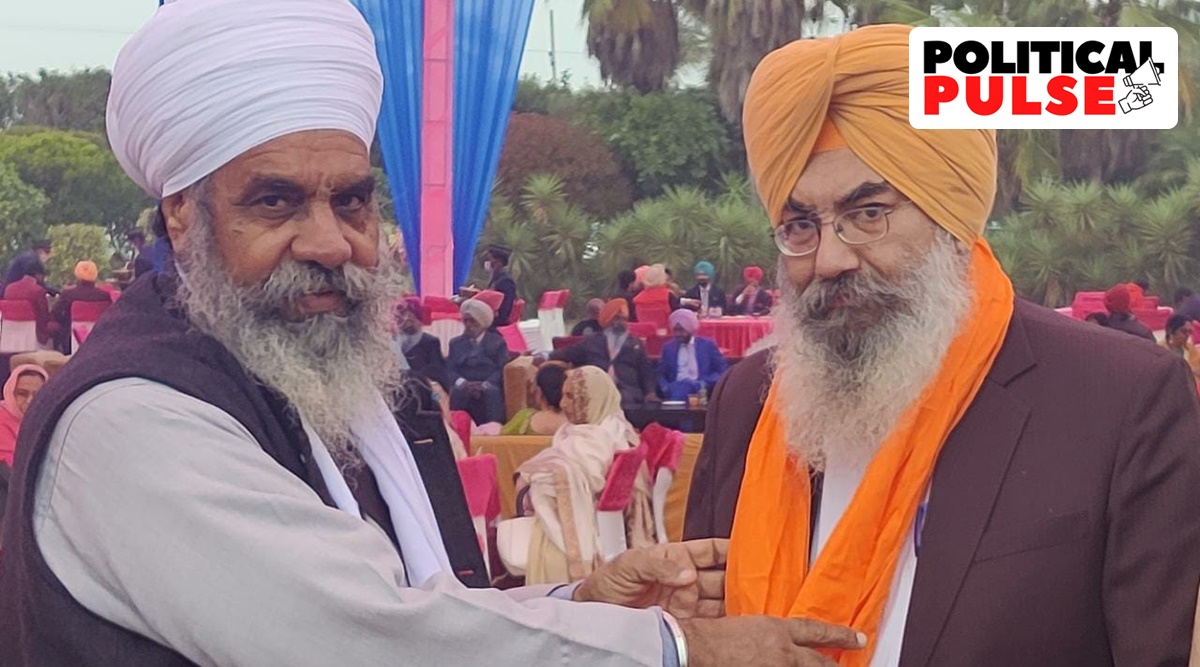
Soon after Harnam Singh Dhumma’s comment on PM, Sarchand Singh, once the president of the Sikh Students' Federation, an organisation marshalled by Bhindranwale during the 1980s, joined the BJP.Soon after Harnam Singh Dhumma’s comment on PM, Sarchand Singh, once the president of the Sikh Students' Federation, an organisation marshalled by Bhindranwale during the 1980s, joined the BJP.

Last week, Prime Minister Narendra Modi found an unlikely ally in Harnam Singh Dhumma, chief of the Damdami Taksal, a Sikh seminary once headed by Khalistani extremist Sant Jarnail Singh Bhindranwale, who was killed in Operation Blue Star. While others like the SGPC questioned Modi’s announcement of December 26 as Vir Bal Divas to honour the two younger sons of Guru Gobind Singh killed by the Mughals, Dhumma commended him.

Arguably the most vocal chief of the Taksal after Bhindranwale, Dhumma said: “There are very few who fulfill their duty and the PM has done this. He should be thanked. He has told the entire world about the martyrdom of the two younger sons and mother of Guru Gobind Singh.”

Soon after Dhumma’s comment, his spokesperson, Sarchand Singh, once the president of the Sikh Students’ Federation, an organisation marshalled by Bhindranwale during the 1980s, joined the BJP. Singh, a professor of Punjabi, was followed by Kanwarveer Singh Tohra, grandson of the late Gurcharan Singh Tohra, who remained president of the Shiromani Gurdwara Parbandhak Committee for 27 years and was popularly called the pope of the Sikhs.

The BJP, which till a few months ago was struggling to find Sikh faces in Punjab, now has new members with strong Panthic credentials apart from disgruntled Akali and Congress leaders. The Damdami Taksal teaches Sikh scriptures and prides itself on protecting the tenets of the religion in their purest form.

But the BJP-Taksal association is curious for both sides. The BJP has been talking of a Khalistani hand since the start of the farm protests, and has raised the pitch after the blockade that prevented Prime Minister Narendra Modi from addressing a rally earlier this month in Punjab. BJP ally Amarinder Singh routinely talks of the “threat” posed by Khalistani elements in the border state.

Taksal though is closely associated with Punjab’s militancy years. In the 1980s, extremists commanded by Bhindranwale had made their base at the Taksal’s headquarters at Chowk Mehta, 40 km from Amritsar. As recently as 2016, there were allegations that the Taksal was involved in a bid to kill a Patiala-based preacher opposed to it, Ranjit Singh Dhadrianwale.

Defending his entry into the BJP, Sarchand said when regional parties fail to resolve issues pertaining to the panth, an individual is forced to look for alternatives. “The state leadership has failed to get its demands met by the Centre. The BJP at the Centre can resolve long-pending issues such as the release of Sikh political prisoners and others pertaining to gurdwaras outside the state.”

Story continues below this ad
Defending his entry into the BJP, Sarchand said when regional parties fail to resolve issues pertaining to the panth, an individual is forced to look for alternatives.

Sarchand also said the PM had demonstrated his sincerity by trying to bring justice to victims of the 1984 anti-Sikh riots and by opening the Kartarpur Corridor to allow pilgrims visa-free access to one of the Sikh holy shrines. “The Congress attacked our religion, the holiest of our shrines (Golden Temple, during Operation Blue Star). The BJP stood by us, the PM celebrates Gurpurab, why shouldn’t we support it?”

Admitting not everyone is happy, Sarchan added: “To them, I say we should have a dialogue with the BJP as an insider.”

On the labelling of farmer protesters as “Khalistanis”, Sarchand said the PM had never called them that. “These are mischievous elements,” he said, adding that he would rally Sikh historians and intellectuals to support the party.

Tohra, a political greenhorn whose father was a minister in the Akali Dal Cabinet led by Badal Senior, said an old friend told him the RSS was very fond of Sikhs, and that the PM’s actions demonstrated it. After he joined the BJP, Tohra said, its leaders asked him what he would do for the well-being of Sikhs. “Even the Akalis no longer ask this question.”

Story continues below this ad

On the bitterness caused by the farmer agitation, Tohra, an engineer-turned farmer whose actor wife Mahreen Kaleka has been supporting the farm agitation, shot back: “Has a Congress PM ever apologised for Operation Blue Star? But the PM (Modi) sought forgiveness for the three farm laws.”

While the BJP said the developments show that the Punjabis are having a change of heart towards it, other parties see “rank opportunism”. Senior Akali leader and former minister Dr Daljeet Cheema said: “People are joining the BJP for their personal gains, and the ‘panthic soch (thinking)’ will not condone it.”

Prof Amarjit Singh, director of Guru Granth Sahib Studies at Guru Nanak Dev University, Amritsar, said only time will tell whether the saffron party is really interested in resolving panthic issues. “It was during their tenure that Punjabi was removed as a special language by Jammu and Kashmir. Complete justice is yet to be done in the 1984 riots. The Sachar panel had provided streetwise details of the culprits, they can act on it. Also, if they are serious about Punjab’s welfare, they should open the Wagah border for trade.”

Manraj Grewal Sharma is a senior journalist and the Resident Editor of The Indian Express in Chandigarh, where she leads the newspaper’s coverage of north India’s most politically and institutionally significant regions. From Punjab and Haryana to Himachal Pradesh and the Union Territory of Chandigarh, she oversees reporting at the intersection of governance, law, politics and society. She also reports on the diaspora, especially in Canada and the US. With a career spanning journalism across several countries, academia and international development, Manraj brings a rare depth of perspective to regional reporting. She is widely regarded as a leading chronicler of Punjab’s contemporary history and socio-political evolution, particularly its long shadow of militancy, federal tensions and identity politics. Her book, Dreams after Darkness, remains a definitive account of the militancy years and their enduring aftermath. Professional Background & Expertise A gold medalist in mass communication and a post-graduate in English literature, Manraj has a multifaceted career spanning journalism, academia, and international development. She was also awarded a fellowship by National Foundation of India and did several in-depth pieces on Manipur. Internationally, she has reported from Israel, US, UK, Myanmar, and Mauritius Her key focus areas include: Regional Politics, History, Agriculture, Diaspora, and Security. Of late, she has started focusing on Legal & Judicial Affairs: Much of her recent work involves reporting on high-stakes cases in the Punjab and Haryana High Court, ranging from environmental policy to civil rights. International Consulting: She previously served as a consulting editor for the Asia Pacific Adaptation Network and a publishing consultant for the Asian Development Bank (ADB) in Manila. Academia: For five years, she was the managing editor of Gender, Technology and Development, a peer-reviewed international journal at the Asian Institute of Technology, Bangkok. Recent Notable Articles (Late 2025) Her recent reportage focuses heavily on judicial interventions and regional governance: 1. Environment & Governance "‘NGT can’t test legality of policy’: HC hears challenge to Punjab’s ‘Green Habitat’ plan" (Dec 22, 2025): Covering a critical legal battle over whether the National Green Tribunal has the authority to strike down a state policy regularizing farmhouses on delisted forest land. "High court pulls up Punjab poll panel over audio clip probe" (Dec 10, 2025): Reporting on judicial concerns regarding the transparency and fairness of local body elections. 2. Legal Rights & Social Welfare "HC issues notice to Punjab, Haryana over delay in building old age homes" (Dec 22, 2025): Reporting on a contempt petition against top officials for failing to establish government-run homes for the elderly as promised in 2019. "Victims can appeal acquittals in sessions court without seeking special leave" (Dec 19, 2025): Highlighting a significant procedural shift in criminal law following a Supreme Court ruling. "HC upholds benefits for Punjab FCI officer acquitted in 20-year-old bribery case" (Dec 19, 2025): A report on the concept of "honourable acquittal" and its impact on employee benefits. 3. Human Rights & Identity "As Punjab denies parole to MP Amritpal Singh, HC asks it to submit ‘foundational material’" (Dec 1, 2025): Covering the legal proceedings regarding the radical preacher and sitting MP's request to attend Parliament. "Protecting life paramount: HC backs Muslim woman in live-in after verbal divorce" (Nov 6, 2025): Analyzing judicial protections for personal liberty in the context of traditional practices. Signature Beats Manraj is recognized for her ability to decode complex judicial rulings and relate them to the everyday lives of citizens. Whether it is a 30-year-old land battle in Fazilka or the political implications of Kangana Ranaut’s candidacy in Mandi, her writing provides deep historical and regional context. Contact @grewal_sharma on X manrajgrewalsharma on Instagram ... Read More


 

Latest Comment
Post Comment
Read Comments
Advertisement
Advertisement
Advertisement
Advertisement