5 min read
© The Indian Express Pvt Ltd



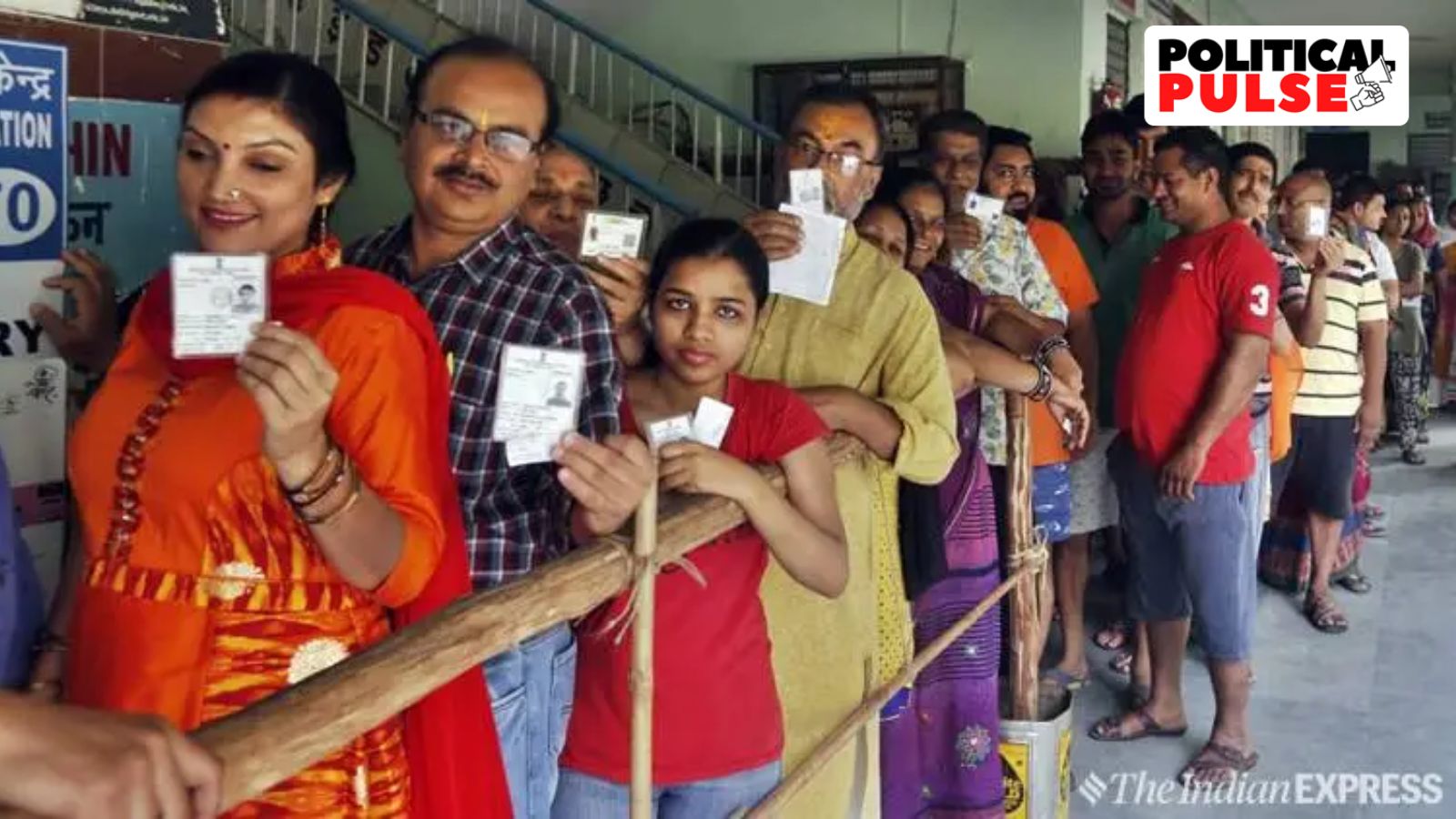 In terms of votes, the BJP’s share fell from 58.21% in 2019 to 46.11% with the Congress rising from 28.51% to 43.67%. (Express File Photo)
AS THE countdown begins to the Haryana Assembly polls, a look back at results of the 2019 state elections and the recently concluded Lok Sabha polls show that the ruling BJP’s hold on the state has slid from 2014.
Over the past two decades, the BJP and Congress have been the dominant parties in Haryana, putting once regional powerhouse INLD in the shade. While the Congress was in power, under Bhupinder Singh Hooda, from 2005 to 2014, the BJP has held power for the last two terms, beginning with the Narendra Modi wave in 2014. In 2019, though, the BJP required the help of the Jannayak Janata Party (JJP) to form the government.
The Lok Sabha polls have reflected this trend, with the Congress winning a majority of the seats in 2004 and 2009 in Haryana, the BJP leading in 2014, and then sweeping the constituencies in 2019.
In the recently held Lok Sabha polls, however, the Congress clawed back, winning five seats, the same as the BJP.
1966-1996: From Cong to regional parties
In the three decades after Haryana was carved out of Punjab in 1966, the Assembly was dominated by the Congress, barring the Janata Party’s single term in power beginning in 1977 after the Emergency, and the Lok Dal government’s brief stint from 1987 to 1991.
Since 1996, the BJP has been on the rise. That year, the BJP supported the Haryana Vikas Party founded by Bansi Lal to form the government.
Then, in 2000, the Indian National Lok Dal (INLD), the predominantly Jat party founded by former Deputy Prime Minister Chaudhary Devi Lal, came to power.
After two Congress governments led by Hooda, in 2014, Manohar Lal Khattar became the state’s first BJP CM. In elections that followed the 2014 Modi wave Lok Sabha polls – in which the BJP won seven of the 10 Lok Sabha seats in Haryana, reducing the Congress to one and the INLD to two – the BJP won an outright majority in the 90-member Assembly.
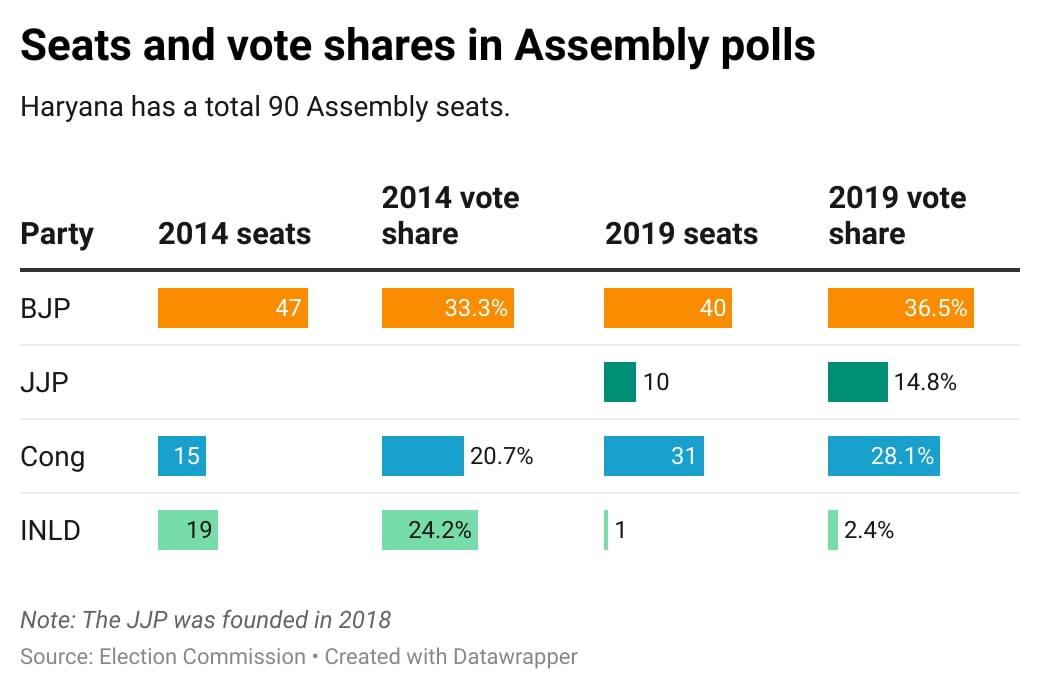
From just four seats in 2009, the BJP soared to 47 in 2014 in the Haryana Assembly. The Congress, which had won 47 seats in 2009, dropped to 15, and the INLD to 19 seats from 31.
 Haryana Assembly
While the BJP performed much better in the 2019 Lok Sabha polls in Haryana, winning all its 10 seats, in the Assembly polls months later, its tally went down to 40, leaving it five short of the majority mark.
The Congress recovered to 31 seats, but the INLD won just one seat. The INLD took the hit from the formation of the Dushyant Chautala-led JJP, its breakaway faction, which won 10 seats and emerged the kingmaker. The BJP took the JJP’s help to form the government, and made Dushyant the Deputy CM.
Following failed seat-sharing talks for the Lok Sabha polls, the BJP dissolved its alliance with the JJP in March this year. It subsequently swore in a new Cabinet, replacing Khattar with Nayab Singh Saini as CM, and taking the help of Independents for a majority.
However, the BJP failed to stem what was seen as a building momentum for the Congress, with the latter winning five seats.
In terms of votes, the BJP’s share fell from 58.21% in 2019 to 46.11% with the Congress rising from 28.51% to 43.67%.
The Aam Aadmi Party (AAP), an INDIA bloc member, failed to win from the lone seat (Kurukshetra) it contested in alliance with the Congress. The AAP however raised its vote share from 0.36% to 3.94% despite contesting just one seat as compared to three last time.
Among the regional parties, the INLD and JJP didn’t win any seats this time too, with vote shares of 1.74% and 0.87%, respectively. In 2019, the parties had secured vote shares of 1.9% and 4.9%, respectively.
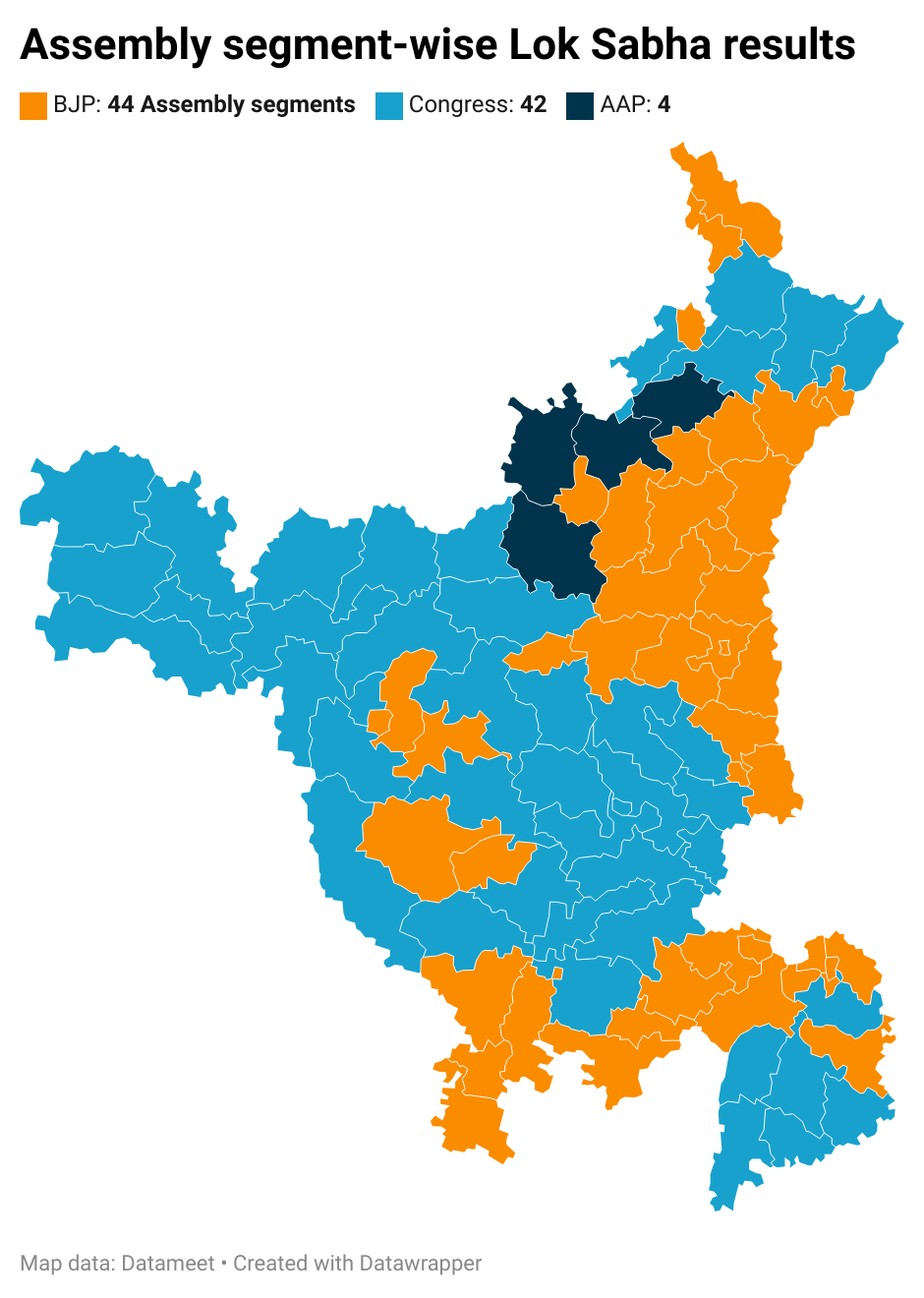
As per voting data from the 2024 Lok Sabha polls extrapolated to the Assembly segment level, the state could see a hung House. But, if the Opposition INDIA bloc hangs together, it may hold the edge in such a scenario.
 Haryana Assembly segments
At the Assembly segment level – each Lok Sabha constituency contains several Assembly constituencies – the BJP won the most votes in 44 of Haryana’s total 90 Assembly seats. The Congress was not far behind at 42, with the AAP leading in the remaining four seats. The JJP and INLD did not lead in any Assembly segment.
Hence, as per the data, while the BJP would fall just short of the 46-seat majority mark, the Congress and AAP’s tallies combined could push the INDIA bloc to the magic number.
Unlike neighbouring Punjab and Delhi, the Congress and AAP’s ties are not as strained in Haryana, and the possibility of an alliance is very much on the table.
The BJP’s estranged ally JJP too has been warming up to the Congress.