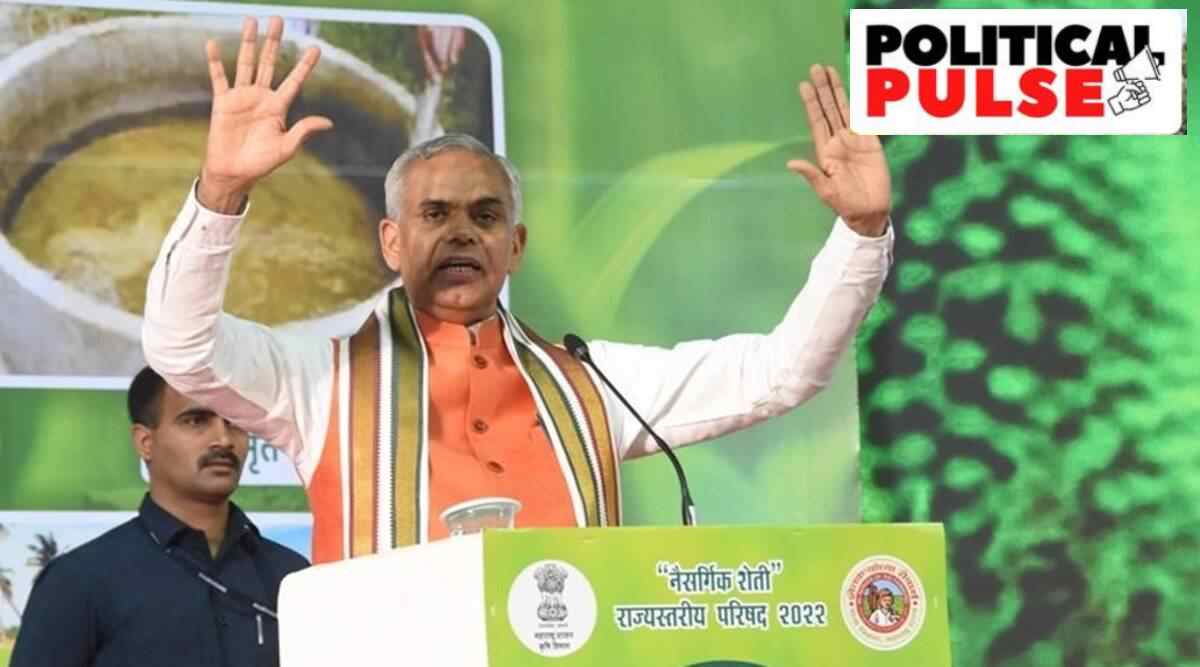
It is an institution that Mahatma Gandhi established in 1920. Now, Gujarat Vidyapith’s decision to give the chancellorship to Governor Acharya Devvrat has sparked a row, with critics questioning the move to hand over the position to a “non-Gandhian” for the first time. On October 11, Devvrat, 63, accepted the offer. He opens up about the controversy and his passion for natural farming, cow-rearing, and more in an exclusive interview to The Indian Express.

Since the time I remember, I have been wearing Gandhi’s khadi and Gandhi’s dhoti-kurta. Gandhiji had huge respect for cows and I am a gaupalak. He has excellently written on cow and agriculture, I talk about cow and agriculture, natural poison-free farming. If Gandhiji would have been there today, he would have blessed me the most. I have dedicated my life completely to this work. He followed ahimsa, satya, brahmcharya, aparigrah, shodh, santosh, tap, swadhyay, ishwar pranidhan. I follow these in totality. For the environment, I do hawan every day. I am completely vegetarian. I work so hard that in my gurukul there is no space for caste, neither do we ask nor do we discuss it. We don’t have anything to do with the fact who is from which caste. He is a human being, work, and move forward, these were his principles. I love the environment, animals and birds, and talk about water and environment conservation. Now, for a Gandhian, what more qualities do I need? They should tell me.
What is your response to being offered the Gujarat Vidyapith chancellorship?
I feel proud and fortunate to get a chance to serve what was established by a great personality like Gandhiji. I feel that his thoughts and principles will be further strengthened because I am influenced by his principles and I follow these in my gurukul. I have the same jeevan darshan (life philosophy).
I know that those who took the decision will be very happy. Among them, there may be a few who think that I am not a Gandhian, they will get to know that their decision (of suggesting my name) is not wrong. I run four gurukuls. All residential and one for girls in Ambala. These gurukuls have been ranked at the top in Haryana and among the top 10 in the country by Education World, which ranks schools across the world.
This year, I wanted 300 children against which 10,000 took the written exam. It started with five students, it was nothing when we started. People have encroached upon this 200-acre land, no one was ready to come, I was only 21 when I joined. I was not appointed principal because I was very capable but because no one wanted to join there. We were starving. We would remove the ceilings kadi to use as firewood and then make the day’s food. Students were from poor backgrounds, people would leave them there; when they would improve they would take them. I did penance for 22 years. No support from the government. I would collect wheat and rice on my own shoulders for the year’s ration and using that we would survive.
Story continues below this ad
I am still the patron of the gurukul and look after the functioning. But we have a management and a trust, but I am not a trustee. Twelve boys of my gurukul are undergoing training at NDA (National Defence Academy) Khadakwasla. Sixty have already cleared the NDA exam. Across Sainik schools, only 32 could clear while 60 alone from my gurukul cleared the exam. At the gurukul I established in Nilokheri eight years back, four students went to IIM (Indian Institute of Management), three went to IIT (Indian Institute of Technology) and another to MIT (Massachusetts Institute of Technology).
I have 35 years of experience in running an institute. For 35 years, I was the principal. Earlier, it was one (institute) that we made into four. This will be helpful.
What are your priorities at Gujarat Vidyapith?
I have never seen their internal arrangements. I will learn the working system of Vidyapith. I will sit with the trustees and the management and understand, will read its laws, with what objectives Gandhiji established the institute. And I will take these objectives forward with the support of the trustees.
You have stayed away from political issues since you took over as Gujarat Governor.
Story continues below this ad
I have never been associated with any political party. My mission was education, natural farming, gaupalan (cow rearing), inculcating yog pranayam in the young generation, and creating an addiction-free society for youth in rural areas. I am also associated with the Prime Minister’s missions of Beti Bachao Beti Padhao and Swachh Bharat Abhiyan. But it was never my wish to join a political party or use any political platform. This was never my wish or my interest.
Also, this responsibility that has been bestowed upon me is fortunately constitutional and has nothing to do with politics. So, while staying at Raj Bhavan in Gujarat I thought about public service to which the oath binds us. In Himachal Pradesh, too, I did the same. I would even visit university hostels and resolve their issues. I still carry a favda (spade) and tasla (iron pan) in my car and every month I undertake Swachhata Abhiyan and tree plantation. I keep myself away from political tangles. Do your own work, politics is others’ work, and let them handle that.
How and when did you start natural farming?
Around 2012-’13, one day one of the employees of Gurukul Kurukshetra fell unconscious while spraying pesticides at the farm. He survived, but this left a huge question in my mind. That this employee neither drank nor ate this pesticide. By merely inhaling it, his life was in danger. What about 1,500 children at my gurukul whom I serve wheat, rice, pulses and vegetables from the farm where I get this sprayed directly? This poison going into their bodies is a crime. From there, I started looking for a solution.
I was informed about organic farming by agricultural universities and specifically Krishi Vigyan Kendra in Kurukshetra. I contacted Dr Hari Om, a senior scientist heading KVK and asked him for alternatives to this poisonous farming. He told me about organic farming and sent experts to me. With his help, we set up a place for vermicompost used at the farm. But with that, a lot of weeds would grow for which we would employ labourers. At the end of the first year, I did not get anything and the entire produce was eaten by insects and flies. I experimented on five acres of land.
Story continues below this ad
I further researched and found that organic farming has been encouraged by central and state governments for the last 20-30 years. If this was so beneficial then it would have been popular in the last 30 years.
From there, I researched natural farming. The idea came from nature, from a forest. When nature’s arrangement is such that it provides everything in a forest then why will it not provide at my farm? The same rules that work there will work at my farm is what is natural farming.
We are also told that you have a team of agriculture experts working on natural farming. What do they do?
We need to use some new techniques in natural farming and shun the old ones. I have a team of 10 scientists and agricultural experts. It includes Dr Baljit Singh Saran from Hisar Agriculture University. He is a microbiologist and senior scientist who has worked with microbiologists in the US, France, and the UK. We assigned a task to the team five years ago to research gau mutra (cow urine). Dr Hari Om, Dr Rajeshwar Chandel who is the Vice Chancellor of Dr YS Parmar University of Horticulture and Forestry at Nauni in Solan, HP, and Dr Subhash from there are also part of the team. There are also other scientists from Andhra Pradesh, Rajasthan, and Uttar Pradesh.
Story continues below this ad
These scientists researched the dung of all animals and all breeds of cows. They found 300 crore bacteria in one gram of cow dung. It looks like God has put up a bacteria factory in cows’ intestines.
The situation is such that a farmer who was putting 10-20 kg of urea on his one-acre farm to increase production is not achieving it even after using eight to 10 bags. As a result, such is the increase in chemicals, his costs, too, increase; he gets into debt as his income declines. This is a big challenge for the country.
What are the major issues in its wider application across the state or country vis-a-vis fears of food shortage?
Organic farming has created this scare, which is the reality too. Also, Indian scientists are misguiding farmers that look at Sri Lanka where organic farming was used and they are dying of hunger; so, if you follow them, you too will be in the same condition. I, too, would say the same. If you follow organic farming this will be the problem but not in the case of natural farming. One has to be careful in following the complete system in natural farming.
How do you think the National Education Policy will play out and how long will it take to implement?
After 35 years, the entire system has been changed. With this change, I believe there will be a change in their talent, they will get a chance to show their talent. Till now, it was forced upon students that they have to study through rote learning. Now, whatever they will do will be with their understanding. Next year this will be implemented a great deal.


 9 min read