
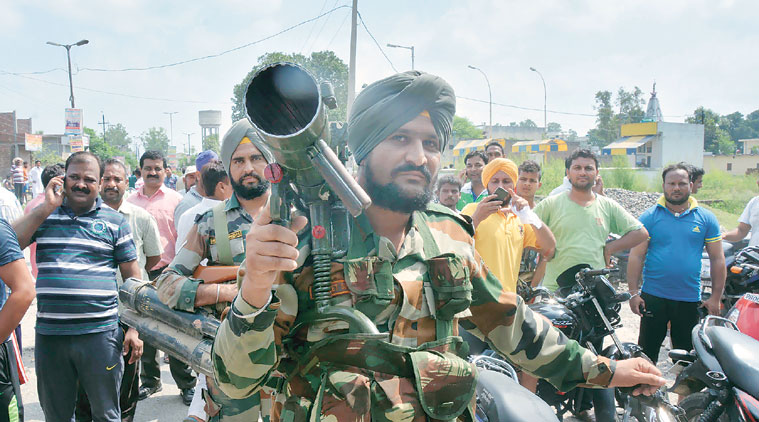
Less than four weeks after Prime Minister Narendra Modi initiated his breakthrough dialogue with Prime Minister Nawaz Sharif, his Pakistan policy is facing its first test by fire. Monday’s terrorist attack in Punjab, the first of its kind by Pakistan-based jihadists, has lent weight to hardliners inside and outside government who are critical of the prime minister’s decision to resume talks. Home Minister Rajnath Singh, voicing their sentiments, has said that while India wants peace, it cannot be “at the cost of national honour”. It is true, as hardliners point out, that Pakistan’s military-led establishment continues to nurture groups responsible for attacks like these. Yet, to terminate the dialogue process will be precisely the wrong move. It is important for the prime minister to shut his ears to the tweets of the hawks, and stay the course.
The reasons for continuing to engage Pakistan diplomatically are compelling. First, the absence of diplomatic engagement means there is that much less space for reflection at moments of crisis — raising the risks of miscalculation or accidents leading the two countries into a conflict neither can afford. For nuclear-armed nation states, dialogue is all the more important. The United States and Soviet Union, after all, continued to engage diplomatically even while waging proxy wars across the globe. Second, the India-Pakistan diplomatic engagement has, since its origins in the 2001-02 crisis, yielded significant security gains. From a situation where thousands of civilians and soldiers died in Jammu and Kashmir every year, fatalities are now down to barely over two-digit levels. Ever since the 26/11 attacks, Pakistan has, in addition, been forced by US pressure to rein in the Lashkar-e-Toiba; as a result, India is seeing historically low levels of terrorist violence. Third, calling off dialogue will not make India any more secure. After all, largescale terrorist attacks took place even in 2002, when the two countries were on the edge of war.


